Share on Facebook
 Share on X
 Share by Email
 Share on Google Classroom
With its distinctive long ear tufts and bright yellow eyes, the large nocturnal great horned owl (Bubo virginianus) is the most widespread and adaptable owl in the Americas. Fourteen unique subspecies of the great horned owl have been identified, each separated by an array of size, plumage and patterning differences. The great horned owl is Alberta's official bird (see Symbols and Emblems of Canada).
Appearance
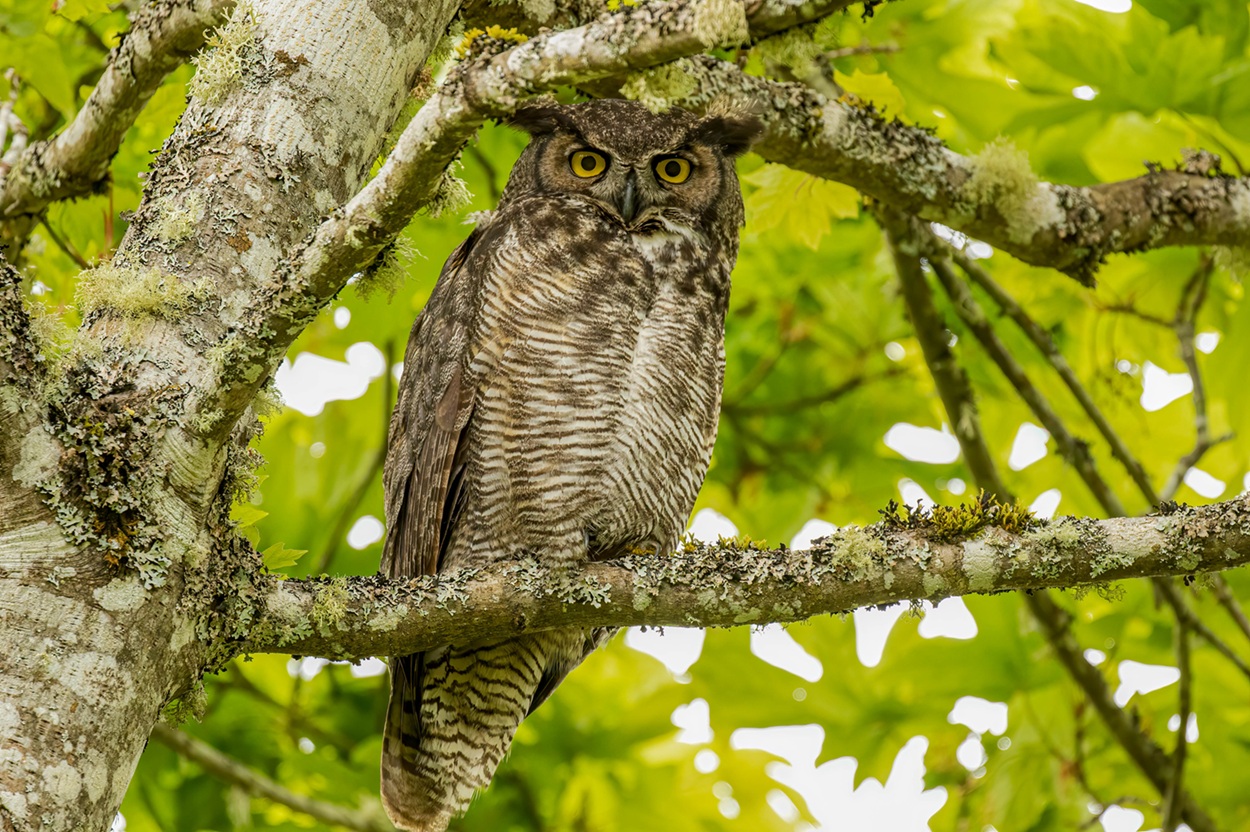
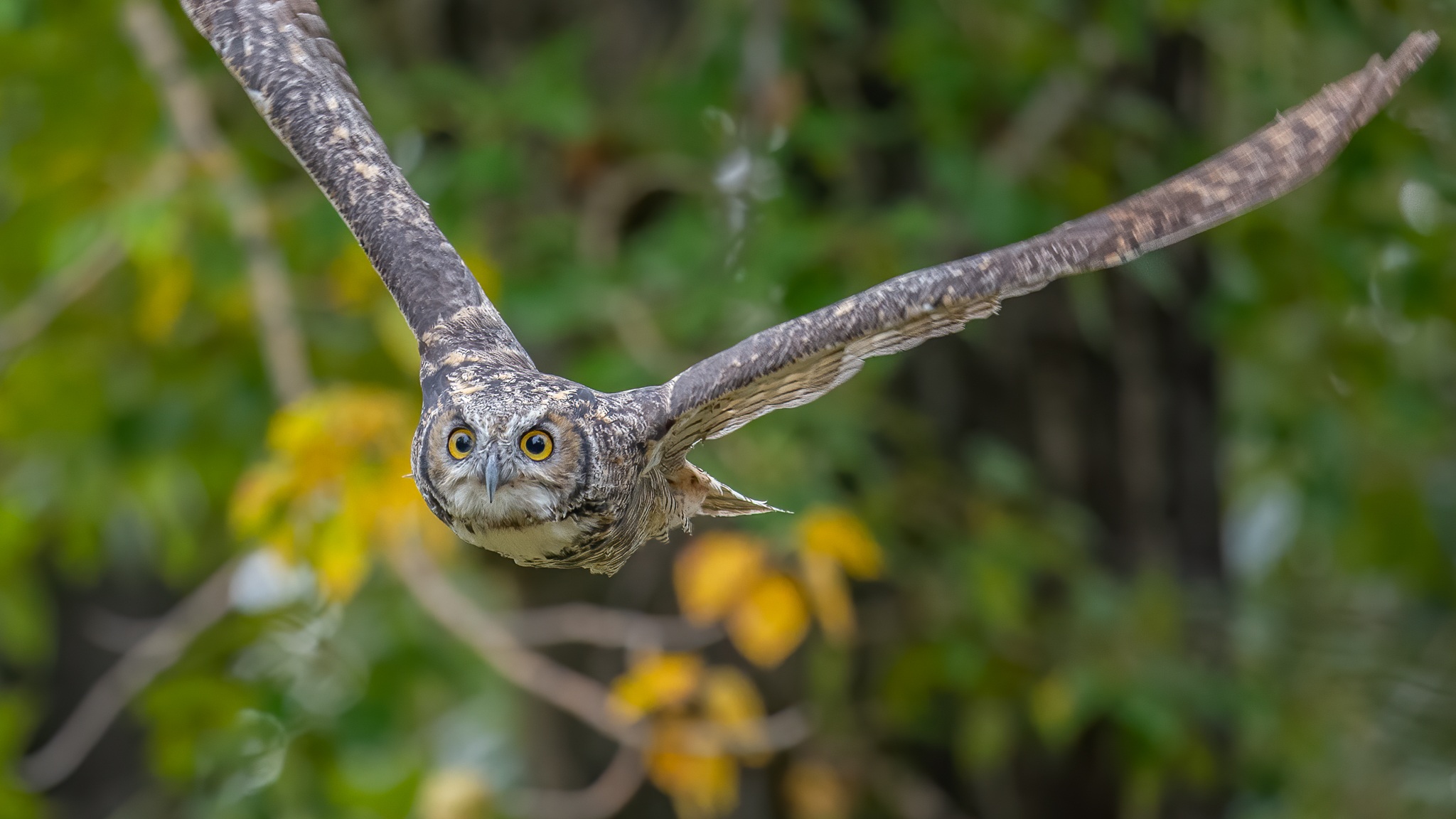
The great horned owl is named for, and perhaps most recognizable by, its large multicoloured ear tufts, often black and cinnamon — though colour varies widely, according to prevailing historical regional humidity. The tufts, which can be flattened and hidden from view, not only aid in sound localization, but also camouflage by breaking the owl's silhouette; they are also used expressively in a large variety of visual communications. Unlike the great grey and snowy owls, great horned owl ears are bilaterally symmetrical.
Enormous eyes with vivid chrome-yellow irises are surrounded by off-white feather rings within a strong black perimeter that defines a facial disc considerably smaller than that of the great grey owl. A slate-coloured bill, sharp and hooked for tearing meat from bone, is often partly concealed by feathers. Alongside this bill are elongated white “whiskers,” with a white “brow” line above and around the eyes.
Named “winged tigers” in 1885 by the naturalist E.T. Seton, Bubo virginianus's patterning has tigerish aspects and colouration as part of a complex feather design, with mottled and variegated vertical patterning around and below a white crescent “bib” of variable size, and horizontal bars on either side of a whitish to white breast and abdomen. Its legs and immensely strong talons are densely covered with feathers; relatively short, wide wings, adapted for forest manoeuvring, are horizontally variegated, with a dark-feathered protective leading edge.
Great horned owls exhibit sexual dimorphism, and the species ranges greatly in size depending on geographical location — tending smaller in the south, larger in the north — measuring in length from 46 to 63 cm and weighing between 0.91 and 2.5 kg, with a wingspan reaching up to 200 cm.
Although the female is larger than the male, she has a smaller syrinx, which results in a differently pitched hoot. Her signature hoot is different in other ways: the male's consists of four to five notes with a vibrato on the second note, while hers has six to nine. Territory-defining hoots sound like a faraway foghorn. Great horned owl vocalizations are varied and complex; within this complexity, each individual has its own distinct call.
Did you know?
The Southern Tutchone name given by the Dene (Athabaskan) peoples of the southwest Yukon for the great horned owl is mäddhį; the Yup'ik peoples of Alaska and far eastern Russia call it iggiayuli. According to Yup'ik legend, the great horned owl speaks yugtun and drops feathers from its wings while delivering messages to folk about the future.
Distribution
The great horned owl is highly adaptable and widely distributed over the Americas, from the Arctic to the tropics of South America. Before European colonization and its effects on the landscape (deforestation, habitat fragmentation, etc.), it likely had a much smaller distribution, limited to riparian habitats and natural tree groves in North American grasslands. Though its first choice is secondary growth woodland, swamps, orchards and agricultural areas, the great horned owl can adjust to any semi-open habitat in a variety of climates, as long as there is available prey. Although preferring to perch and roost in forest canopies, they will often choose open ground in the summer to avoid being host to black flies, which can seriously compromise their health.
The great horned owl's home range varies with habitat quality and prey availability. Pairs often remain within this territory, living solitarily outside of the nesting season. They migrate only if food is scarce: during the cyclical snowshoe hare population crashes in Alberta and Saskatchewan, for instance, the great horned owl travels southeast in search of food.
Reproduction and Development
The monogamous great horned owl nests early, between December and May, depending on geographic location, giving nestlings a survival advantage by giving young more time to grow before the following winter and reducing competition for prey. Mating rituals include duetting vocalizations and mutual preening; a bonded pair will roost together near the nesting site for several months prior to eggs being laid.
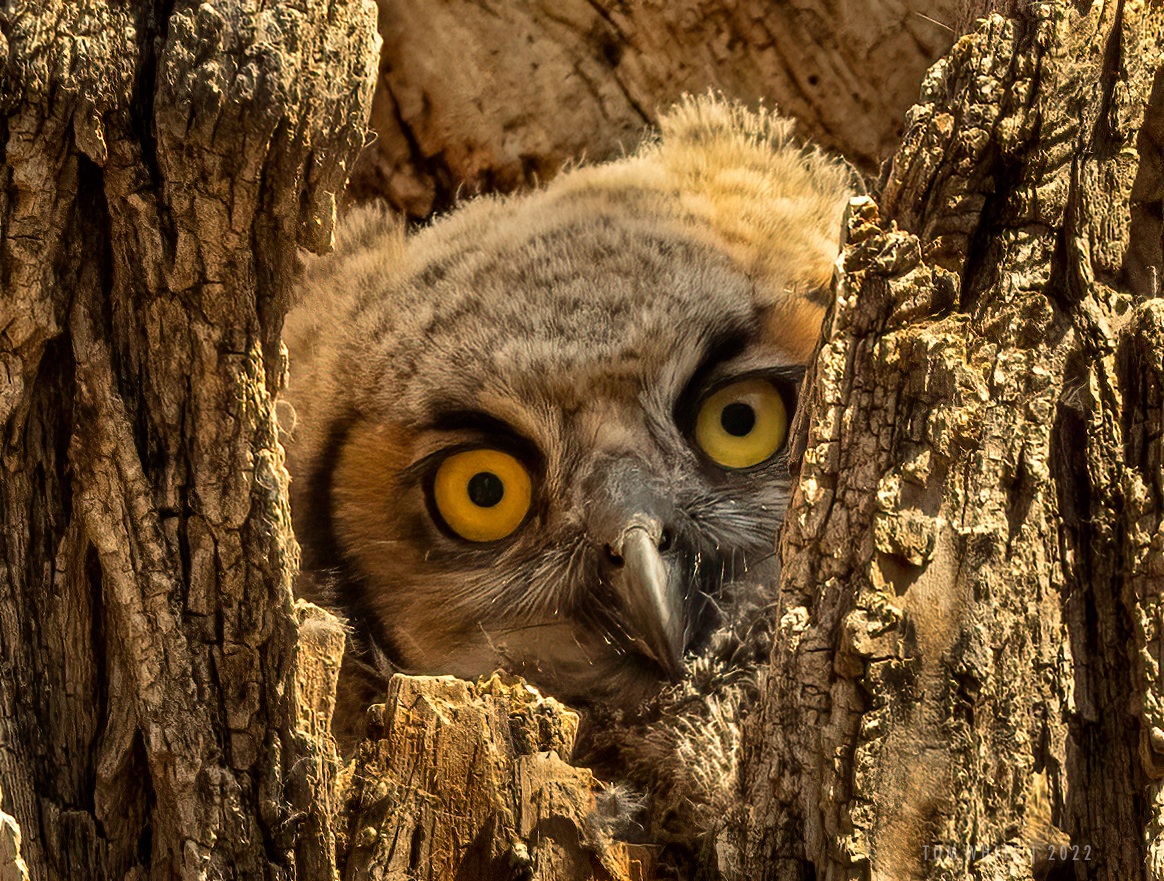
Nesting pairs are limited by territory, but sites vary widely, from live tree cavities to human-made platforms and occasionally the ground. They often use old nests of other species, including hawks, crows, ravens and even squirrels. The female lays an average of one to four nearly spherical 5.5 cm by 4.5 cm eggs in a single yearly clutch, which she incubates for 28 to 37 days. Laying and hatching are spaced at intervals averaging two days; egg size decreases with order of laying.
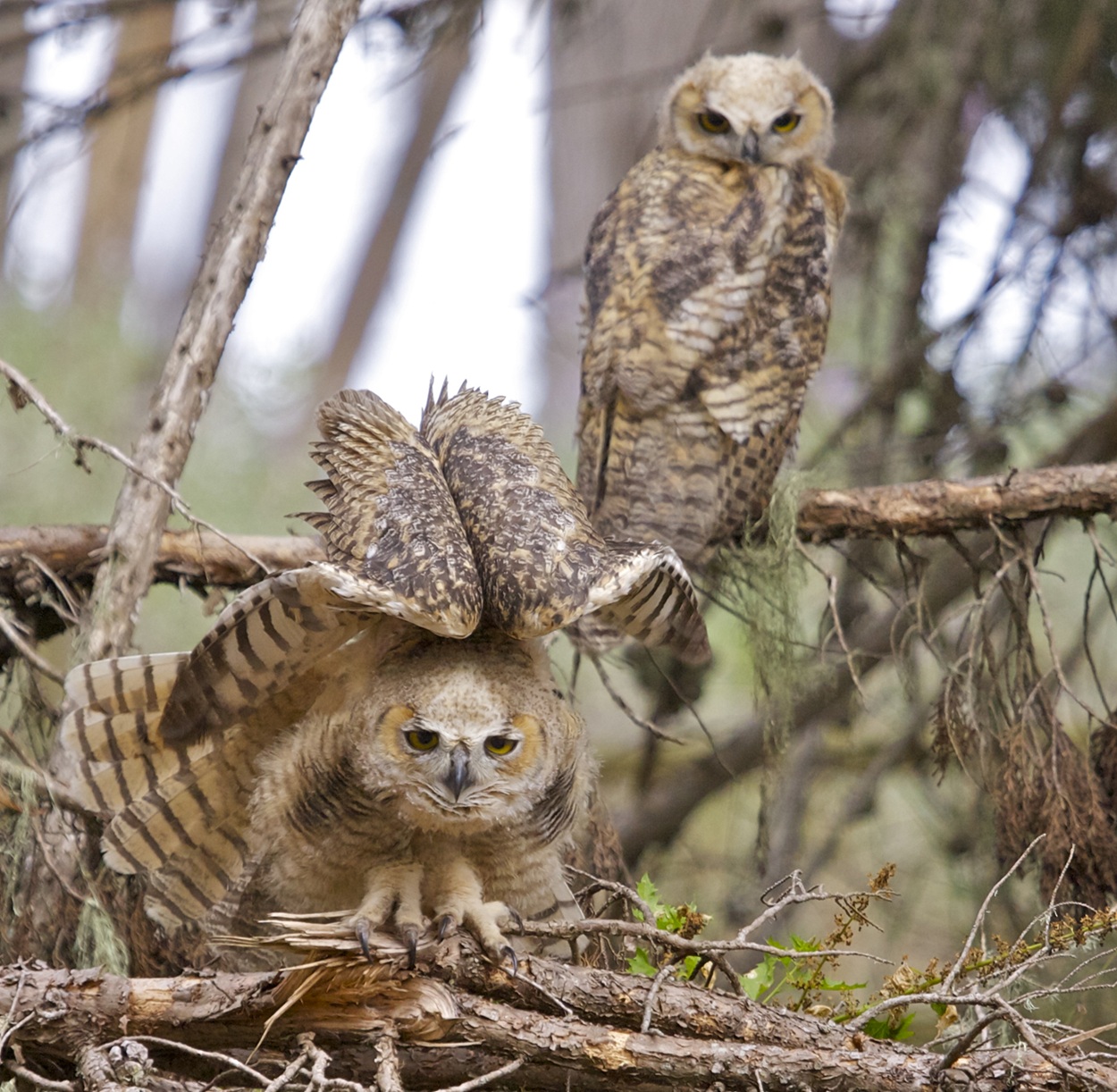
Hatchlings will begin to vocalize while still in the egg, shortly before hatching. The male chooses a favourite roost near the nest and is the sole food provider for at least the first two weeks after hatching, while the female continues to brood; young remain in the nest for about 35–42 days. Male great horned owls have been observed spreading their wings over the brooding female and chicks to protect them from adverse weather. Both parents will vigorously defend the nest with a variety of vocalizations, postures, bill snapping and foot strikes.
Young great horned owls remain near their parents, to varying degrees, for up to six months, learning and picking up survival skills along the way. While some skills and vocalizations are inborn, others are learned gradually, by mimicry and repetition.
Diet and Predation
Great horned owl prey selection is extremely diverse; although, if available, it has a marked preference for rabbits, hares, mice and coots. It is a dietary generalist, and if times are desperate, will even eat carrion. Depending on environment and availability, on average 90 per cent of its diet is composed of mammals and around 10 per cent by other birds; empty gaps are filled with miscellaneous amphibians, reptiles, insects and other invertebrates. The low mean energy constant per individual doesn't make insects usually worth the effort, but when large quantities of insects gather, usually due to human-made light sources, it becomes worthwhile. Size of prey varies geographically and seasonally, ranging from crickets, scorpions and tiny rodents to skunks, geese and other raptors.
Primarily a nocturnal hunter, the great horned owl is most active during dawn and dusk, and will perch 5 to 10 m above the ground at the edges of clearings, sighting prey from up to 90 m away. Occasionally, it glides low over clearings in search of prey, or hunts for smaller prey on the ground in a tilting gait. Kills are usually executed by talon strikes that crush the skull or sever the spinal cord.
Great horned owls will store large quantities of prey in the nest during times of high availability; frozen food is thawed 10 minutes before eating by resting upon the desired portion.
Conservation Status
Because of their wide distribution and adept adaptation to human heterogenization of the environment, the International Union for Conservation of Nature (IUCN) lists the great horned owl as a species of least concern; nevertheless, they are threatened by multiple other human-made conditions, including collisions with buildings and vehicles, secondary poisoning and toxic build-up through prey by such things as strychnine, lead, rodenticide and pesticides, illegal shooting and trapping, electrocution, and a host of diseases increasingly spread as the planet warms, including avian tuberculosis, herpesvirus, encephalitus, pneumonia, anemia, blood parasites, West Nile virus and avian influenza (bird flu).
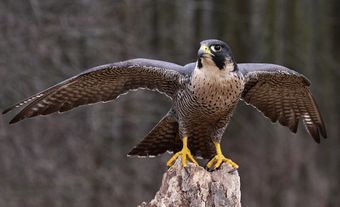
In several cases, the increasing distribution of the great horned owl threatens vulnerable populations (such as the peregrine falcon, spotted owl and piping plover) due to competition and predation.
Canadian Relevance
Many vital field studies of the great horned owl have taken place in Saskatchewan, Yukon and Ontario. A province-wide children's vote selected it as Alberta's provincial bird in 1977 (see Symbols and Emblems of Canada).
Did you know?
Great horned owls settle territorial disputes in a relatively unique way. They mark territorial bounds with their calls and have singing duels to avoid the catastrophic injuries they are likely to cause one another should a disagreement become physical. Folklore is often linked to a specific understanding of nature and ecological relationships, and this social choice fits with the Indigenous Passamaquoddy legend of The Owl Husband, a great horned owl who uses his wits and flute skills to capture a woman in marriage and take her to the village of owls.