Share on Facebook
 Share on X
 Share by Email
 Share on Google Classroom
The history of Fort Saint-Jean, located on the banks of the Richelieu River, reflects 350 years of military occupation. Beginning in 1666, the site was used as a staging post and warehouse for the Carignan-Salières Regiment troops to fight the Haudenosaunee. Later, the fort was occupied by the Marquis de Montcalm’s French troops and even by the American revolutionary army. (See The American Revolution and Canada.) Today, the Royal Military College Saint-Jean is located on this site.
The Richelieu Issue
The Richelieu River was already used as a north-south communication line for the First Nations before European colonization. It provides access to the St. Lawrence River to the north and Lake Champlain to the south, which leads to the Hudson River. This waterway was both a military advantage and a potential weakness for the defensive system of New France. The river became the scene of clashes during most of the conflicts of the French and British colonial periods.
First Fort in 1666
As early as 1665, the colony wanted to curb the raids by the Haudenosaunee (see Iroquois Wars) that limited French colonization in the Montreal region and the economic development of New France. (See Population Settlement of New France.) Along the Richelieu River, nicknamed the Iroquois River, Governors Alexandre de Prouville de Tracy and Daniel de Rémy de Courcelle ordered the construction of a series of five fortifications: Richelieu (Sorel), Saint-Louis (Chambly), Sainte-Thérèse, L'Assomption (Saint-Jean) and Sainte-Anne (île La Motte).
Construction of Fort de l'Assomption began in 1666. It was initially given this name because its construction was reportedly completed on 15 August, the day of the Assumption in the Catholic religious calendar. However, Marquis Alexandre de Prouville de Tracy referred to it as Fort Saint-Jean-Baptiste as early as 1667 in a letter to the minister Jean-Baptiste Colbert. The name was later shortened to Saint-John.
This fort was located near the Richelieu River and at the head of rapids that stretch to Fort Chambly, making it a mandatory portage site. The purpose of the fort was to block the enemies’ access to the St. Lawrence River. It also opened the route to the Haudenosaunee while protecting a potential French retreat.
Fort Saint-Jean served as a staging post and warehouse for the troops. The first garrison was composed of about twenty soldiers from the Carignan-Salières Regiment, under the command of Captain Alexandre Berthier. The following year, a peace treaty was signed with the Haudenosaunee and the fort was abandoned in 1672.

In the early 2010s, archaeological digs unearthed the remains of the first fort on the site of the Royal Military College Saint-Jean. However, no description remains and archaeological traces do not allow for a precise image to be formed. It may have resembled the other forts of the Richelieu region: square or rectangular in shape, with four bastions, surrounded by a double wooden palisade 120 feet on each side and about fifteen feet high, equipped with a parapet for defence.
Second Fort in 1748
During the War of the Austrian Succession, the colonial authorities again became aware of the usefulness of a fort in this location. This time, it was the British colonies that put pressure on the border. Fort Saint-Frédéric, built further south in 1731, protected access to the Richelieu River. However, it was much too far from the heart of the French colony to be supplied quickly. It needed a staging post.
The site of the former Fort Saint-Jean seemed to be the perfect fit. In March 1748, Roland-Michel Barrin de La Galissonière entrusted the construction of a new military structure to engineer Gaspard-Joseph Chaussegros de Léry, junior.
The fort’s construction was completed in March 1749. It was modest and imperfect, due to a lack of financial resources; it was made of stakes, measuring 200 feet on each side, and equipped with four bastions. A communication route was also built between the fort and La Prairie, near Montreal, to facilitate supply deliveries.
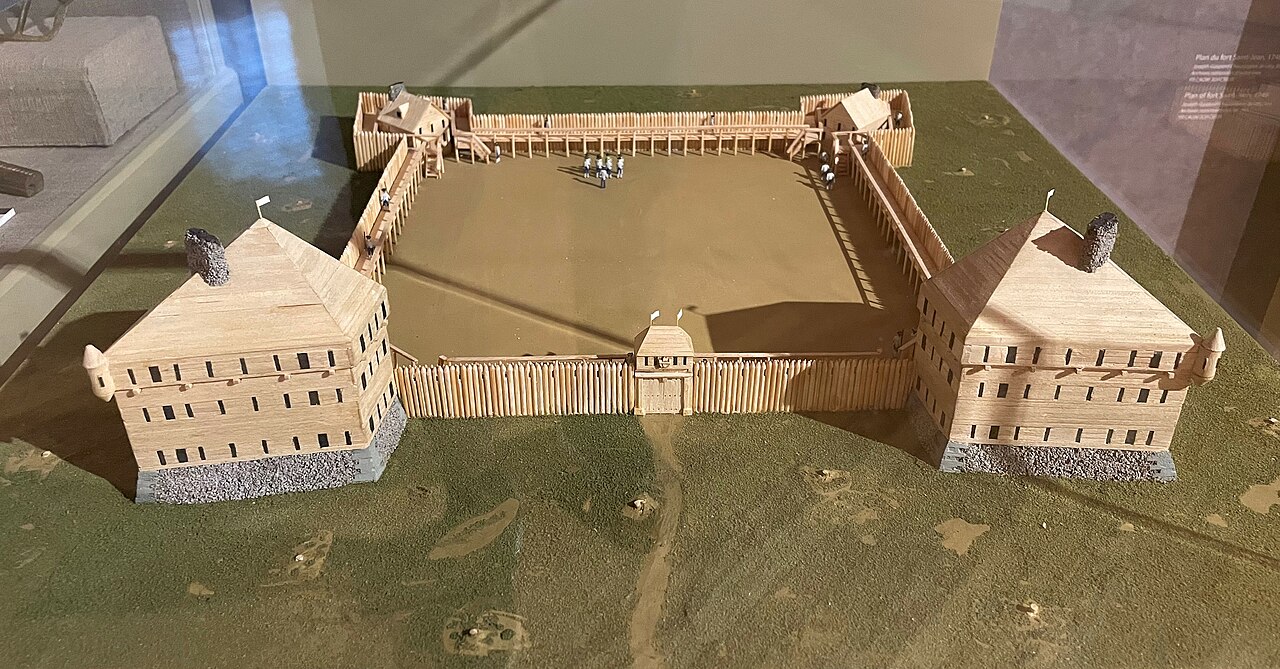
In July 1749, Swedish botanist Pehr Kalm briefly visited the fort, nicknaming it Marengouins Fort. (See Mosquito.)
During the Seven Years' War, Fort Saint-Jean served as a foothold for the various campaigns on Lake Champlain. In 1756, a shipyard was in operation. In 1757, Marquis Louis-Joseph de Montcalm approved additional work proposed and supervised by engineer Jean-Nicolas Desandrouins. In fact, Montcalm passed through the site in 1758, on his way to Fort Carillon. (See also Battle of Carillon.)
At the end of August 1760, as the British army marched towards Montreal, the French army abandoned and disabled the forts in the Richelieu Valley. Fort Saint-Jean, then under the command of Jean-Georges Dejean de Roquemaure, was no exception; it was set on fire during the night of 29 to 30 August.
American Revolution
During the American War of Independence, Fort Saint-Jean was once again in service. In mid-May 1775, the rebel army, led by Benedict Arnold, made its first incursion up Lake Champlain into Fort Saint-Jean. The fort's garrison, consisting of a dozen British soldiers, was unable to put up resistance. Arnold captured one of the boats and sank the others to prevent a pursuit by the British army, then returned to Fort Crown Point. (See Crown Point.) Governor Guy Carleton realized that the fort was vulnerable and that access to Canada depended on the British army's ability to push the enemy back across the Richelieu River. He ordered that the fort be rebuilt, partly on the remains of the 1748 fort, and that its defence be reinforced, in particular with two redoubts. By the end of May 1775, about 500 British soldiers, 100 Canadian volunteers, and Kanyen'kehà:ka warriors were stationed here, under the command of Major Charles Preston.
Beginning on 17 September 1775, rebel commander Richard Montgomery arrived with fewer than 1,500 men to lay siege to the fort. Thanks to its small fleet, the rebel army managed to erect artillery batteries to bombard the fort. Several factors favoured neither the besiegers nor the besieged: disease, lack of ammunition and food, as well as cold and humid temperatures.
After more than 45 days of siege, the British army surrendered on 2 November and received honours of war for its exemplary defence. The road to Montreal was now open to American rebels, and the city surrendered on 13 November. Nevertheless, the delay caused by British resistance may have been the reason that the siege of Quebec City failed during the winter of 1775 to 1776.
American rebels occupied Fort Saint-Jean that same winter. They use the facilities as a hospital, warehouse and staging post. In June 1776, the British army regained control of the fort and drove out the rebels, who had already set fire to the infrastructure.
No longer having any doubt that the fort represented a strategic hub in the fight against the American rebels, the British army rebuilt it and developed the shipyard. Controlling navigation on the Richelieu River and Lake Champlain was a challenge for both sides. More than twenty boats were built or assembled at Fort Saint-Jean during the summer of 1776, including two schooners and a frigate. They contributed to the British victories at Valcour Island in October 1776 and Ticonderoga in 1777.
After the Treaty of Paris was signed in 1783, a peaceful period began, and the fort became a customs post.
19th century
During the 19th century, two conflicts again disrupted the fort’s peace and quiet. During the War of 1812, it served as an arsenal and base because of its proximity to the American border. Then, during the Patriotes' Rebellions of 1837 to 1838, a hospital and barracks were set up there to accommodate 800 soldiers to quell the situation in the Richelieu Valley.
Royal Military College Saint-Jean
The site's educational function began in 1883. The fledgling Canadian army’s infantry, cavalry and engineering schools occupied the remains of the fort. In 1952, the Royal Military College Saint-Jean was founded to welcome French-speaking officer cadets. After being closed in 1994, due to national defence budget cuts, then reopened in 2007, the college continues its mission of military education to this day.