Share on Facebook
 Share on X
 Share by Email
 Share on Google Classroom
The Eastern musk turtle (Sternotherus odoratus) is a small freshwater turtle native to Eastern North America. In Canada, it is found in the southernmost reaches of northern Ontario, throughout parts of southern and central Ontario and in extreme southwestern Quebec. Eastern musk turtles inhabit shallow areas in lakes, rivers, streams, ponds and wetlands. Individuals are highly aquatic and rarely leave the water except to nest. It is listed as a species of Special Concern under Canada’s Species at Risk Act (see Species at Risk Legislation in Canada).
Description
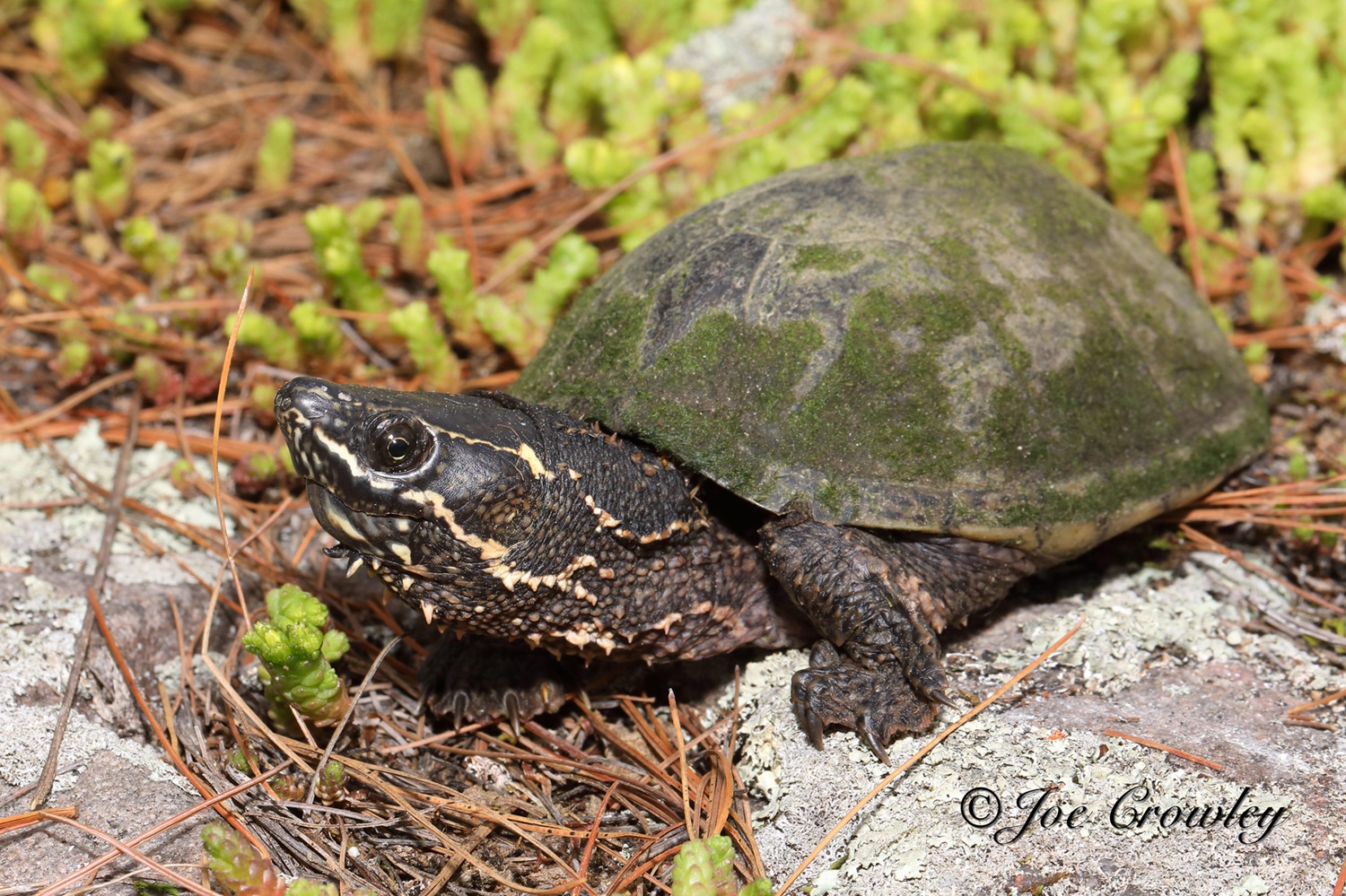
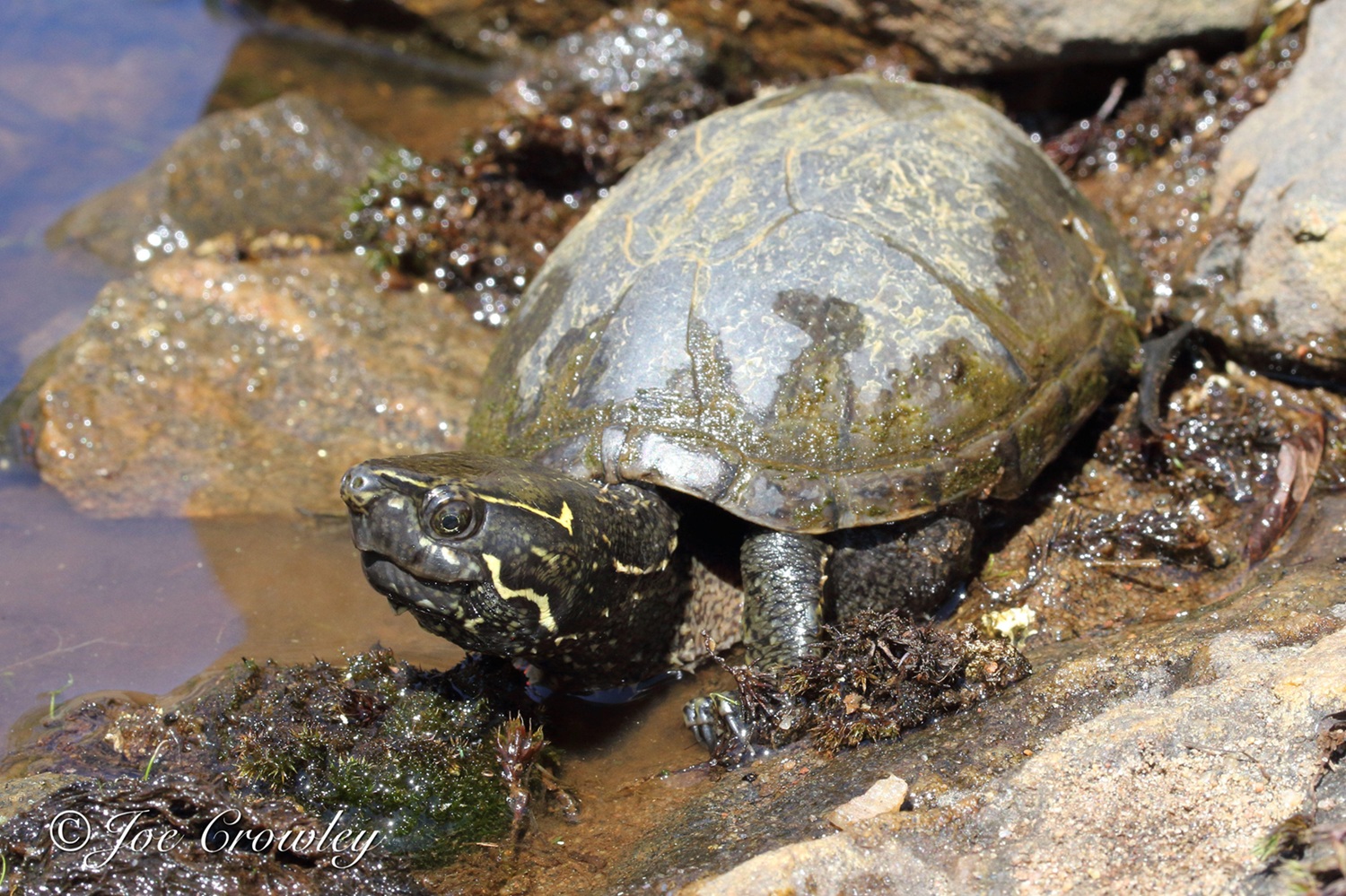
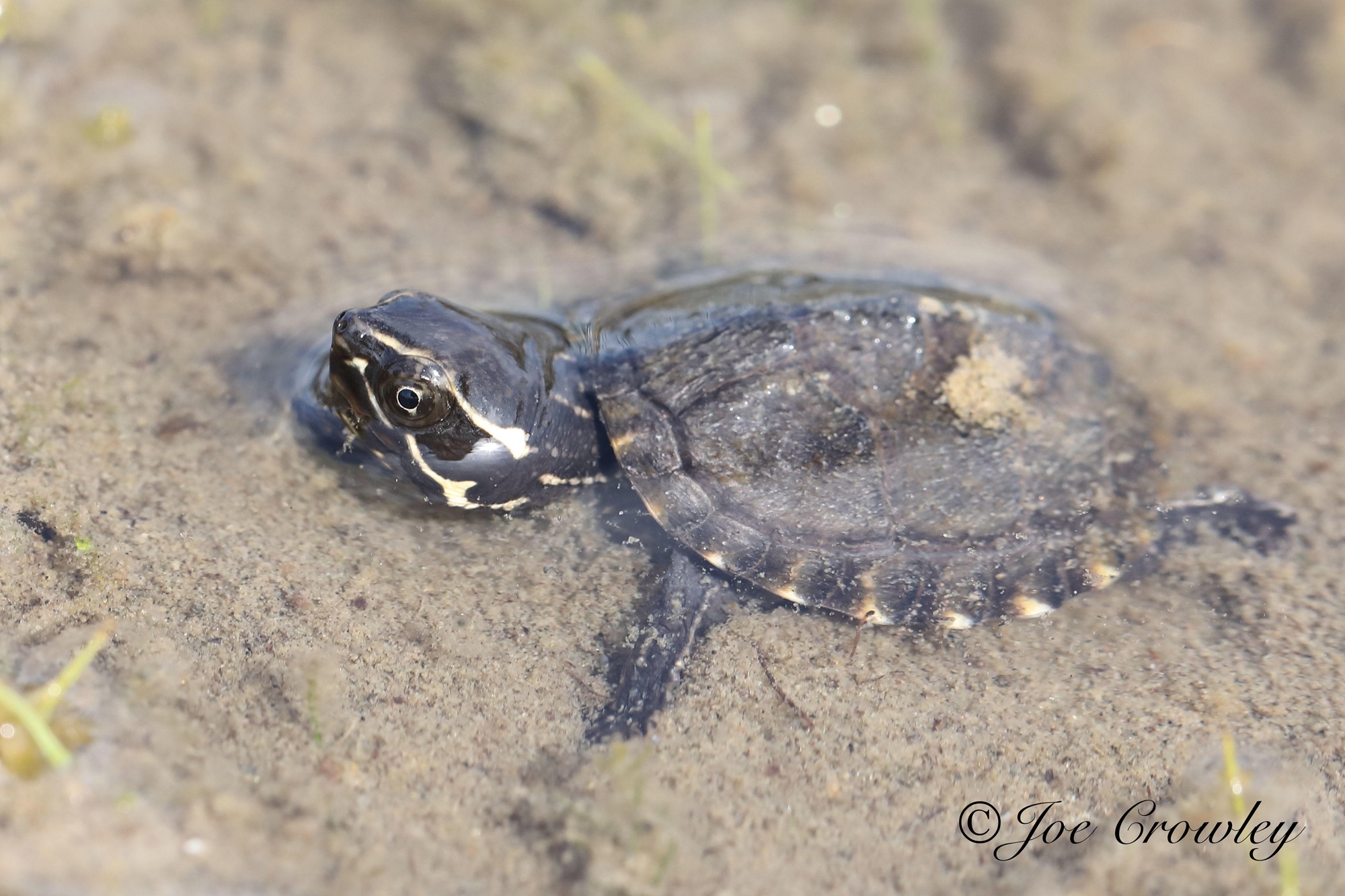
The Eastern musk turtle is a small freshwater turtle with a narrow, highly domed, smooth carapace (upper shell). Individuals can grow to a carapace length of 15 cm, although most do not exceed 13 cm. The carapace is grey, brown or black and sometimes has spots or streaks, particularly on younger individuals. Individuals have a large head, pointed snout and fleshy projections called barbels on the chin and throat. The skin is pinkish grey to black. Two white to yellow stripes are usually present on each side of the head that run from the nose, above and below each eye and onto the neck. The plastron (bottom shell) is yellow to brown with fleshy areas between the scutes (the enlarged scales that make up the shell). Hatchlings look similar to adults but are black with three keels (raised ridges) on the carapace and a white spot on each marginal scute (the scutes along the outer edges of the shell). Hatchlings have a carapace length of 17–25.4 mm.
Did you know?
This species is also known as the stinkpot turtle. This name, as well as its standard common and scientific names, is a reference to the musk that individuals emit from four glands on the underside of the carapace. When threatened, individuals may excrete this foul-smelling musk to deter predators. The musk also plays a role during mating by helping individuals differentiate between sexes.
Distribution and Habitat
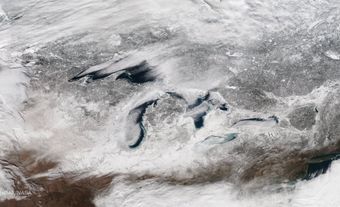
In Canada, the Eastern musk turtle is found in Ontario from the Sudbury area south and east throughout parts of central and southern Ontario, as well as along the north shore of the Ottawa River in southwestern Quebec. In Canada, its distribution is generally associated with large lake and river systems, including the shorelines of the Great Lakes. The Eastern musk turtle is widespread throughout the Eastern United States, ranging from Maine south to Florida and west to Wisconsin and Texas.
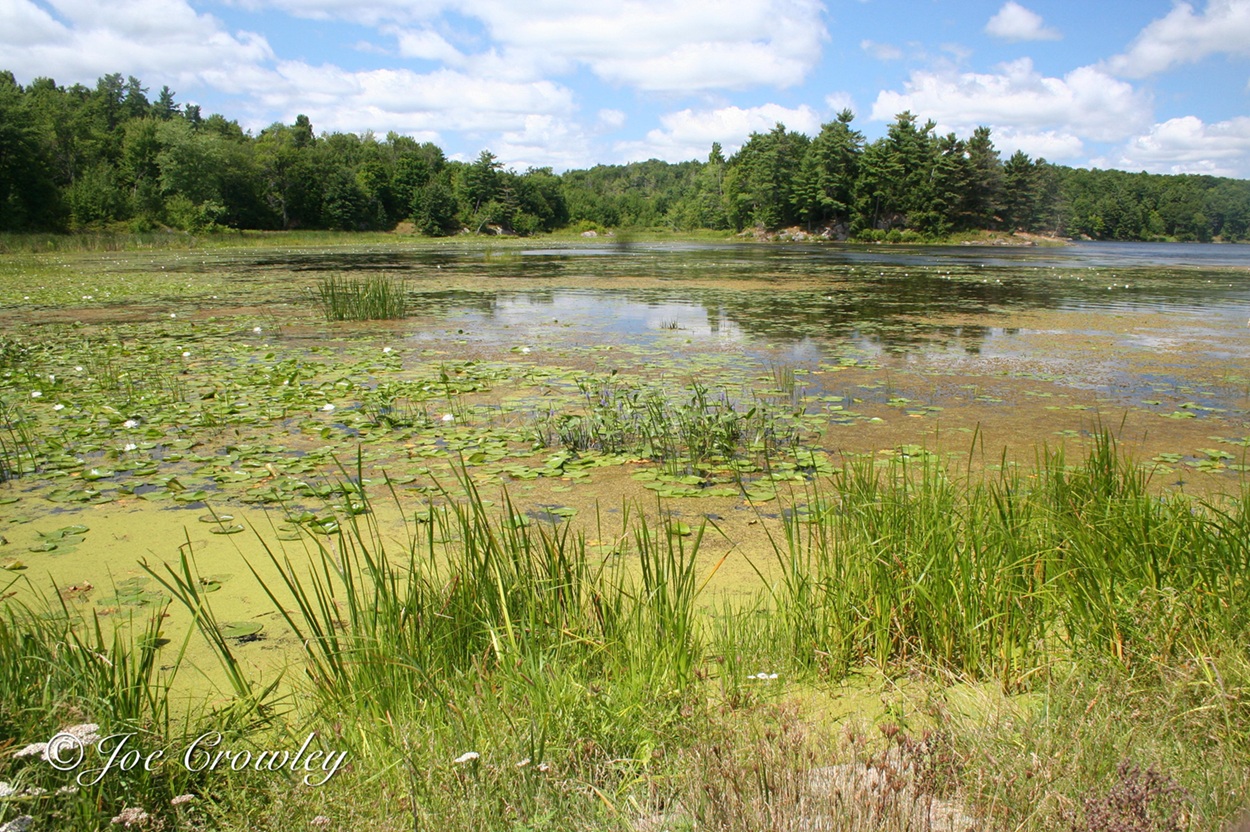
Eastern musk turtles live in lakes, rivers, streams, ponds and wetlands. They are usually found in shallow areas with soft, mucky bottoms, low flow and abundant vegetation. Females dig their nest in loose soil, decaying vegetation, rotting wood or in the walls of beaver or muskrat lodges. Nests are laid in sunny areas where warm temperatures help the eggs develop. During the winter, individuals hibernate underwater, where they bury themselves in the mud at the bottom of the waterbody.
Did you know?
Eastern musk turtles rarely bask out of the water. Instead, they bask under floating vegetation at the water’s surface or by burying into the mud in warm, shallow areas. Because of their secretive basking behaviour, Eastern musk turtles often go unnoticed, even in areas where they are common.
Reproduction and Development
Individuals mate in the spring (April and May) and the fall (September and October). In Canada, females lay a single clutch of eggs in June or July, but some individuals may not reproduce every year. Females typically lay three to seven eggs, but clutch size can range from three to 13 eggs. Eggs are oval and are 18–31 mm in length. Hatchlings emerge from the eggs in August or September after an incubation period of 65–86 days. Like many freshwater turtles, Eastern musk turtles have temperature-dependent sex determination, meaning the sex of the offspring is determined by the incubation temperature of the eggs. Cooler temperatures produce mostly males, while warmer temperatures produce females. In Canada, females reach sexual maturity at eight to nine years of age, while males mature at five to six years of age. Turtle eggs and hatchlings have low survival, and few individuals survive to adulthood. Once they reach adult sizes, however, they have high survival and may live for over 50 years.
Diet and Predation
Eastern musk turtles are generalist predators and eat a wide variety species, including insects (adults and aquatic larvae), plants, mollusks (e.g., snails, clams), algae, fish and their eggs, amphibians (eggs, larvae and adults) and carrion (dead animal and plant matter). Individuals are primarily active during the late morning and early evening. They forage for prey while walking along the bottom of the waterbody.
The main predators of adult and juvenile Eastern musk turtles are bald eagles, hawks (e.g., red-tailed hawks), raccoons and fishers. Hatchlings and small juveniles have many additional predators, including wading birds (e.g., great blue herons), predatory fish, American bullfrogs, northern watersnakes and snapping turtles. Eastern musk turtle eggs are consumed by a variety of mammalian predators (e.g., raccoons, striped skunks, red foxes and fishers), crows, herons, snapping turtles, snakes and occasionally other species.
Threats
Habitat destruction is one of the primary threats to the Eastern musk turtle in Canada and typically results from housing and cottage development, draining wetlands for agricultural uses, shoreline hardening (e.g., replacing natural shorelines with rock or metal walls) and dredging of waterways. Additionally, the invasive European common reed (Phragmites australis), which invades shallow-water habitats, is spreading rapidly across southern Ontario and degrading the species’ wetland and shoreline habitats (see Invasive Species in Canada: Plants). Commercial and recreational fishing is also a significant threat to this species. Eastern musk turtles commonly drown in commercial fishing traps, while the ingestion of fishing hooks may also be a major source of mortality in areas with high recreational fishing pressure. Other threats include an increased abundance of nest predators (e.g., raccoons) in many human-settled areas, pollution, mortality from boat collisions and climate change.
Status and Conservation
Globally, the Eastern musk turtle is listed as Least Concern by the International Union for Conservation of Nature. However, Eastern musk turtle populations are declining in Canada, and this species has already disappeared from parts of its Canadian range, particularly in southwestern Ontario. For this reason, it has been listed as a species of Special Concern under Canada’s Species at Risk Act (see Species at Risk Legislation in Canada). The Eastern musk turtle’s secretive nature results in it being overlooked in many areas. Increasing people’s awareness of the eastern musk turtle and the threats it faces is a simple but important way to contribute to the recovery of this species in Canada.