Share on Facebook
 Share on X
 Share by Email
 Share on Google Classroom
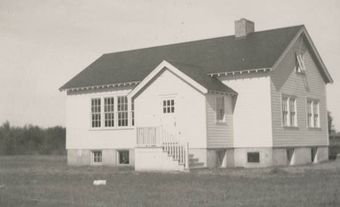
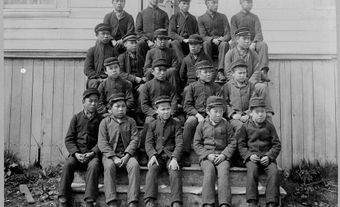
Day schools were racially segregated educational institutions used by the government to assimilate Indigenous children into Euro-Canadian society (see Indian Day Schools in Canada). These schools operated throughout Canada until 2000 and in Newfoundland and Labrador until 2009. Over 150,000 students attended Indian Day Schools in Canada, excluding students who attended similar day schools in Newfoundland and Labrador. Day schools are related to the residential school system, as both aimed to sever ties between Indigenous children and their cultures and languages in an effort to assimilate them into Western culture. Unlike residential schools, these schools were operated in Indigenous communities, allowing Indigenous children to return home after school hours (see also Residential Schools in Newfoundland and Labrador). Churches primarily operated these schools with funding from federal governments in Canada, excluding Newfoundland and Labrador. In Newfoundland and Labrador, provincial and federal governments funded day schools. The schools impacted Innu in Labrador and Mi’kmaq on the island of Newfoundland. Given that Newfoundland and Labrador didn't join Confederation until 1949 and, unlike much of the rest of Canada, no treaties were made between the government and Indigenous peoples, First Nations in the province were not recognized under the Indian Act (see also Newfoundland and Labrador and Confederation; First Nations in Newfoundland and Labrador). As such, residential and day schools in Newfoundland and Labrador operated separately from educational systems present elsewhere in the country.
Innu
Innu have been living in their ancestral territory, Nitassinan, along the Labrador-Quebec peninsula since time immemorial. Innu oral histories tell of their ancestors living in Nitassinan since the glaciers retreated about 9,000 years ago. Their ancestors, dubbed the Daniel Rattle and Point Revenge Complexes by archaeologists, lived in Labrador about 2,000 to 400 years ago. Today, Nitassinan is divided by the Quebec-Labrador boundary. Innu live on either side of the provincial border, including over 24,000 in Quebec and approximately 3,200 in Labrador. There are two Innu First Nations and reserves in Labrador, Sheshatshiu Innu First Nation and Mushuau Innu First Nation (see First Nations in Newfoundland and Labrador; Reserves in Newfoundland and Labrador). Sheshatshiu Innu First Nation governs the Sheshatshiu federal reserve, which is located in Central Labrador along the North West River. Mushuau Innu First Nation governs a reserve in the community of Natuashish, which is located on the North Coast of Labrador.
The Innu Nation is a political organization representing the Innu in Labrador, specifically members of Sheshatshiu Innu First Nation and Mushuau Innu First Nation. The Innu Nation is actively involved in land claims negotiations, continued development of self-government and Innu sovereignty and dedication to healing and protecting Innu culture. The Innu Nation serves as the voice of the over 3,000 Innu living in what is now called Labrador.
Innu Day Schools
Innu day schools operated in Sheshatshiu, Old Davis Inlet, Davis Inlet and Natuashish from the 1950s to 2009. In 2009, the province transferred its control of these schools to the Innu Nation through their school board, Mamu Tshishkutamashutau-Innu Education (MTIE). Before the transfer, various regional school boards and churches administered these schools and the provincial and federal governments funded them. Unlike Indian Day Schools elsewhere, the Yale School in North West River required Innu students to stay in dormitories away from their homes in Sheshatshiu. The Yale School also served as a residential school for Innu and Inuit in Labrador (see Residential Schools in Newfoundland and Labrador).
For over 60 years, Innu children were regularly and frequently subject to abuse in these schools while under the care of school staff. Abuse took the form of sexual misconduct, neglect, maltreatment and deprivation of a healthy childhood. Such abuse was done by teachers, adults in authority positions and other students. Innu students were beaten and lived in constant fear of being assaulted, both physically and emotionally. Students often felt unable to tell their parents out of intimidation, fear, threat of reprisal and further abuse.
Like other Indian Day Schools in Canada, Innu day schools were a colonial tool that forced Innu to settle permanently in villages. The day schools encouraged Innu to abandon traditional life on the land. Innu children were taught that their family’s way of life, including cultural beliefs, values and teachings, were wrong and worthless. To further sever the connection between children and their culture, some schools forbid Innu from speaking in Innu-Aimun, the Innu language. According to the statement of claim for the Innu day schools class action lawsuit, “[children] were forced to adopt a foreign language and culture and were severely punished for non-compliance.” As time went on, Innu-Aimun was gradually accepted in the school system and eventually became integrated fully when Innu took control of their own education in 2009.
Innu day schools contributed to intergenerational harm experienced by community members, including higher levels of addiction, poorer mental health, increased rates of suicide, decreased levels of educational attainment and loss of ability to fully exercise their Indigenous rights, among other damages (see also Intergenerational Trauma and Residential Schools).
In January 2024, the Innu Nation and three of its members filed legal action against the Government of Canada and the Government of Newfoundland and Labrador related to Innu experiences in day schools. Innu in Labrador were left out of the Federal Indian Days Schools Settlement Agreement, as they were not recognized under the Indian Act until the early 2000s.
Mi’kmaq
The Ktaqmkuk (Newfoundland) Mi’kmaq oral history indicates they have been living on Ktaqmkuk since time immemorial. Ktaqmkuk is one of the eight Mi’kmaw districts in Mi’kma’ki, the ancestral homeland of the Mi’kmaq Nation. There are two recognized Mi’kmaw First Nations in Newfoundland, Miawpukek First Nation and Qalipu Mi’kmaq First Nation. Miawpukek First Nation was the first federally recognized First Nation in Newfoundland and Labrador and governs Samiajij Miawpukek Indian Reserve, located on the south coast of Newfoundland (see also Reserves in Newfoundland and Labrador). Qalipu Mi’kmaq First Nation was the most recently recognized First Nation in the province. Unlike the Miawpukek First Nation, the Qalipu First Nation does not manage reserve lands on behalf of the federal government.
Mi’kmaw Day Schools
Stories from Mi’kmaq throughout Ktaqmkuk tell of abuse faced at day schools starting in the 1900s. However, there has been a lack of formal documentation (e.g., legal proceedings and research).
Mi’kmaq across the island faced measures in schooling aimed at disconnecting them from their culture. This disconnect is shown explicitly in the elimination of Mi’kmaw language services at churches and schools. In Miawpukek First Nation (Conne River), the Catholic Church established St. Anne’s, a church-run school in 1908, with education and church services only offered in English. Prior to the church opening the school, the chief did all the prayers in Mi’kmaw.
Like other schools in Newfoundland and Labrador, St. Anne’s received funding from the provincial government. Many Mi’kmaq were Roman Catholic, so they feared challenging the church on its English-only programming and felt their children needed to attend the community school (see also Catholicism in Canada).
While the school always taught in English, early teachers spoke Mi’kmaw. However, in 1911, the school moved to teachers who only spoke English, without fully forbidding the Mi’kmaw language. However, in 1916, Father Stanley St. Croix forbade the use of Mi’kmaw in the community school. According to scholars Doug Jackson and Gerald Penney, “[h]e told teachers to strictly enforce the use of English in the classroom. Children were strapped if they reverted to Micmac.” From then on, the school was operated with English-speaking teachers only. This contributed to the elimination of the Mi’kmaw language in Newfoundland, with the last fluent speaker passing away in the 1980s.
The Miawpukek community disagreed with St. Croix’s methods, which ultimately led to St. Croix using his religious influence to force Miawpukek Chief Noel Jeddore into exile. Jeddore’s exile effectively abolished the Office of the Chief and the band government.
The colonial attitudes of St. Croix, the church and the school left children and adults in the community disconnected from their culture. According to a Mi’kmaw Elder who spoke with scholar Eleanor Alwyn, children within the community were conditioned to believe that “Mi’kmaq was bad, and the language was bad and evil,” leading to generations of trauma and shame for being Mi’kmaq.
Legacy
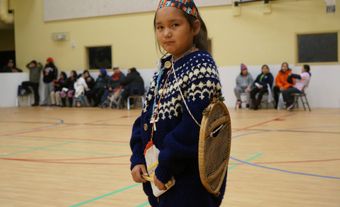
Day schools have left lasting and deeply harmful impacts on Innu and Mi'kmaw communities in Labrador and Newfoundland, including experiences of physical, emotional and sexual abuse, as well as the erosion of cultural practices and languages. Language loss is particularly evident in the decline of the Mi'kmaw language on the island of Newfoundland, which is directly attributed to day schools. Despite these enduring impacts, Innu and Mi'kmaq demonstrate remarkable resilience through decades of activism and community-led initiatives to take control of their children's education.
For instance, since 2009, the Innu have exercised control over their own education through Mamu Tshishkutamashutau–Innu Education, which administers schools in Sheshatshiu and Natuashish. Similarly, the Mi'kmaq of Miawpukek have managed their education system through the Miawpukek First Nation's Department of Education since 1986, operating Se't A'newey Kina'matino'kuom (St. Anne's School). The Qalipu Mi’kmaq First Nation, representing Mi'kmaq living outside Miawpukek, also leads a range of cultural programming — including language camps, drumming circles and traditional craft workshops — to strengthen cultural identity and community connection. Furthermore, according to the Government of Newfoundland and Labrador, Qalipu Mi’kmaq First Nation officials collaborate with public schools across the province to integrate Mi'kmaw culture, language and history into the curriculum.