Share on Facebook
 Share on X
 Share by Email
 Share on Google Classroom
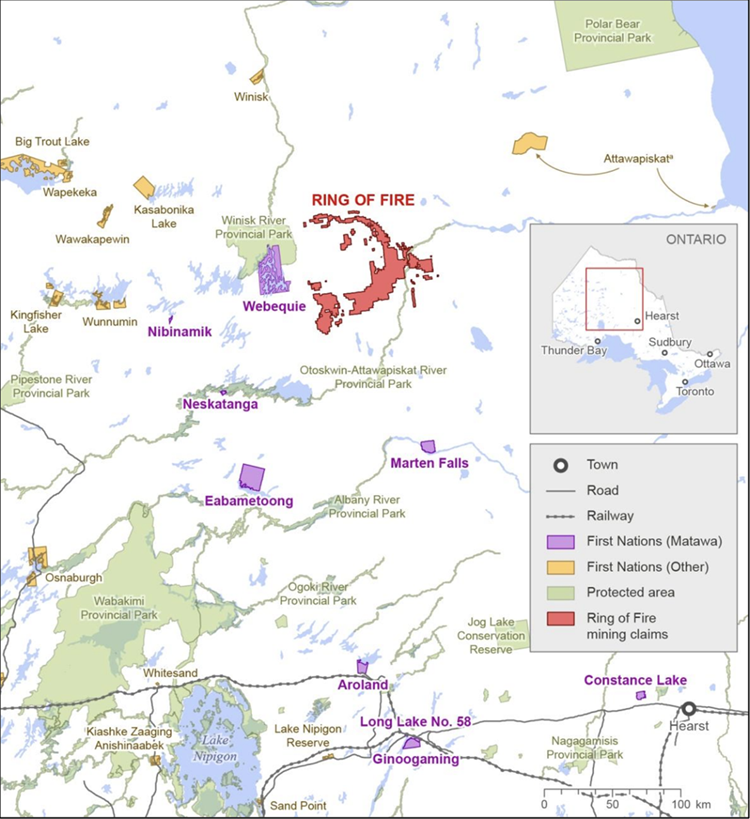
Ontario’s Ring of Fire, 8,000 km², refers to a region of critical mineral deposits in the James Bay lowlands of Northern Ontario. Located within the traditional territory covered by Treaty 9, it has become a focal point of conflict over resource development, Indigenous rights and environmental protections.
Key Terms
Critical minerals — Natural elements and compounds essential to modern technology, economic security and the transition to a low-carbon economy.
Why is it called the Ring of Fire?
Ontario’s Ring of Fire is a crescent-shaped belt reportedly rich in critical mineral deposits in ancient volcanic rock. Noront Resources founder Richard Nemis, together with geologist John Harvey and financier Robert Cudney, collectively named the area “Ring of Fire” after the song popularized by Johnny Cash. In Anishinaabemowin (Ojibwe), the region is known as Kawana'bi'kag, meaning “hole in the ground.”
Physical Features
Ontario’s Ring of Fire is centred on McFaulds Lake in the Kenora District, roughly 500 km northeast of Thunder Bay. The area is more than 8,000 km². Its unique shape is about 100 km in diameter, formed by a magnetic belt of dense igneous rocks. Most mineral discoveries lie within a greenstone belt — so called for traces of green colour in the bedrock. While sizable mineral reserves have been identified, the full commercial viability of mining remains contingent on feasibility studies and infrastructure development.
The area lies in the Hudson Bay and James Bay lowlands, a vast boreal peatland characterized by bogs, fens, slow‑growing forest and tundra (see Wetlands in Canada). It contains thousands of small lakes and is home to wildlife such as boreal caribou and diverse fish populations. The Ring of Fire is accessible only by air or, for a few months each winter, by seasonal ice roads; thus, debates over extraction feasibility and infrastructure needs persist.
Treaty Lands
The Ring of Fire lies within the territory covered by Treaty 9 (the James Bay Treaty), signed in 1905 and 1906. The treaty encompasses the Hudson Bay and James Bay lowlands and includes the homelands of the Cree and Ojibwe (Anishinaabe) peoples, who have lived in and used the region for thousands of years. In the 1600s, Hudson’s Bay Company fur traders arrived, establishing posts near Indigenous trapping grounds — particularly for marten. Settlements gradually formed around these trading sites. By the turn of the 20th century, as industrial development pressures mounted, First Nations sought to negotiate treaties to protect their livelihoods, leading to the Treaty 9 process. (See also Numbered Treaties.)
During the treaty negotiations, Crown representatives made oral promises that Indigenous signatories would retain the right to hunt, fish and trap on their traditional lands. Canadian courts have since affirmed that such oral promises are binding, though successive governments have been criticized for failing to fully uphold them. Adhesions to Treaty 9 were made in 1908 and again in 1929–1930, but many First Nations in the region maintain that they never surrendered decision-making authority over their territories. Indigenous communities assert their jurisdiction was never surrendered under Treaty 9.
Discovery of Critical Minerals
In the summer of 2007, Noront Resources Ltd. announced its discovery of a high-grade source of nickel-copper in the muskeg swamps of the James Bay lowlands — a project later named Eagle’s Nest. Since then, additional nickel, copper, platinum and chromite have been claimed. Additionally, zinc, vanadium, cobalt, palladium and titanium deposits have been found. Noront also staked a claim to develop gold mining in the region, and over the years, claims in the area increased. In 2022, Wyloo, an Australian company, acquired Noront and renamed it Ring of Fire Metals.
Legislation
In 2010, the Ontario Liberal government introduced the Far North Act, which mandated a joint planning process with First Nations. The legislation was passed despite widespread objections from Indigenous communities, who viewed it as an infringement on their sovereignty. By 2013, the Ring of Fire gained national attention. First Nations appointed former Ontario premier Bob Rae as their lead negotiator, while the province appointed former Supreme Court justice Frank Iacobucci to represent its interests.
Under Ontario Premier Doug Ford, elected in 2018, the Progressive Conservative government has made developing the Ring of Fire a central economic commitment. The push intensified in 2025 amid a trade conflict with the United States, as both Ontario and the federal government sought to strengthen Canada's economic independence by fast‑tracking critical-mineral projects. The province enacted legislation granting new powers to expedite major initiatives and relieve them from certain regulatory obligations. Premier Ford proposed designating the Ring of Fire a “special economic zone,” a step that critics argued would circumvent environmental assessments and undermine consultation processes.
In 2025, tensions escalated further with the passage of Ontario’s Bill 5, which gives the government broad authority to accelerate infrastructure and resource projects. That same year, federal and provincial governments agreed to eliminate duplicative impact assessment work for large projects to speed up development, framing the project as a “nation‑building” initiative essential to countering international trade pressures.
Environmental Concerns
Environmental advocates and some First Nations have raised alarms about the impact of mining and infrastructure on the region’s sensitive peatlands. The Hudson Bay and James Bay lowlands constitute one of the largest continuous peatland complexes in the world, storing billions of tonnes of carbon. Disturbance of these areas — through road construction, drainage or mining — could release more than 1 billion tonnes of carbon dioxide, undermining climate goals even as the minerals extracted are marketed as essential for the low‑carbon transition (see Climate Change). The region also supports critical wildlife habitat, including boreal caribou populations, which are already under pressure from industrial activity elsewhere in Northern Ontario. The Mushkegowuk chiefs called for a moratorium on development, while Kitchenuhmaykoosib Inninuwug and Wapekeka First Nations want to ensure permanent protection of their lands and waters from industrial activities. (See also Wetlands in Canada.)
Ongoing Development
First Nations in and around the Ring of Fire hold diverse views on resource development. Some communities see economic opportunities — jobs, infrastructure and revenue sharing — as a path toward self-determination and improved quality of life. Marten Falls and Webequie First Nations support road construction in the region, citing the need for improved community access, reduced isolation and economic opportunities. Others oppose large‑scale mining. Opponents argue that large‑scale mining threatens treaty rights, traditional livelihoods and the environmental integrity of the boreal peatlands, which are among the largest carbon stores on Earth. Many also challenge Ontario’s “free‑entry” mining claim system, asserting that it violates the duty to consult and the principle of free, prior and informed consent.
At the beginning of 2026, plans for roads and transmission lines needed for large-scale mining were underway, but opposition from First Nations continued to grow. A January 2026 interim report identified major barriers to meaningful participation, noting that some communities faced “dire emergency and crisis conditions” and lacked equitable resources. The report also highlighted ongoing power imbalances, as First Nations were expected to negotiate complex development agreements while struggling to meet basic needs such as housing, clean water and health care.