Share on Facebook
 Share on X
 Share by Email
 Share on Google Classroom
William Krehm, journalist, musician, real estate developer, and political activist (born 23 November 1913 in Toronto, ON; died 19 April 2019 in Toronto). The brother of pianist Ida Krehm, William Krehm was a leading figure in the Canadian Trotskyist movement during the Great Depression and the Canadian leader of the League for a Revolutionary Workers’ Party. Krehm was the last surviving Canadian witness to events in Barcelona during the Spanish Civil War. Krehm later became a foreign correspondent in Latin America and a real estate developer in Toronto.
Early Political Activism and the LRWP
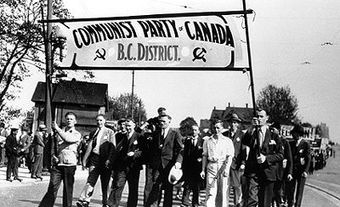
William Krehm came from a Jewish working-class family. He had musical talent and went with his family to Chicago at age 15 where he studied the violin. He also had a strong interest in communism. In Chicago and during later travel to New York, he encountered several members of an emerging branch of organized communism: the Communist League of America (Opposition). Following Josef Stalin’s seizure of power in the Soviet Union, this group had coalesced around former leaders of the Communist Party of the United States of America who refused to disavow Leon Trotsky. These “Trotskyists” initially sought reform of the Communist Party and the Third International (the Comintern). When Krehm returned to Canada in 1930 to study at the University of Toronto, he joined the Toronto branch, under the leadership of Maurice Spector.
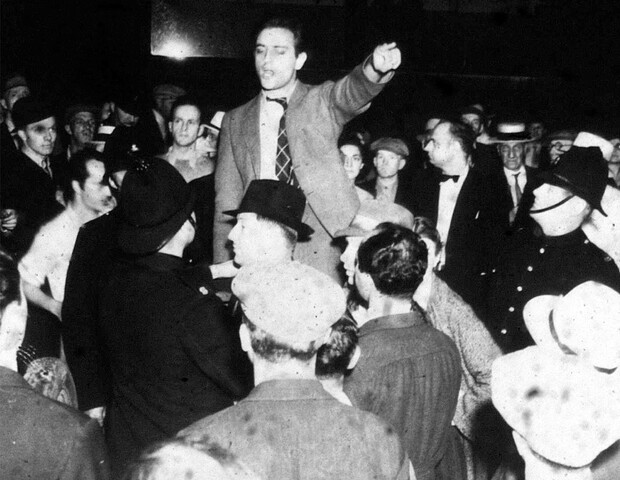
Krehm was contrarian, strong-willed, and an enthusiastic speaker who attracted the loyalty of other young people. He formed a faction within Spector’s group that agitated for a more active role in fomenting revolution. Spector twice expelled Krehm for his factionalism. By 1934, Krehm’s faction included some of the Trotskyists’ most capable young organizers. Additionally, they had a strong link with B.J. Field (real name Max Gould) who had come to some prominence amongst the Trotskyists in New York because of his work on Wall Street as a financial consultant, his personal friendship with Leon Trotsky, and his role in a major hotel and restaurant workers strike in early 1934. Krehm went to New York City to help Field organize his own group, and eventually led the Canadian wing of the “Fieldites,” which became the League for a Revolutionary Workers’ Party (LRWP).
Spanish Civil War
In the autumn of 1936, Krehm and Field travelled to Brussels for a conference hosted by the International Bureau for Revolutionary Socialist Unity (better known as the London Bureau). The Spanish Civil War had broken out just months earlier, and the two had the opportunity to visit Barcelona before the conference.
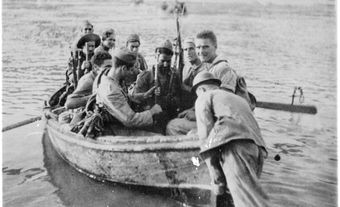
The cause of the revolution in Catalonia became Krehm’s primary motivation in the following months. After contacting like-minded revolutionaries in London and Paris, he returned to Barcelona in January 1937. Rather than joining the International Brigades as an active fighter, he worked with the Workers’ Party of Marxist Unification (POUM), an anti-Stalinist group. He tried to make them adopt a more aggressive revolutionary position. Krehm was arrested in the summer of 1937 and held without charges. He participated in a hunger strike and was deported to France a few months later. (See also Mackenzie-Papineau Battalion.)
Anti-Fascist Activism in Canada
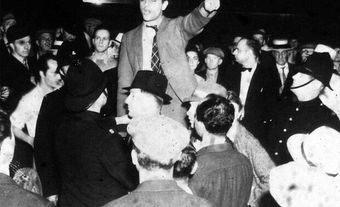
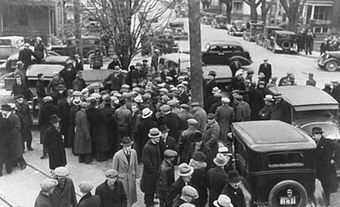
Upon returning to Canada, Krehm took a leading role in organizing resistance to Adrien Arcand’s efforts to expand organized fascism into Ontario and across the country. The Provisional Anti-Fascist Committee, based mostly on the groups that had come together to advocate for Krehm’s release from prison in Spain, directed its energies towards protesting fascist rallies in Toronto. The largest and most famous one was the inaugurative convention of the National Unity Party, held on 4 July 1938 at Massey Hall. Krehm was one of the speakers in the protest rally nearby. He was among the four protestors arrested by police, and among the two convicted of obstructing police. Krehm was fined $25 despite the best efforts of his defence counsel, J.L. Cohen.
Journalism in Latin America
Following the outbreak of the Second World War, Krehm realized that there was little opportunity to continue revolutionary work. He travelled to Mexico City by bus in 1940, hoping to leverage his Spanish-language skills and personal connections to the refugees who had fled Spain following the fall of the Spanish Republic in 1939. Krehm was among the guards assigned to protect Leon Trotsky’s body following his assassination in August 1940. His girlfriend, Gladys Cowan, travelled to Mexico City, where they married in 1941.
Krehm sold stories about Latin America and eventually became a regular correspondent for Time magazine. He was highly critical of American foreign policy in the region, and his stories attracted much unwanted attention. He went into hiding when his visa expired, and U.S. State Department officials assisted the Mexican government in deporting Krehm to Guatemala. He continued his work as a journalist in Latin America and returned to Canada in 1948
Return to Canada
Krehm continued his work in Canada as a journalist, musician, and music critic. Although he was no longer politically active, his earlier work in the communist movement ensured that he remained under some surveillance during the early Cold War period. Police officers sometimes visited his home and workplace, making it challenging to keep an ordinary job.
Leveraging the post-war housing boom, Krehm began developing rental properties. He started working for himself and developed properties for sale. In 1963, he established O’Shanter Development Company Ltd., a successful rental housing company.
Kreham later took a strong interest in monetary reform. He wrote several books and co-founded a think tank, the Committee on Monetary and Economic Reform (COMER). Under Krehm’s leadership, COMER sued the Bank of Canada for allegedly failing to fufill its mandate. They fought the matter until 2017 when the Supreme Court of Canada declined to review the Federal Court of Appeal’s decision against COMER.