Share on Facebook
 Share on X
 Share by Email
 Share on Google Classroom
The League for a Revolutionary Workers’ Party (LRWP) was a small but influential communist organization active in Canada from 1934 until 1940. Often referred to as “Fieldites” – after their leader in New York, B.J. Field – the extreme left-wing group advocated for violent revolution, direct labour action, the formation of workers’ councils (Soviets), and the establishment of a new revolutionary organization to replace the corrupted Third International (Comintern). The Canadian wing of the LRWP was notable for its volume of publications, some successes in labour and anti-fascist organization, and its support for the Workers’ Party of Marxist Unification (POUM) during the Spanish Civil War.
Formation of the LRWP
The LRWP began as a faction within the Communist League of America (Opposition), a group often referred to as the Left Opposition or Trotskyists, which had broken off from the Stalin-aligned Communist Party a few years earlier. When the Left Opposition expelled several members in New York, Toronto, and Montreal, the faction formed a new organization.
The LRWP was initially formed as the Organizing Committee for a Revolutionary Workers’ Party (OCRWP) as a partnership between B.J. Field (real name Max Gould) and Benjamin Gitlow. They hoped to build a coalition among the various small revolutionary groups in New York City to create an alternative to the Communist League of America (Opposition) and the Communist Party of the United States of America (CPUSA). Gitlow, previously a leader in the CPUSA, soon left this alliance to establish a revolutionary caucus within the Socialist Party. Field could not attract much support in New York, but he maintained a devoted following among Canadian Trotskyists.
The group never numbered more than 100 active members. Although small, by the late 1930s it was larger than the official Trotskyist movement in Canada from which it had splintered. The LRWP’s membership was principally young, working-class Jews. The organization was also notable as most revolutionary organizations in Canada were composed chiefly of men. In contrast, about half of the LRWP’s membership were young women.
LRWP in Canada
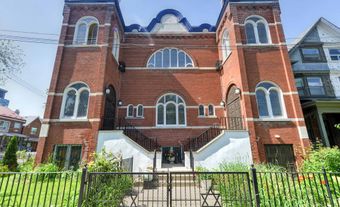
The LRWP in Canada was strongest in Toronto, with smaller branches in Montreal, Quebec, and London and Hamilton, Ontario. William Krehm was its principal leader in Toronto, although the group had several energetic, devoted, and capable young leaders who hitchhiked and “rode the rails” from one location to another. One member travelled from Toronto to Vancouver, British Columbia, and San Francisco, California, on a year-long mission to establish new branches there. The LRWP also sent members to London, Montreal, Stratford, and Niagara Falls in Ontario, and Rouyn-Noranda in Quebec to organize workers for strike action or to radicalize existing strikes. The group ran an extensive education program on Marxist theory at its “clubhouse” in Toronto.
Publications
The Toronto LRWP acquired a second-hand printing press, which it used to produce letterhead, pamphlets, and three separate newsletters: Workers’ Voice (for adult Canadians), Labor Front (for adults in the United States), and Revolutionary Youth (for young Canadians).
Revolutionary Youth League
The existence of a youth newsletter, and the corresponding Revolutionary Youth League (RYL) that published it, is also notable given that most of the LRWP were in their 20s. The LRWP formed the RYL in 1936 after the Co-operative Commonwealth Federation Youth Movement (CCFYM) discovered LRWP efforts to infiltrate and radicalize the socialist youth organization. The LRWP maintained the RYL to attract disenchanted CCFYM members. Most members of the RYL were also members of the LRWP.
Anti-Fascist Activities
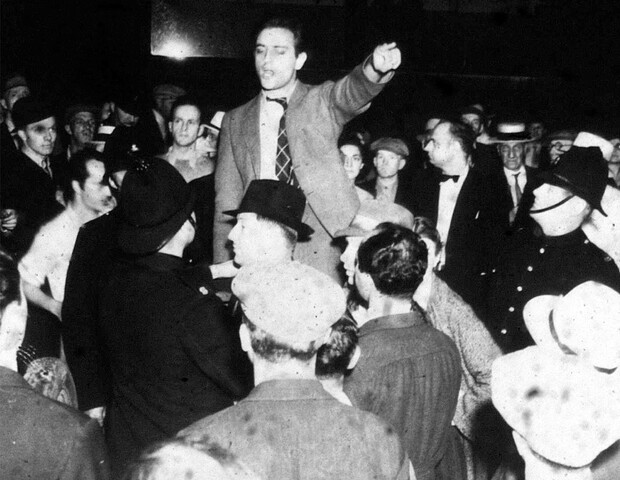
The Canadian LRWP successfully built temporary alliances with Jewish working-class organizations, anarchists like the Toronto Libertarian Group, and civil rights advocates. Their most notable success with such alliances was the formation of the Provisional Anti-Fascist Committee, which campaigned against Adrien Arcand’s attempts to expand his fascist organization into Ontario. The LRWP and its supporters staged a series of protests against fascist rallies and raised money for their anticipated legal defence. The National Unity Party held its first major rally at Massey Hall in July 1938. Four protestors were arrested and charged, and the Provisional Anti-Fascist Committee provided for their legal defence. Two members were convicted of obstructing police.
International Relationships
LRWP publications show a strong interest in international affairs. Field and Krehm regularly wrote to European leaders of revolutionary socialist organizations and included copies of their newsletters and pamphlets. Leveraging Field’s contacts from his travel in Europe, they convinced some correspondents that they were much larger and more influential than they actually were. Fenner Brockway, the British Independent Labor Party leader, invited them to a peace and antifascism conference in Brussels in the autumn of 1936. The International Bureau for Revolutionary Socialist Unity (better known as the London Bureau) hosted the conference.
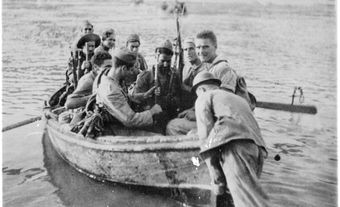
During the Brussels conference, Krehm and Field advocated for the POUM to reject associations with the Soviet Union and any elements of the “bourgeois” government. This position was not well received, and Krehm’s subsequent agitation in Barcelona led to his imprisonment during the summer of 1937. Upon his return to Canada, the LRWP held rallies and published a pamphlet by Krehm, Revolution and Counter-Revolution in Spain (1938), that was highly critical of the Spanish Republic. Most liberal Canadians supported the Spanish Republic, and this message did not resonate. (See Canada and the Spanish Civil War.)
Second World War and Dissolution
The LRWP formally opposed Canadian involvement in the Second World War, framing the conflict as an imperialist and capitalist endeavour. Members briefly considered maintaining the LRWP as an underground revolutionary movement, but ultimately stopped revolutionary activities sometime in 1940. The group ceased operations, and only a few members returned to revolutionary politics following the Second World War.