Share on Facebook
 Share on X
 Share by Email
 Share on Google Classroom
The Mackenzie-Papineau Battalion was a unit in the Second Spanish Republican Army during the Spanish Civil War (1936–39). The battalion was largely composed of Canadian volunteers and was known formally as the 60th Battalion of the XVth International Brigade. Formed in July 1937, it fought in several key campaigns until the Second Spanish Republic disbanded the International Brigades in September 1938. Although the battalion had many Canadian volunteers, it also included large numbers of American, British, Cuban, Finnish, and Spanish volunteers. To add further confusion, Canadian volunteers who served in other units are often referred to as having been members of the Mackenzie-Papineau Battalion (“Mac-Paps”).

Canadian Volunteers in Spain
The Spanish Civil War began in July 1936. Almost immediately, foreign volunteers went to Spain to fight for both sides. Most volunteers from North America fought for the Second Spanish Republic, particularly after the Third International (Comintern) mobilized to support the recruiting effort. The Communist Party of Canada was critical in recruiting, organizing, and dispatching volunteers for Spain. Some Canadians were already in Europe and served in hastily organized militias, but the first organized contingent of volunteers sent from Canada to Spain arrived in early 1937. Bob Kerr, a Scottish-Canadian volunteer, was sent to represent the Communist Party of Canada’s interests within the International Brigades.
Most Canadian volunteers joined the more numerous American volunteers in the Abraham Lincoln Battalion in the XVth International Brigade. The Abraham Lincoln Battalion fought its first battle at the Jarama Valley in February 1937. With the arrival of more norteamericanos, the XVth International Brigade established an additional unit: the George Washington Battalion.

Formation of the Mackenzie-Papineau Battalion
Meanwhile, Canadian volunteers advocated for a Canadian unit to acknowledge the Canadian contribution to the war effort and to serve as a rallying symbol for support from Canada. Following the fighting at Jarama, Irish-Canadian Joseph Kelly convened a meeting in late April 1937 to discuss forming a Canadian company. Attendees included Communist Party of Canada members Edward Cecil-Smith, Bob Kerr and Edo Jardas. They decided to push for a Canadian company named in honour of William Lyon Mackenzie and Louis-Joseph Papineau, leaders of the 1837–38 rebellions in Upper and Lower Canada.
In May, the Communist Party of Canada’s newspapers announced the creation of “The Friends of the Mackenzie-Papineau Battalion,” an organization that would advocate and fundraise for Canadian volunteers in Spain. This organization predated the creation of an actual Canadian battalion, or even a company. At the time, the project of creating a Canadian unit was merely an aspiration. The XVth International Brigade was organizing a new battalion, but it was initially going to be named after another American.
On 1 July 1937, however, the XVth International Brigade announced that the new battalion would be named the Mackenzie-Papineau Battalion. Its creation coincided with the near destruction of the George Washington Battalion in the Brunete Offensive; the survivors joined the Lincoln and Mackenzie-Papineau Battalions. By the end of the summer, the XVth International Brigade was reorganized and had three battalions composed of foreign volunteers: the British Battalion, the Abraham Lincoln Battalion and the Mackenzie-Papineau Battalion. The brigade's fourth battalion mainly consisted of Spanish soldiers.
Training and Organization
The XVth International Brigade established the Mackenzie-Papineau Battalion during a lull in its operations. Consequently, the battalion benefited from a three-month training period before its first battle in October 1937, far more training than any battalion raised earlier in the war. Despite the Canadian name, the Mackenzie-Papineau Battalion was initially led by Americans. The first battalion commanders were Americans Robert Merriman, Rollin Dart, and Robert Thompson. When the battalion deployed to its first battle at Fuentes de Ebro, Thompson was the commanding officer, and every company commander and commissar was American, except one. Niilo Makela, a Finnish-Canadian volunteer, commanded the Machine Gun Company.
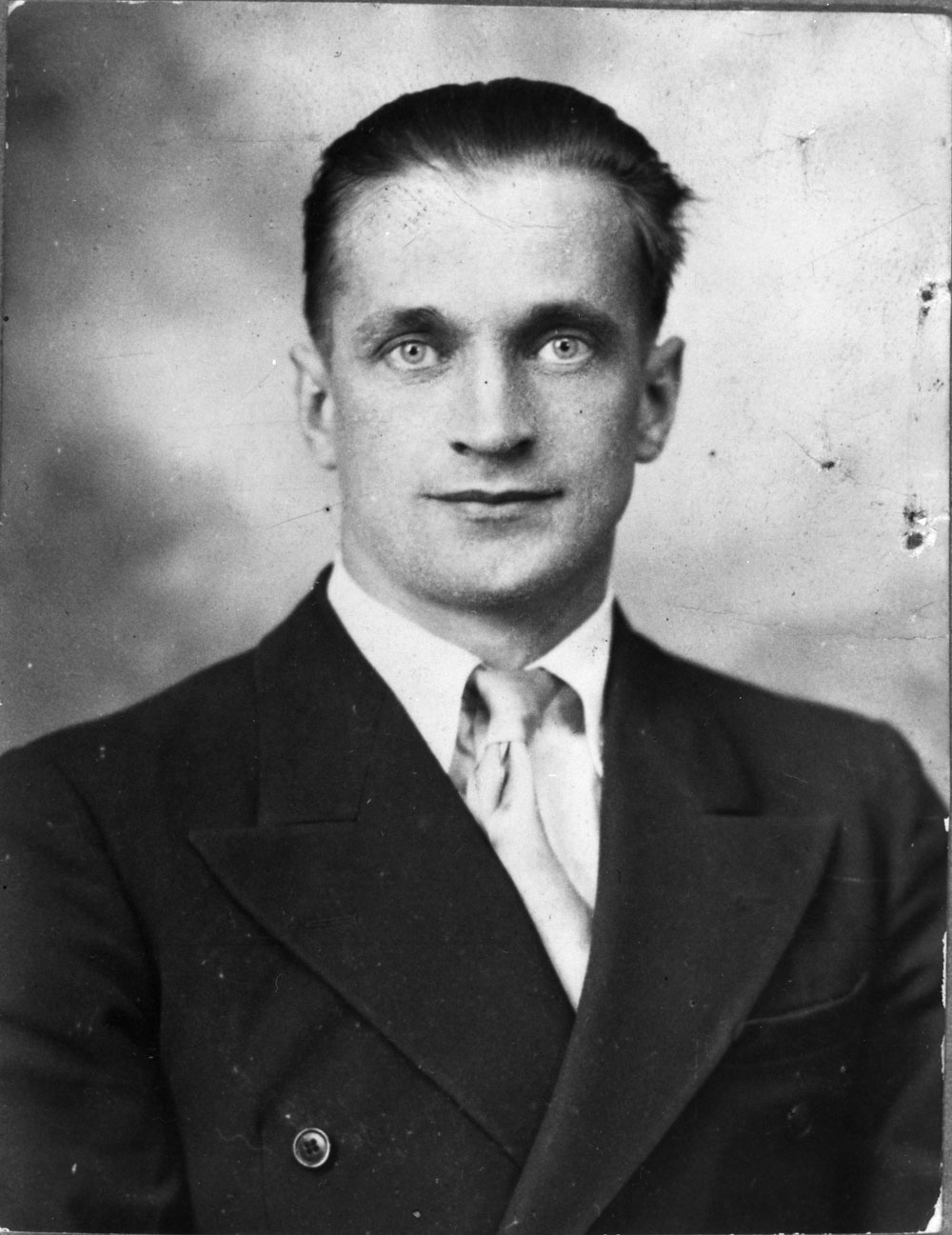
The Mackenzie-Papineau Battalion consisted of a battalion headquarters, three rifle companies and one machine gun company. The headquarters included signalers with radios and heliographs, cartographers, a doctor and medics, and kitchen staff. The machine gun company had four or five Maxim guns, and the battalion also had a small collection of other special weapon systems, like mortars and sniper rifles. The battalion had a cadre of political officers or commissars that operated in conjunction with the battalion and company commanders. These commissars provided additional oversight on decision-making.
Fuentes de Ebro
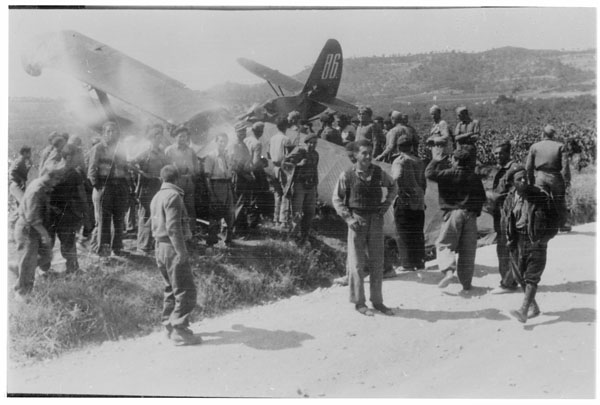
The Mackenzie-Papineau Battalion's first battle was at Fuentes de Ebro in October 1937. The XVth International Brigade was assigned the mission of seizing the town. The brigade's plan was straightforward: Republican aircraft would strike the Nationalist positions, an artillery barrage would suppress the defenders, and tanks with mounted Spanish soldiers would advance against the town. The three battalions of foreign volunteers would then assault through no man's land. However, due to poor planning and coordination, the Mackenzie-Papineau Battalion advanced against an unsuppressed enemy. They attacked bravely but failed to take much ground. The battalion took heavy casualties.
After the attack at Fuentes de Ebro, the XVth International Brigade required large numbers of reinforcements. Edward Cecil-Smith took over from Robert Thompson and became the first Canadian commander of the Mackenzie-Papineau Battalion. He commanded the battalion for most of its time in Spain.
Defence of Teruel
The Mackenzie-Papineau Battalion’s next operation was the defence of Teruel. The Nationalists had held this town since early in the war, but Republican troops captured it in one of their first major tactical victories in late 1937. The XVth International Brigade was among the forces sent to replace the Republican troops and defend Teruel against persistent Nationalist counterattacks. On 17 January 1938, Nationalist cavalry breached their right flank. Cecil-Smith personally led efforts to counter the charge, using mobile machine gun posts and even his command post staff to fight off the cavalry. The Mackenzie-Papineau Battalion held its positions and prevented the fall of Teruel. The battalion received a unit citation from General Juan Modesto.
After being pulled out of the line at Teruel, the Mackenzie-Papineau Battalion launched a successful nighttime raid against a Nationalist position at Atalaya. Cecil-Smith aborted the next raid when they lost the element of surprise.
Aragon Offensive and Retreats
In March 1938, the XVth International Brigade was resting in a rear position when General Francisco Franco launched the Aragon Offensive. The onslaught used foreign troops, modern aircraft, and tanks from his German and Italian allies. The rapid attack repulsed the first line of Republican defenders. The Mackenzie-Papineau Battalion rushed to a blocking position at the town of Azuara to guard the flank of the XVth International Brigade’s main defensive area at Belchite.
The battalion made several attempts to regroup and fight during the retreats, notably at Caspe, where Niilo Makela was killed. Caspe fell to the Nationalists on March 17. The Mackenzie-Papineau Battalion began the battle with 500 soldiers, ending with only 250. Only half of the remaining soldiers still had their weapons. In early April, the Mackenzie-Papineau Battalion took on reinforcements and put up a brief resistance around Mora d’Ebre. The Nationalist offensive reached the Mediterranean Sea on April 15. What remained of the Mackenzie-Papineau Battalion was pushed to the east side of the Ebro River.
Ebro Offensive
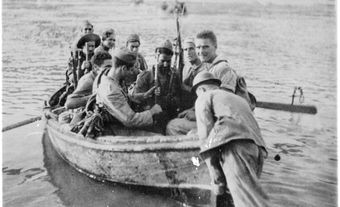
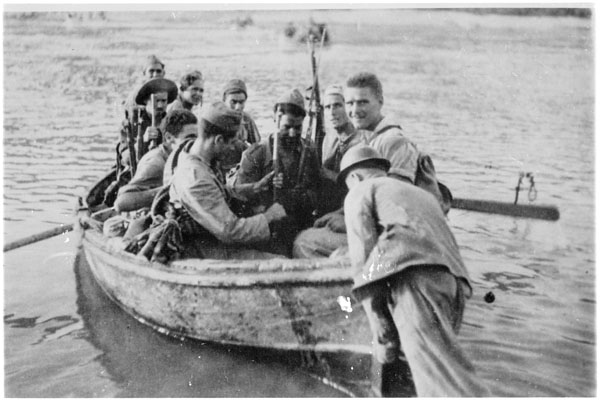
The Mackenzie-Papineau Battalion's final battles were the large Republican offensive to cross the Ebro River and defence of the bridgehead. In July 1938, the Mackenzie-Papineau Battalion crossed the Ebro River and participated in assaults on the towns of Asco and Flix. In August, they fought fiercely in the Sierra de Pandols (nicknamed the Mountains of the Moon) for 11 days and nights, enduring heavy artillery and close combat. During the subsequent fighting in the Sierra de Cavalls in September 1938, Cecil-Smith was accidentally shot in the leg by his own pistol and evacuated. Gunnar Ebb (real name Paavo Koskinen), a Finnish volunteer, took temporary command of the battalion.
Disbandment and Return to Canada
During peace negotiations in September 1938, the Spanish Republic announced it would disband the International Brigades. The Mackenzie-Papineau Battalion paraded for the last time in Barcelona before proceeding to Ripoll, where the International Brigades sorted the volunteers by country of origin. All Canadian volunteers were grouped together regardless of where they had served previously and were referred to as Mac-Paps. Cecil-Smith, following the departure of Bob Kerr and his replacement, Jack Taylor (real name Muni Erlick), became the senior Communist Party of Canada representative in Spain.
Notably, the Canadian government did not provide financial assistance to repatriate the volunteers, who had defied the Foreign Enlistment Act by joining the war. Instead, the Communist Party of Canada, the Friends of the Mackenzie-Papineau Battalion, and various private donors facilitated their return. A train carrying most of these volunteers departed Barcelona for France on 25 January 1939, just before the city fell to Nationalist forces. The group of 292 Canadians, 95 Americans, and 11 Mexicans narrowly escaped.
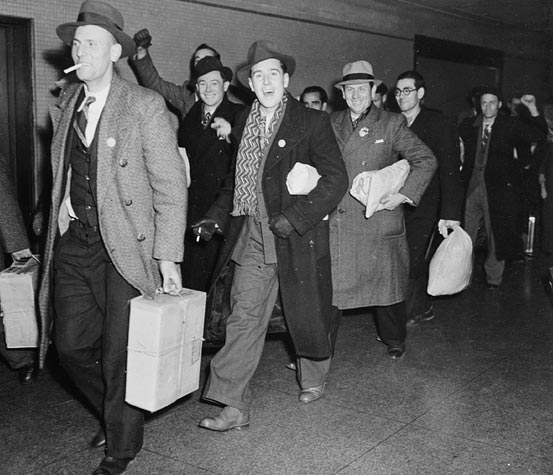
When most of the Canadian volunteers returned to Canada in February, they were greeted by large cheering crowds, especially in Toronto.
Legacy
There are few artefacts relating to the battalion in museum or personal collections. In 1979, the Veterans of the International Brigades-Mackenzie-Papineau Battalion of Canada advocated for official government recognition of the volunteers as veterans, but the campaign failed. There are monuments to the Mackenzie-Papineau Battalion, however, in Ottawa and Toronto, Ontario, and in Victoria, British Columbia, as well as a memorial stone in Cumberland, British Columbia, and a plaque in Winnipeg, Manitoba.