Share on Facebook
 Share on X
 Share by Email
 Share on Google Classroom
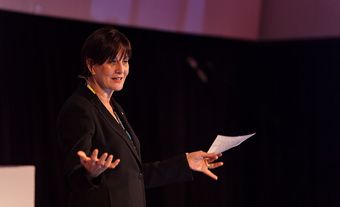
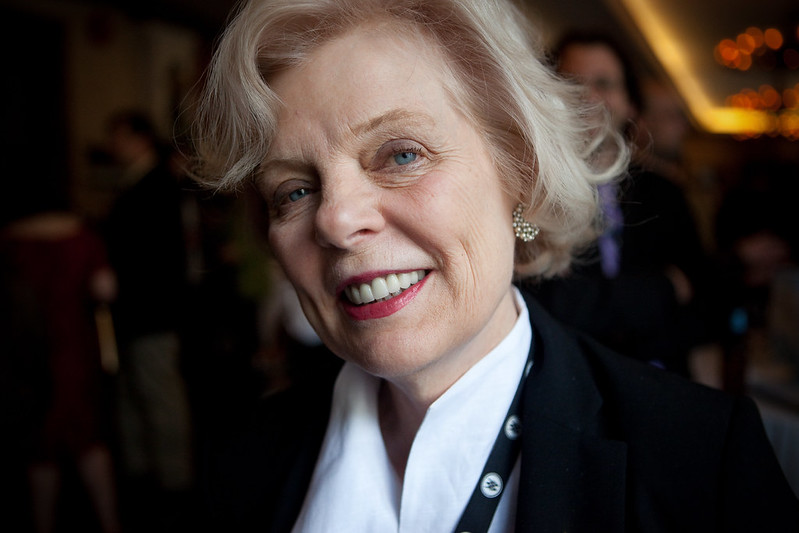
Catherine “Trina” Margaret McQueen (née Janitch), OC, broadcast journalist, producer, executive (born 1943 in Belleville, ON). Trina McQueen is a highly respected trailblazer for Canadian women in broadcast journalism. She was the first woman reporter for CFTO in Toronto, the first woman to host CTV’s W5, and the first woman to both report on camera for CBC’s The National and serve as its executive producer. McQueen spent 25 years at the CBC, rising to VP of television news, current affairs and CBC Newsworld and eventually to network program director for CBC English Television. She became the founding president of Canada’s Discovery Channel in 1995 and president and COO of CTV in 2001. Since retiring in 2002, she has taught at the Schulich School of Business at York University, served on the boards of numerous organizations and was vice-chair of TVO. An Officer of the Order of Canada, she has received several lifetime achievement awards and been inducted into multiple halls of fame.
Early Life and Education
Trina Janitch was the first of five children born to her Yugoslavian father, an engineer, and her Czech mother. She grew up in a middle-class household in Belleville, Ontario, and attended Belleville Collegiate Institute and Vocational School, where she was very active. She was a cheerleader, president of the Drama Club and served on the student council. She also worked as a high school columnist for the Belleville Intelligencer (as did another trailblazing female journalist, Stevie Cameron). “That experience made me decide to go to Carleton for journalism,” McQueen later said. She went on to earn her degree in journalism from Carleton University while also studying at the University of British Columbia (UBC) on an exchange scholarship.
Early Career
After graduating in 1964, Trina Janitch worked for the Ottawa Journal. In 1966, she was hired to be one of two co-anchors on the first season of CTV’s investigative journalism program, W5. At the same time, she was recruited to be the first female reporter at Toronto’s CFTO TV station.
As Canada’s first female journalist in a number of fields, she had to overcome a great deal of sexism. She has recounted the time, early in her career, that the CFTO station manager wanted her fired because, in his words, “women do not have the authority to report news.”
Personal Life
While working at CFTO and going out for drinks with her colleagues one night, Trina Janitch met journalist Don McQueen. He had worked for the Canadian Press and was a producer at the CBC. The two were married in early 1970 and later became “one of Canadian television’s most powerful couples,” according to the Globe and Mail. They were married until Don McQueen’s death in 2015 had a daughter, Jennifer, together.
Career at the CBC
In 1967, Trina McQueen was hired as an editor for CBC TV Toronto local news. In 1968, she became the broadcaster’s first national on camera female reporter. However, she quickly gravitated toward producing stories rather than reporting on them. “I was never entirely happy as an on-air person,” she recalled. “I’m more of an introverted kind of person and I just didn’t like that public aspect of on-air reporting.”
In 1976, at age 33, McQueen was named executive producer of The National. She later added news specials to her responsibilities. McQueen was responsible for hiring stars such as Knowlton Nash, Mike Duffy, Peter Mansbridge and Brian Stewart to various jobs at CBC News.
In 1980, McQueen became network program director responsible for the entire schedule of CBC’s English television. Returning to journalism in 1988, as director of news, current affairs and Newsworld (her title later became vice-president), she oversaw the launch and development of CBC Newsworld. She also introduced the first series of independent documentaries to the CBC. She was responsible for CBC's coverage of federal elections, the Meech Lake Accord constitutional crisis, the Charlottetown Accord referendum, the end of the Cold War and the first Persian Gulf War.
On covering Canada’s Constitutional struggles in the 1980s and early 1990s, McQueen said, “it is very dramatic to see people try to fashion their future in a democratic way. I am a passionate Canadian and I enjoyed being close to a country as it was trying to define itself, while accommodating diversity and distinctiveness and trying to stay together.”
Career at CTV
In 1993, Trina McQueen joined Netstar Communications (then JLL Broadcasting) to manage its licence application for Canada’s new Discovery Channel. On its approval in 1995, she became the founding president of Canada’s Discovery Channel.
In 1999, CTV, Canada's largest private broadcaster, bought Netstar Communications. McQueen was subsequently named executive vice-president of CTV Inc. She became president and COO when Bell Canada Enterprises (BCE) acquired CTV in 2001. (See also BCE Bids for CTV.) She retired from broadcasting in August 2002.
Other Activities
Throughout her career, Trina McQueen was very active in the industry. She chaired the Television Board of the Canadian Association of Broadcasters and the Banff Television Foundation Board. She also served on the boards of Telefilm Canada and the Canadian Television Fund. Her report for the CRTC on Canadian drama led to the establishment of regulatory incentives for drama production. She also chaired the all-industry committee that established a ratings system for Canadian television.
After retiring from CTV, McQueen became the Bell Media Professor in Media Management and Co-Director of the Arts, Media & Entertainment Management Program at the Schulich School of Business at York University. McQueen has also remained in high demand as an administrator. She has served on the boards of the CBC, the Canadian Opera Company, the Canadian Institute of Advanced Research, the Canadian Journalism Foundation, the Canadian Media Research Consortium, PEN Canada, the Academy of Canadian Cinema & Television, and Historica Canada (the publisher of The Canadian Encyclopedia). She also served as vice-chair of TVO from 2016 to 2019.
(See also Journalism; Television Programming.)
Honours and Awards
- Inductee, Canadian News Hall of Fame (2001)
- Inductee, Canadian Association of Broadcasters Hall of Fame (2002)
- Special Achievement Gemini Award, Academy of Canadian Cinema & Television (2002)
- Lifetime Achievement Award, Canadian Journalism Foundation (2002)
- Woman of the Year Award, Canadian Women in Communications (1997)
- D. Dunton Award, Carleton University (1999)
- Officer, Order of Canada (2005)
- Inductee, Playback’s Canadian Film and TV Hall of Fame (2008)
- Lifetime Achievement Award, Alberta Film Awards (2009)
- Crystal Award, Women in Film and Television (WIFT) Toronto (2014)
- Inductee, CBC News Hall of Fame (2018)
- Inductee, Radio Television Digital News Association (RTDNA) Canada Hall of Fame (2021)
Honorary Degrees
- Doctor of Humane Letters, Mount Saint Vincent University (1995)
- Doctor of Laws, University of Waterloo (1999)
- Doctor of Laws, Carleton University (2001)
- Doctor of Laws, York University (2019)