Share on Facebook
 Share on X
 Share by Email
 Share on Google Classroom
Simpsons was a Toronto-based department store chain founded as a dry goods store circa 1872 by Robert Simpson. At its peak, its locations stretched from Regina to Halifax, though most were concentrated in the Toronto and Montreal markets. Purchased by the Hudson’s Bay Company (HBC) in 1978, the nameplate was retired in 1991.
Simpsons
The Simpsons flagship department store in Toronto, Ontario, 5 June 1991.
(photo by Ken Faught/Toronto Star via Getty Images)
Beginnings
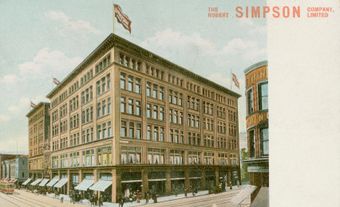
After running several general merchandise businesses in Newmarket, Ontario, either by himself or as a partner from 1858, Robert Simpson moved to Toronto in 1871-72. At an unspecified point in 1872, he opened a dry goods store at 184 Yonge Street, north of Queen Street, just as that area was becoming an important shopping district.
From the beginning, Simpson’s retail rival was Timothy Eaton, whose store south of Queen Street opened in 1869. By the early 1880s, when Eaton moved north, he kept his old location vacant for six months to prevent Simpson from moving in.
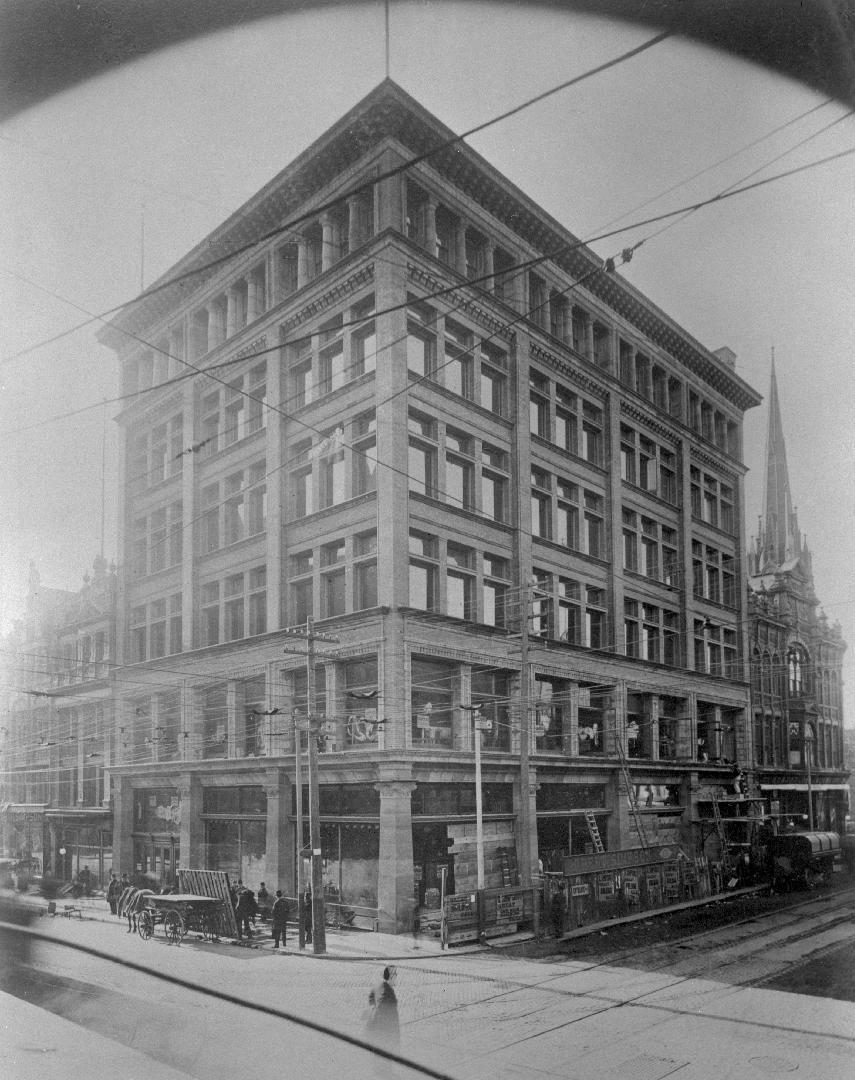
In December 1894, Simpson’s store moved into a new six-storey building at the southwest corner of Queen and Yonge Streets. Newspaper ads published for the store’s opening claimed it was “the loveliest shopping centre in Canada” whose attractions were “manifold and surpass anything that has ever been shown in the Dominion.”
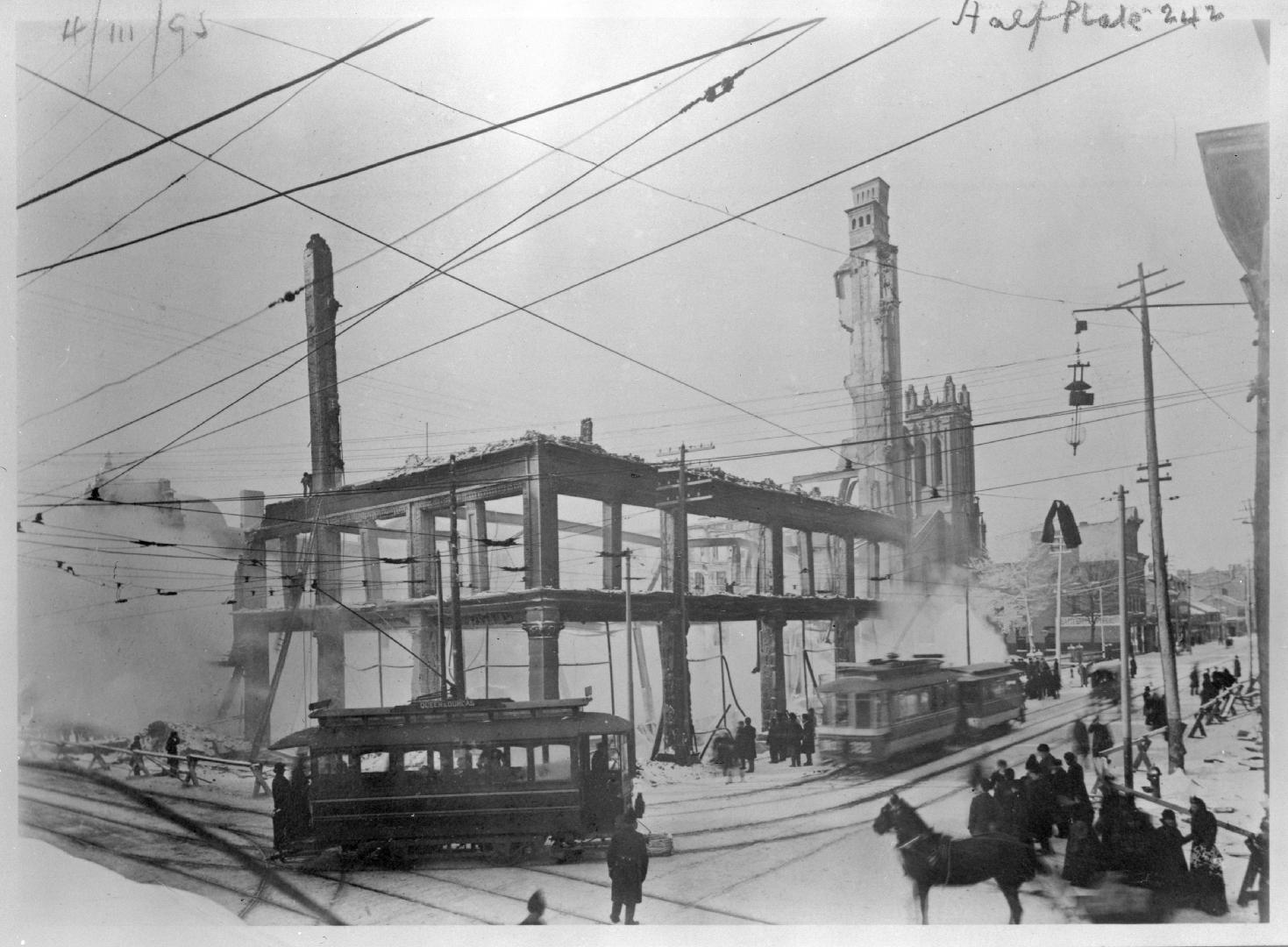
Four months later, in March 1895, the store was destroyed by a major city fire. Simpson vowed to rebuild and, using an identical design with better fireproofing, reopened on the same site in January 1896. Later that year, the company was reorganized as the Robert Simpson Company Limited, with Simpson serving as its president.
Into the 20th Century
Following Robert Simpson’s death in December 1897, the company was sold to Toronto businessmen Alfred Ernest Ames, Joseph Flavelle and Harris Henry Fudger. The latter, who operated a successful wholesaling business, became president.
The company’s first expansion outside Toronto was its purchase of Montreal’s John Murphy and Company in 1905, whose nameplate it retained until 1929. Further expansion included Regina (1916, initially for mail order only), Halifax (1924) and London (taking over Smallman and Ingram in 1944). A large catalogue facility opened in downtown Toronto in 1917.
The company was reorganized again in March 1925, assuming the name Simpsons, Limited.
The Queen and Yonge store gradually expanded, with its most significant growth in 1929. A nine-storey addition, which included the art deco inspired Arcadian Court restaurant, was designed to retain the store’s lunch trade in anticipation of competition from the soon-to-open Royal York Hotel, and Round Room in the new Eaton’s store at College and Yonge Streets.
That year, Fudger was succeeded as president by Charles Luther Burton, who had begun working for Fudger as a teenaged office boy prior to his involvement with Simpsons. He fended off Flavelle’s attempts to interest potential American buyers and outbid him to gain control. He would run the company until handing the presidency to his son Edgar Burton in 1948 (who also became chairman in 1956).
Simpsons-Sears and Continued Growth
By the early 1950s, Simpsons’ catalogue business lagged Eaton’s. American retailing giant Sears, Roebuck and Company sought a local partner as it planned to enter the Canadian market. Edgar Burton was initially apprehensive when Sears approached, fearing it might jeopardize his own future expansion plans, but saw the advantages of Sears’ merchandising experience and the ability to expand into other parts of Canada.
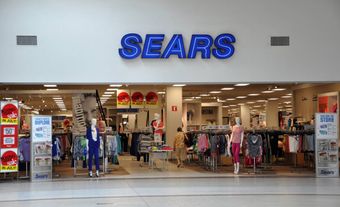
The new company, Simpsons-Sears Limited, was established in 1952 (see Sears Canada Inc). It was equally owned by both companies. Simpsons sold its mail-order business to the new firm for $20 million.
An important part of the agreement was that no Simpsons-Sears stores would operate within 25 miles (40 km) of existing Simpsons stores. This remained in place until the mid-1970s, after which the Simpsons-Sears stores were rebranded as Sears to avoid confusion.
Following Edgar Burton’s death in 1968, his brother George Allan Burton became chairman, and served briefly as president before Charles B. Stewart was appointed in 1970. Edgar Burton’s son Edgar G. “Ted” Burton became president in 1976. The chain continued to expand in southern Ontario and the Montreal area. In 1972, it acquired Murphy-Gambles in Ottawa and rebranded its Sparks Street store.
HBC Ownership
In August 1978, Simpsons and Simpsons-Sears announced a merger in principle, pending approval by the Foreign Investment Review Agency (FIRA). Three months later, the HBC made a bid to buy Simpsons, a prospect the company had considered as far back as 1938. HBC felt that Simpsons, which had 21 stores at the time, complemented its western Canadian base and its recent acquisition of the Zeller’s discount department store chain.
When FIRA approved the Simpsons/Simpsons-Sears merger in December 1978, HBC extended its offer, which analysts recommended Simpsons accept. The merger was withdrawn and, on 28 December 1978, HBC announced that its bid was successful in a deal that would cost $347 million. By March 1979, HBC had acquired 88 per cent of Simpsons, Limited shares. That same year, HBC gained 35.7 per cent of Simpsons-Sears shares. The federal government ruled that Simpsons, Limited and Simpsons-Sears would operate separately and that all shared facilities and services must be severed, as well as having no common board members.
In 1983, Sears, Roebuck and Co. acquired HBC’s shares of Simpsons-Sears, and the following year the company was renamed Sears Canada Inc.
As a division of HBC, Simpsons was initially run separately. Decisions were made to close the Regina store in 1981 (which had been the only location west of Ontario) and downtown Ottawa in 1983. Gradually buying, credit card and advertising operations were merged into HBC.
Demise
During the mid-1980s, Simpsons was repositioned as a store specializing in higher-end fashions targeting middle- and upper-class consumers in the Montreal and Toronto markets. Eight stores outside of those areas were rebranded as The Bay in August 1986. Simpsons would exit the Montreal area in 1989.
In June 1991, with 14 stores left, HBC announced that the Simpsons name would be retired. The chain was never profitable under HBC’s ownership. Eight stores were rebranded as The Bay, while six were sold to Sears Canada. When asked why the name was not at least preserved on the downtown Toronto flagship, HBC owner Ken Thomson told the Toronto Star that “we decided it was better to join the momentum of The Bay and start with a clean slate.”