Share on Facebook
 Share on X
 Share by Email
 Share on Google Classroom
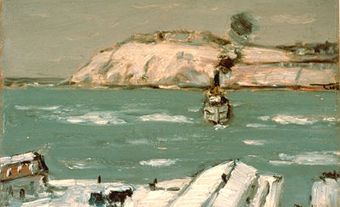
Maurice Galbraith Cullen, painter (born 6 June 1866 in St John's, Newfoundland; died 28 March 1934 in Chambly, QC). Cullen introduced French impressionism to Canada; best known for his paintings of snow, his work inspired members of the Group of Seven.
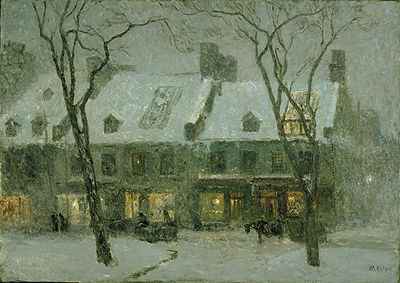

Maurice Cullen was born in St. John’s, Newfoundland, and moved to Montreal with his family in 1870. There he began his art training as a sculptor at the Conseil des arts et manufactures and with sculptor Louis-Philippe Hébert. Like other artists of his generation, he went to Paris for additional training. He arrived there in 1889 and decided to become a painter; he attended the École des beaux-arts, studying, like Paul Peel, with Jean-Léon Gérôme, then with Élie Delaunay.
By 1895, when Cullen returned to Montreal, he had darkened the tonality of the impressionist style learned abroad. In time he became the true interpreter of Montreal's cityscape, particularly of night or dusk scenes, invariably with shimmering lights. He was also one of Canada's great painters of snow.
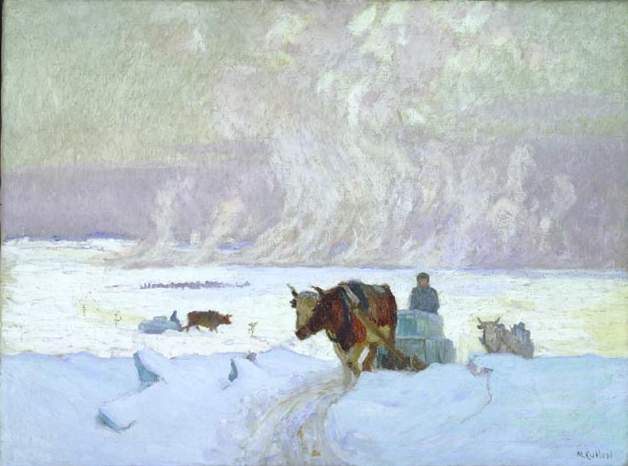
Like his colleague and friend James Wilson Morrice, Cullen was a major figure in Canadian art. His gift was that of a romantic — an ability to capture light and mood. Some of his work was influenced by William Blair Bruce, whom Cullen often visited in Gréz between 1892 and 1894. Cullen in turn influenced many by teaching for years at the Art Association of Montreal. He showed in the first exhibition of the Canadian Art Club, an advanced group of the period, and was made a member in 1910.
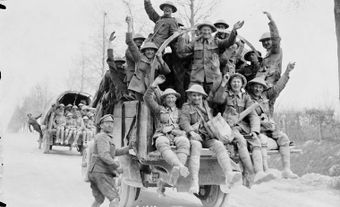
In November 1910, Cullen returned to Newfoundland, where he married widow Barbara Merchant Pilot. She and her five children moved to Montreal. When the First World War broke out, Cullen’s four stepsons — John, Edward, William and Robert Wakeham — enlisted in the Canadian Expeditionary Force; John died in June 1917 at Acheville, France.
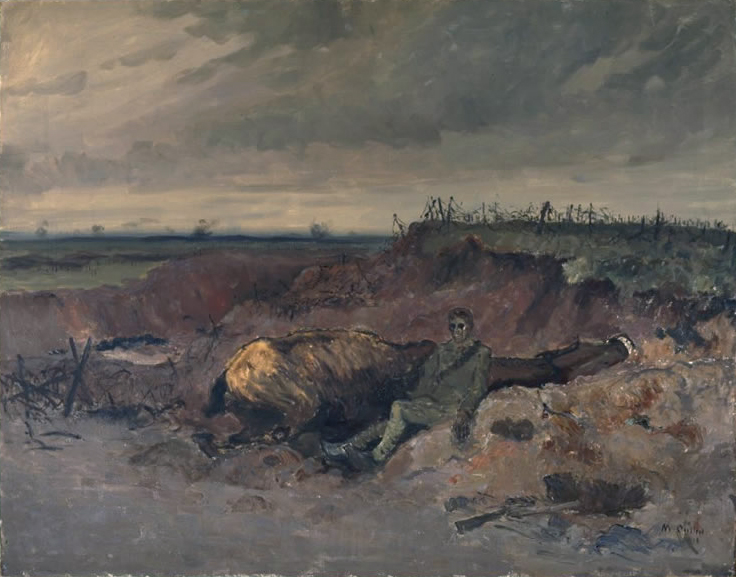
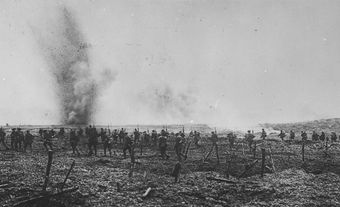
In 1918, Cullen became an official war artist and was sent overseas to paint scenes of the Western Front. The Canadian War Memorials Fund, initiated by Lord Beaverbrook, also employed such artists as A.Y. Jackson, Frederick Varley, J.W. Beatty and Charles Walter Simpson, among many others. (See Canadian War Art Programs and Artistic Legacy of the First World War.)