Share on Facebook
 Share on X
 Share by Email
 Share on Google Classroom
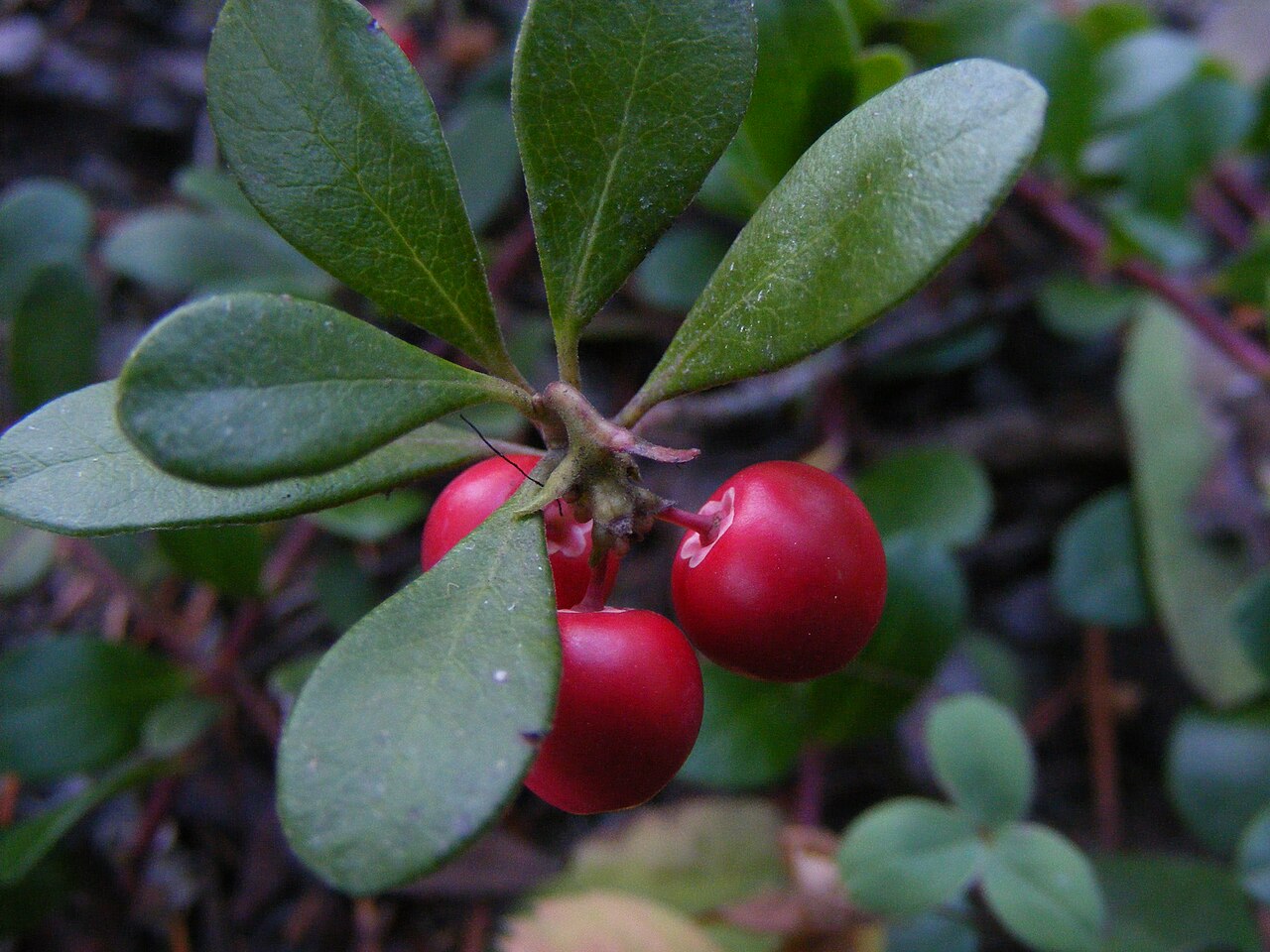
Bearberry, or kinnickinnick, is a trailing, evergreen shrub in the heather family. The genus name, Arctostaphylos, derives from Greek arctos, "bear," staphylos, "bunch of grapes"; species name, uva-ursi, from Latin uva, "bunch of grapes," ursus, "bear" — literally "bearberry, berry-bear." Kinnickinnick is Algonquian for "that which is mixed."
Description
The flexible, rooting branches of bearberry grow up to 2 m long, are covered with reddish, shreddy bark and bear alternate, dark green, oval leaves. Small, waxy, urn-shaped flowers are white or pink, tipped with red. They grow in small clusters at branch ends, in late spring and early summer, and develop into bright red, fleshy fruits. (See also Wild Berries in Canada.)
Distribution and Habitat
Bearberry grows across Canada on dry sandy soils (often called sandberry), but is also found on gravel terraces, sand dunes and in the boreal forest, and is valuable as ground cover for checking erosion on watersheds. It is less common above the treeline.
Uses
Bearberry leaves are combined with tobacco and smoked by Niitsitapi (Blackfoot) and other Indigenous groups in religious ceremonies (see also Religion and Spirituality of Indigenous Peoples in Canada).
Bearberry extract has a high content of tannic and gallic acids which make it an astringent. It also contains arbutin, which becomes a germicide in the renal tract. The Thompson tribe of British Columbia have used it for kidney diseases, and the Niitsitapi (Blackfoot) make an infusion for sore gums, and salve for skin diseases. (See also Indigenous Peoples' Medicine in Canada; Traditional Plants and Indigenous Peoples in Canada.)