
Browse "Communities & Sociology"
-
Article
Canadian Human Rights Commission
The Canadian Human Rights Commission and the Human Rights Tribunal Panel were established under the 1977 Canadian Human Rights Act to investigate and resolve individual complaints about discriminatory employment practices.
"https://thecanadianencyclopedia.ca/images/tce_placeholder.jpg?v=e9dca980c9bdb3aa11e832e7ea94f5d9" // resources/views/front/categories/view.blade.php
https://thecanadianencyclopedia.ca/images/tce_placeholder.jpg?v=e9dca980c9bdb3aa11e832e7ea94f5d9
-
Article
Canadian Identity
The question of what it means to be a Canadian has been a difficult and much debated one. Some people see the question itself as central to that identity. Canadians have never reached a consensus on a single, unified conception of the country. Most notions of Canadian identity have shifted between the ideas of unity and plurality. They have emphasized either a vision of “one” Canada or a nation of “many” Canadas. A more recent view of Canadian identity sees it as marked by a combination of both unity and plurality. The pluralist approach sees compromise as the best response to the tensions — national, regional, ethnic, religious and political — that make up Canada.
"https://d3d0lqu00lnqvz.cloudfront.net/media/media/af24ecdf-07e4-4430-bbe0-b4a913834b9d.jpg" // resources/views/front/categories/view.blade.php
https://d3d0lqu00lnqvz.cloudfront.net/media/media/af24ecdf-07e4-4430-bbe0-b4a913834b9d.jpg
-
Article
Canadian Identity and Language
Language policy in Canada, as it relates to Canadian identity, traditionally encompasses three points of view. One favours an officially bilingual Canada. It reaffirms the country as the product of two “founding peoples.” A version of this approach, introduced by Prime Minister Pierre Trudeau, endorses official bilingualism but rejects the claim that two “peoples” or “nations” deserve any special recognition. Rather, it argues that we should instead emphasize Canada’s multiculturalism. The second position argues that, since no linguistic group deserves special status, the country should therefore have no official languages. The third position argues that Canada is not only multicultural, but also multinational. It argues that French and English should have official status because this recognizes two of the country’s founding nations. This approach also suggests that efforts should be made to help preserve Indigenous languages.
"https://thecanadianencyclopedia.ca/images/tce_placeholder.jpg?v=e9dca980c9bdb3aa11e832e7ea94f5d9" // resources/views/front/categories/view.blade.php
https://thecanadianencyclopedia.ca/images/tce_placeholder.jpg?v=e9dca980c9bdb3aa11e832e7ea94f5d9
-
Article
Canadian Parents for French
Canadian Parents for French is a national organization of parents dedicated to the expansion of French second-language learning opportunities for young Canadians. Primarily driven by the volunteer efforts of parents, it has been the leading organization in Canada dedicated to the expansion of French immersion programs and the improvement of French second-language learning programs since the 1970s.
"https://thecanadianencyclopedia.ca/images/tce_placeholder.jpg?v=e9dca980c9bdb3aa11e832e7ea94f5d9" // resources/views/front/categories/view.blade.php
https://thecanadianencyclopedia.ca/images/tce_placeholder.jpg?v=e9dca980c9bdb3aa11e832e7ea94f5d9
-
Article
Canadian Political Science Association
The Canadian Political Science Association was founded in 1913. It lost its membership to WWI, but was reconstituted in 1929 and has operated continuously since. It was incorporated under the Canada Corporation Act in 1971.
"https://thecanadianencyclopedia.ca/images/tce_placeholder.jpg?v=e9dca980c9bdb3aa11e832e7ea94f5d9" // resources/views/front/categories/view.blade.php
https://thecanadianencyclopedia.ca/images/tce_placeholder.jpg?v=e9dca980c9bdb3aa11e832e7ea94f5d9
-
Article
Canadian Response to the "Boat People" Refugee Crisis
The welcoming and resettlement of many thousands of refugees from Southeast Asia in the late 1970s and early 1980s represents a turning point in the history of immigration in Canada. It was the first time that the Canadian government applied its new program for private sponsorship of refugees — the only one of its kind in the world — through which more than half of the Vietnamese, Cambodian and Laotian refugees who came to Canada during this period were admitted. In recognition of this unprecedented mobilization of private effort, the people of Canada were awarded the Nansen Medal, an honour bestowed by the United Nations for outstanding service to the cause of refugees. It was the first and remains the only time that the entire people of a country have been collectively honored with this award. But most importantly, this positive, humanitarian response by Canadians reflected a change in their attitude toward refugees. Never before in its history had Canada welcomed so many refugees in so little time.
"https://d3d0lqu00lnqvz.cloudfront.net/media/media/3a40eecb-55cf-4185-be37-c6a9f48da2e6.jpg" // resources/views/front/categories/view.blade.php
https://d3d0lqu00lnqvz.cloudfront.net/media/media/3a40eecb-55cf-4185-be37-c6a9f48da2e6.jpg
-
Article
Canadian Response to the Syrian Refugee Crisis
The ongoing Syrian conflict has catalyzed different responses in Canada. The Liberal government of Justin Trudeau, which came into power in November 2015, has greatly expanded the resettlement of Syrian refugees into Canada. However, the policies have also been criticized as Canada continues to fight Islamophobia and negative attitudes about refugees.
"https://d3d0lqu00lnqvz.cloudfront.net/media/media/1436a986-2cd6-40f4-a393-3d2d69724117.jpg" // resources/views/front/categories/view.blade.php
https://d3d0lqu00lnqvz.cloudfront.net/media/media/1436a986-2cd6-40f4-a393-3d2d69724117.jpg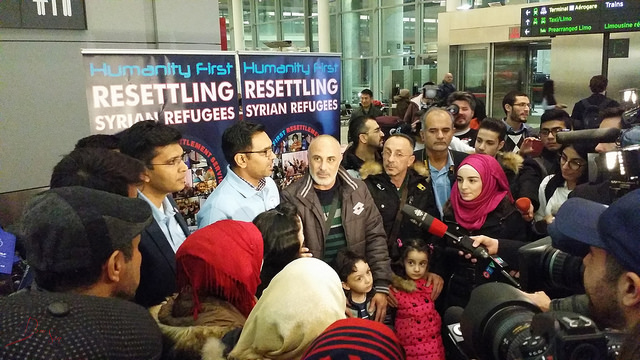
-
Article
Capitalism in Canada
Capitalism is an economic system in which private owners control a country’s trade and business sector for their personal profit. It contrasts with communism, in which property effectively belongs to the state (see also Marxism). Canada has a “mixed” economy, positioned between these extremes. The three levels of government decide how to allocate much of the country’s wealth through taxing and spending.
"https://d3d0lqu00lnqvz.cloudfront.net/media/new_article_images/Capitalism/Railroading.jpg" // resources/views/front/categories/view.blade.php
https://d3d0lqu00lnqvz.cloudfront.net/media/new_article_images/Capitalism/Railroading.jpg
-
Article
Toronto Caribbean Carnival (Caribana)
The Caribbean community in Toronto, Ontario, organized this carnival for the first time in 1967 under the name Caribana as part of Canada’s Centennial celebrations. It has since grown into a major summer event, drawing nearly two million people to the city every year. Since 2015, the official name of the festival has been the Toronto Caribbean Carnival, although it is still commonly referred to as Caribana by many.
"https://d3d0lqu00lnqvz.cloudfront.net/media/media/75602bde-4a29-4c06-b05c-bda4187ceb0b.jpg" // resources/views/front/categories/view.blade.php
https://d3d0lqu00lnqvz.cloudfront.net/media/media/75602bde-4a29-4c06-b05c-bda4187ceb0b.jpg
-
Article
Casavant Society
Two societies, one formed in Montreal and the other in Toronto in the mid-1930s, for the purpose of presenting recitals by the best Canadian and foreign organists. The name was chosen in honour of Casavant Frères, the noted organ builders.
"https://thecanadianencyclopedia.ca/images/tce_placeholder.jpg?v=e9dca980c9bdb3aa11e832e7ea94f5d9" // resources/views/front/categories/view.blade.php
https://thecanadianencyclopedia.ca/images/tce_placeholder.jpg?v=e9dca980c9bdb3aa11e832e7ea94f5d9
-
Article
Catholic Action
Faithful to the Vatican's teachings and following the example of the church in France, elements of the Roman Catholic Church in Québec established Catholic action groups to associate laymen of various ages and professions with the church's social work, particularly in urban areas.
"https://d3d0lqu00lnqvz.cloudfront.net/media/media/6e559a82-fa39-4e67-8505-cd188e83d9d0.jpg" // resources/views/front/categories/view.blade.php
https://d3d0lqu00lnqvz.cloudfront.net/media/media/6e559a82-fa39-4e67-8505-cd188e83d9d0.jpg
-
Macleans
Catholic Church Sex Abuse Scandals
This article was originally published in Maclean’s magazine on July 22, 2002. Partner content is not updated. It's a face that has played host to a lot of fists. John Caruso's nose is crooked, there are reminders of past stitches around the corners of his eyes, and his forehead has as many bumps as a corduroy road.
"https://thecanadianencyclopedia.ca/images/tce_placeholder.jpg?v=e9dca980c9bdb3aa11e832e7ea94f5d9" // resources/views/front/categories/view.blade.php
https://thecanadianencyclopedia.ca/images/tce_placeholder.jpg?v=e9dca980c9bdb3aa11e832e7ea94f5d9
-
Article
Catholic Women's League of Canada
With over 80,000 members across the country in 2019, the Catholic Women's League of Canada (CWLC) represents the largest organized body of Catholic women in Canada. It is officially recognized by the Canadian Conference of Catholic Bishops as a lay association of women and is affiliated with the World Union of Catholic Women’s Organizations. The CWLC national office is in Winnipeg, Manitoba.
"https://d3d0lqu00lnqvz.cloudfront.net/media/new_article_images/CatholicWomensLeagueCanada/cwl-logo.png" // resources/views/front/categories/view.blade.php
https://d3d0lqu00lnqvz.cloudfront.net/media/new_article_images/CatholicWomensLeagueCanada/cwl-logo.png
-
Article
Catholicism in Canada
The Greek word katholikos means "general" or "universal." It refers most commonly to the Christianity that is in communion with the pope and the Church of Rome, that is, the beliefs and practices of a Catholic Church. The modern ecumenical movement often refers to all Christians as sharing in the church's Catholicism, which is derived from the universal headship and reign of Christ. According to the 2021 census, 10.9 million Canadians (29.9 per cent) identified as Catholic.
"https://d3d0lqu00lnqvz.cloudfront.net/media/media/34236b4e-1829-4ee7-9927-c93f6fa7947f.jpg" // resources/views/front/categories/view.blade.php
https://d3d0lqu00lnqvz.cloudfront.net/media/media/34236b4e-1829-4ee7-9927-c93f6fa7947f.jpg
-
Article
Celebrating Asian Heritage in Canada
Many Canadians today see our diverse population as a source of pride and strength — for good reason. More than one in five Canadians were born elsewhere. That is the highest percentage of immigrants in the G7 group of large industrialized nations. Asia (including people born in the Middle East) has provided the greatest number of newcomers in recent years. Since the 1990s, Canadians — who once thought primarily of Europe when they considered events abroad — now define themselves, and the world, differently. As former prime minister Jean Chrétien said: “The Pacific is getting smaller and the Atlantic is becoming wider.”
"https://d3d0lqu00lnqvz.cloudfront.net/media/media/adef87b1-6957-4124-95cc-3d0682f22ba6.jpg" // resources/views/front/categories/view.blade.php
https://d3d0lqu00lnqvz.cloudfront.net/media/media/adef87b1-6957-4124-95cc-3d0682f22ba6.jpg