Share on Facebook
 Share on X
 Share by Email
 Share on Google Classroom
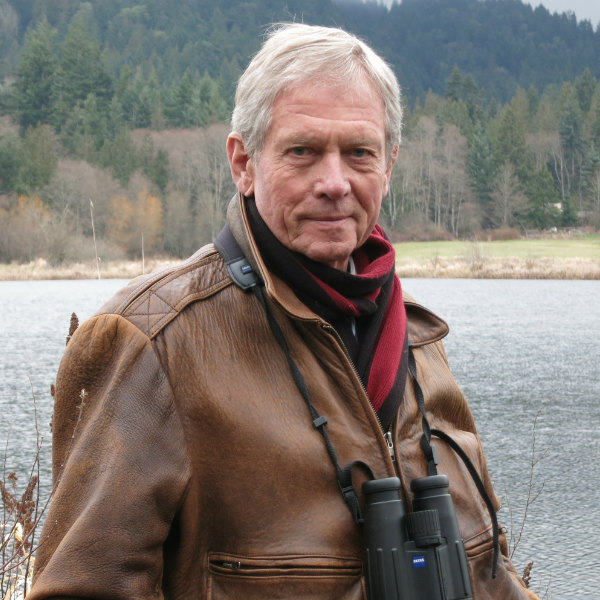
Robert McLellan Bateman, OC, OBC, painter (born 24 May 1930 in Toronto, ON). Robert Bateman is known for his artwork, which frequently features wildlife and natural landscapes, as well as his environmental activism. He was made an Officer of the Order of Canada in 1984 and a Member of the Order of British Columbia in 2001.
Education
Robert Bateman received his early training as a naturalist at Toronto's Royal Ontario Museum and studied painting and drawing with Gordon Payne and Carl Schaefer. He studied geography at the University of Toronto (BA 1954) and in 1955 graduated from the Ontario College of Education. As a young artist, he was inspired by the Group of Seven. He explored several abstract and semi-abstract styles before settling on the realism he is known for today.
Activism
Throughout his career, including twenty years as a high school teacher (art, geography) in southern Ontario, Bateman has consistently combined art and environmental advocacy. As a young man, he helped establish Ontario's Bruce Trail, and in recent years, he has used his renown as an artist to promote environmental causes around the world. Since moving to British Columbia in 1985, he has actively opposed large-scale industrial fishing and logging. Many of his paintings contain overt conservation messages. He speaks out frequently about the threat to traditional ecosystems, both natural and human, which he refers to as "the disappearing world." Bateman's book Thinking Like a Mountain, detailing his thoughts on the growing eco-crisis, was published in 2000. In 2002, he published Birds, which collected many of his finest paintings of birds and bird life.
Art
In part because of his enormous popularity and in part because of his chosen subject matter, Bateman has an uneasy relationship with the "fine art" establishment, which tends to categorize his work as "wildlife art." Nonetheless, his best works, which frequently place wild animals in carefully researched, ecologically accurate natural settings, are also sophisticated compositions that often owe a considerable debt to modern abstractionists such as Mark Rothko and Canada's Paul-Emile Borduas as well as to traditional Japanese and Chinese art. In 1985, an exhibition of his work entitled Portraits of Nature was mounted at the Smithsonian Institution in Washington, DC. A major retrospective of his work opened in November 2007 at the McMichael Canadian Art Collection and toured internationally until 2009.