Share on Facebook
 Share on X
 Share by Email
 Share on Google Classroom
Noah Henry Carpenter, FRCSC, medical doctor, surgeon (born 17 February 1945 in Sachs Harbour [now Ikaahuk], NT; died 25 September 2023 in MB). Noah Carpenter is considered to be the first Inuvialuk, and the first Inuk, to become a medical doctor and skilled surgeon. He specialized in thoracic and vascular medicine. Carpenter was a role model for many in the medical profession and an inspiration to Northerners.
Early Years
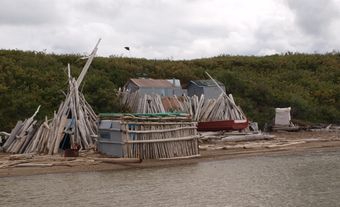
Noah Carpenter was born in a hunting camp near Sachs Harbour (Ikaahuk), Northwest Territories, to a family that enjoyed a traditional way of life. His father was a successful hunter-trapper who expected his son to also work in the then-booming fur trade. He did not understand the younger Carpenter’s decision to become a doctor until later in his life.
Carpenter started at the residential school in Aklavik in 1954 when he was nine. After graduating high school in Inuvik in 1963, he moved to Winnipeg to study chemistry at the University of Manitoba. He graduated in 1967 with a BSc in chemistry. He initially intended to become a high school science teacher but decided to go into medicine.
Carpenter was an exceptional student, and with his high marks, he was accepted into medical school. Carpenter maintained a high grade point average throughout medical school, placing him in the top 20 per cent of his class.
Education and Career
In 1971, Noah Carpenter graduated with a medical degree, becoming Canada’s first Inuit doctor. He went on to complete a four-year general surgical residency and fellowship at the University and Affiliated Hospitals in Edmonton, Alberta. From 1977 to 1980, Carpenter specialized further, doing an additional Adult Cardiovascular and Thoracic Surgery Fellowship at the University of Edinburgh in Scotland. He returned to Canada and worked as a thoracic and vascular surgeon at St. Joseph’s Hospital in Comox, British Columbia.
His work in thoracic surgery focused on diagnosing and treating diseases of organs in the chest, such as the lungs. His expertise in peripheral vascular surgery focused on the body's blood circulatory system outside the heart and brain. Carpenter was known for being most at home working in the hospital or clinic with his patients.
Carpenter continued advancing thoracic and vascular surgery treatment and techniques in the medical centres he worked at. He specialized in microsurgical, vascular endoscopy, laser and laparoscopic surgery techniques in Brandon, Manitoba and Vancouver, British Columbia, as well as in Colorado, Texas and California. He was recognized for his work, receiving an honorary Doctorate of Law on 2 June 1983 from the University of Calgary. That September, Carpenter was profiled in a two-part series on CBC television’s Focus North. The program highlighted how a young Inuk from the High Western Arctic had pursued a successful medical career.
In 1987, Carpenter was appointed a Citizen Ambassador to China. Medical professionals who have served as Citizen Ambassadors typically travelled to the host country to tour medical facilities, observe healthcare treatment methods and share advanced techniques and knowledge with medical peers in that country. He was an active member of a number of medical associations, serving on the Native Physicians Association of Canada, the Canadian College of Health Service Executives, the Science Institute of the Northwest Territories, the Canada Science Council and the International Society of Endovascular Surgeons. He was also recognized as a Fellow of the Royal College of Surgeons of Canada and Fellow of the Royal College of Surgeons of Edinburgh.
Carpenter worked in hospitals and medical clinics in Edmonton, Comox, Winnipeg and Brandon. Despite his outstanding qualifications as a doctor and surgeon, Carpenter never worked in a Northern health care centre. He had expected to one day “be welcomed with open arms” for a job at a northern hospital. However, he was disappointed that there were no positions for him in the Department of National Health and Welfare, nationally or regionally in the Western and Eastern Arctic. Reasons for this were never explained, and he spent his career in southern hospitals.
Inspiring Others
In 1995, Noah Carpenter was honoured with a National Aboriginal Achievement Award (now Indspire Award) for his medical contributions and accomplishments. The award also recognized his dedication to inspiring Indigenous youth to understand the importance of pursuing higher education.
Carpenter was a proponent of working hard to achieve a goal. “If you are willing to sacrifice a lot,” he said in a 1983 CBC interview, “you can achieve practically anything you want in this country, no matter where you are from.”
He was a living example of this, studying and working hard to successfully become one of the top in his field. Until 2019, Carpenter regularly travelled to the Inuvialuit region of the Northwest Territories to visit family and speak to young people. He encouraged them to pursue their interests and advance themselves through education. In her eulogy for him in the Legislative Assembly, Jackie Jacobson, a Northwest Territories MLA, described Carpenter as a role model who inspired many.