Share on Facebook
 Share on X
 Share by Email
 Share on Google Classroom
Neoliberalism is a political and economic philosophy. It calls for free markets, limited government intervention, privatization, deregulation and free trade. The philosophy emerged following the Second World War through such economists as Friedrich Hayek and Milton Friedman. After the economic crises of the 1970s, confidence in Keynesian economics was undermined. This allowed neoliberalism to gain prominence. It became mainstream under Margaret Thatcher in the UK, Ronald Reagan in the US and Brian Mulroney in Canada. Globalization boomed with free trade agreements such as NAFTA. However, recent crises have prompted governments to adopt more interventionist approaches.
Background History
Classical liberalism was the dominant political ideology in the 17th and 18th centuries. Adam Smith advanced it in The Wealth of Nations (1776). Classical liberalism is rooted in individual liberty. It uses laissez-faire economics, a free-market system centred on the belief that governments should not intervene in the economy.
Intellectuals John Stuart Mill and David Ricardo further advanced classical liberalism. It remained dominant until the Great Depression. The Depression lasted a decade and resulted in enormous unemployment. The Depression called into question laissez-faire economics. It led to new ways of thinking about the economy.
Rise and Fall of the New Deal
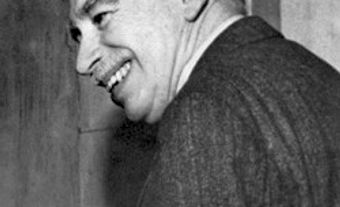
The New Deal was a series of reforms passed by US president Franklin D. Roosevelt in 1933. The New Deal was a progressive political philosophy that catered to the “forgotten man.” During the New Deal era, Keynesian economics became the prevailing ideology. Keynes argued that government spending during economic crises stimulates the economy.
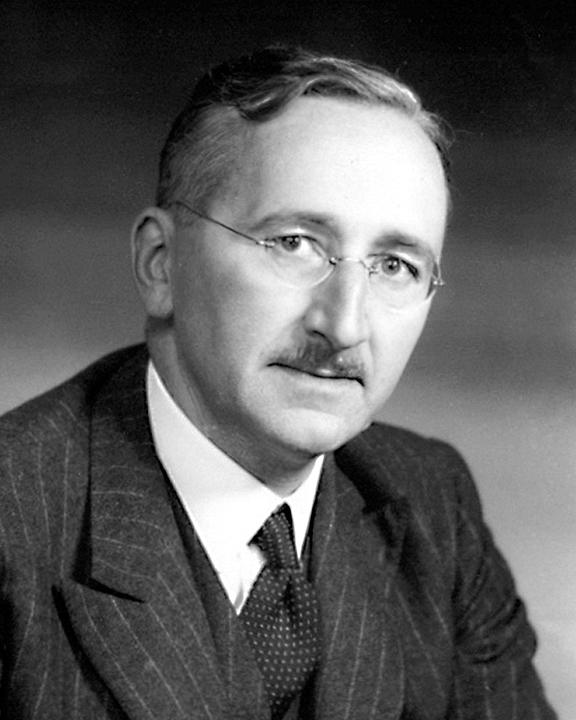
As the Second World War neared its end, the first stirrings of neoliberalism emerged. Austrian economist Friedrich Hayek, who first conceived neoliberalism in 1936, grew concerned about the preservation of “the free society.” In response, he came up with a method to preserve it. Hayek’s The Road to Serfdom (1944) outlines what he saw as the dangers of social democracy. In 1947, Hayek founded the Mont Pelerin Society. This group of 36 intellectuals met on the Swiss Plateau overlooking Lake Geneva to discuss the fate of liberalism. A key member of the Mont Pelerin Society was University of Chicago economist Milton Friedman. He authored numerous works that promoted his neoliberal ideas.
Over the following decades, various think tanks — a new form of political organization made up of businesspeople, journalists and other intellectuals — advocated neoliberalism.
Neoliberal Era
In the 1970s, the New Deal era collapsed. In 1973, the Organization of Petroleum Exporting Countries (OPEC) imposed an oil embargo. This led to a surge in oil prices and global economic instability. Later, the Iranian Revolution of 1979 and the Iran-Iraq War (1980–88) further strained oil prices. Along with these crises came stagflation, an economic condition of both high unemployment and inflation.
The combination of economic hardships, among other events such as Watergate, led to a lack of confidence in the existing system. This allowed neoliberal policy to enter mainstream politics. Foundational neoliberal Hayek maintained his influence, opposing labour unions, among other positions. Friedman gained influence over economic policy as his theory of monetarism was adopted in Britain and the US. (See also Monetary Policy.)
Margaret Thatcher, the first female prime minister of the UK, was elected in 1979. Upon entering office, Thatcher was faced with high unemployment. She combated it with neoliberal policies such as deregulation, union reform and privatization. Ronald Reagan was elected president of the United States in 1980. Reagan was determined to repair free-market policy in America. He implemented policies similar to Thatcher's, such as tax cuts and union-busting.

Brian Mulroney was elected prime minister of Canada in 1984. He introduced various neoliberal policies. Mulroney deregulated the market, reduced government involvement (particularly in the energy sector) and privatized Crown corporations such as Air Canada and Petro-Canada. Mulroney's tax reforms reduced personal and corporate taxes by introducing the Goods and Services Tax (GST) in 1991. Mulroney also dismantled the National Energy Program (NEP), created under Pierre Trudeau. The Western Accord served as the new free-market energy policy, ending protectionism over Canadian oil and gas.
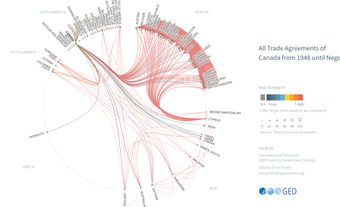
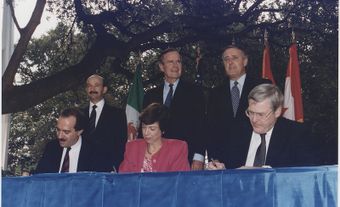
Mulroney and Reagan spearheaded the movement toward globalization with the Canada-US Free Trade Agreement. It was expanded into the North American Free Trade Agreement (NAFTA), which is now the Canada-United States-Mexico Agreement (CUSMA). NAFTA got rid of tariffs and reduced barriers to trade. Other neoliberal policies of the Mulroney era include the creation of the Atlantic Canada Opportunities Agency (ACOA) and the 1985 Atlantic Accord, a plan to gain oil revenue for Newfoundland and Labrador.

The New Washington Consensus
Neoliberalism continued to be the dominant ideology under Canadian prime ministers Jean Chrétien, Paul Martin and Stephen Harper. However, neoliberalism has faced many critiques. The most prevalent concerns wealth distribution. Some believe that the world is richer today than a century ago, with millions worldwide lifted out of poverty. Others believe neoliberalism has increased wealth inequality and led to an erosion of rights.
The shift away from neoliberalism has been multifaceted. Factors have included the global recession of 2008–09, the COVID-19 pandemic, the tenure of anti-globalist Donald Trump as US president, and the economic disruptions from Russia's 2022 invasion of Ukraine and the US and Israel’s war against Iran in 2026.
The new era, called the New Washington Consensus, is a strong shift away from neoliberal policy. The Consensus focuses on protecting domestic economies, green energy, and increased government intervention. For example, the UK has nationalized its train services. President Joe Biden of the US invested trillions into social and climate programs. The European Union (EU) has also led a green transition. Even the International Monetary Fund (IMF), a traditionally free-market group, started the Resilience and Sustainability Trust for those most affected by climate change.
New policies of protectionism and economic nationalism, as well as the expansion of social programs, mark a departure from the neoliberal era toward the New Washington Consensus.