Share on Facebook
 Share on X
 Share by Email
 Share on Google Classroom
Lampreys are a group of primitive vertebrates which, together with hagfish and various extinct forms, comprise the fish class Agnatha. Lampreys occur in both the northern and southern hemispheres. About 41 extant species are known, as well as fossil forms dating from the Mississippian and Pennsylvanian (353–300 million years ago) in the US. Twenty-three species are found in North America, of which 21 are indigenous. Eleven species occur in Canada.

Description
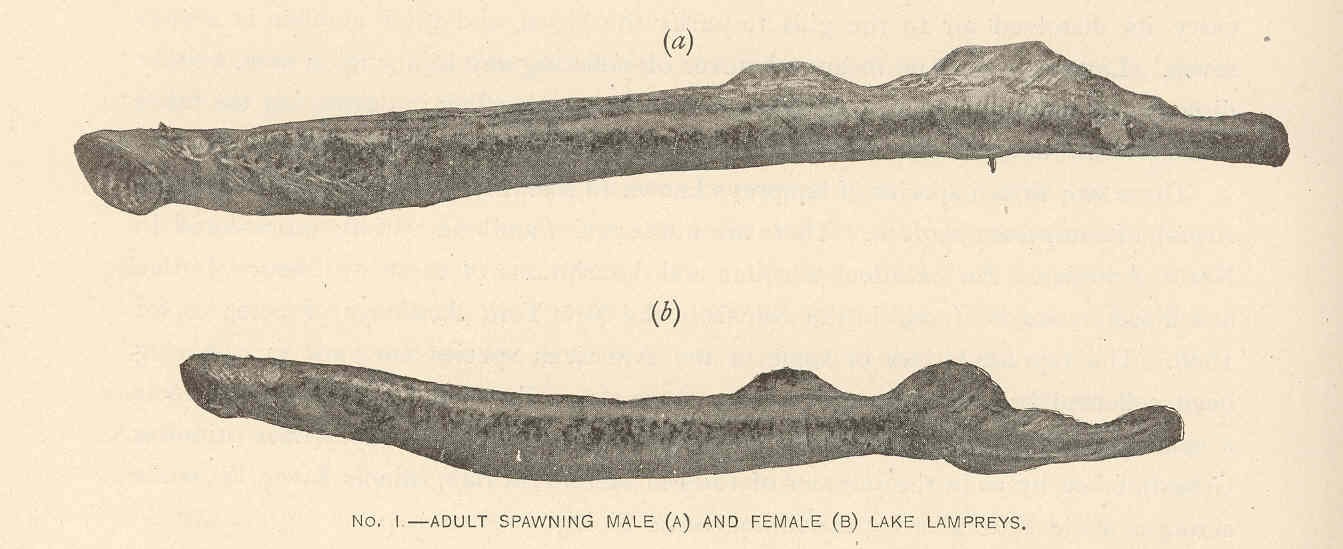
Lampreys have a cartilaginous skeleton and an eel-like body form. They lack scales and paired fins, but have one or two dorsal fins. Seven external gill openings appear on each side of the body, near the head.
Ammocoete
Development begins with a larval stage, the wormlike ammocoete, which has a life span longer than that of the adult. The ammocoete has a broad, hoodlike structure overhanging the mouth. Its principal food is microscopic algae. Eyes are rudimentary and hidden under the skin. For respiration and feeding, water enters the mouth and is extruded through the gill openings. At the onset of metamorphosis, the ammocoete shrinks in length.
Adults
In adults, water for respiration enters and exits only through the gill openings. Metamorphosed individuals acquire a sucking disc with horny teeth. They may be nonparasitic, lacking a functional intestine and not feeding after completion of metamorphosis; or parasitic, retaining a functional intestine and feeding primarily on the blood and body fluids of fish. Of the 37 northern hemisphere species, about 15 are parasitic. Nonparasitic species are confined to freshwater habitats. Although adults of certain species can live in salt water, all species spawn only in fresh water in specially prepared nests, and die shortly after. Before spawning, mature males and females shrink in length. Eggs are small (1 mm diameter); 1,000–260,000 may be laid, depending on the length of the female.

Biological Importance
Three North American species of lamprey are very destructive to fisheries: Atlantic sea lamprey (Petromyzon marinus), 900 mm maximum length, spends some time in the Atlantic and becomes landlocked in the Great Lakes; Pacific lamprey (Entosphenus tridentatus), 690 mm maximum length, found in the west; and arctic lamprey (Lethenteron japonicum), 625 mm maximum length, of arctic regions of North America and Eurasia. These species attack other fish, attaching themselves by their oral discs and sucking the blood and flesh of the host.
In the Great Lakes, the Atlantic sea lamprey contributed to the decline of the lake trout and other fishes. The species always lived in Lake Ontario, but was first found in Lake Erie in 1921, apparently having passed through the Welland Canal, and was established in the Great Lakes by 1940. The Canadian and American governments have instituted a program to reduce the population. Although Lampetra fluviatilis is considered a delicacy in Europe, lampreys are little eaten in North America, except by the Indigenous people of the West Coast.
Did you know?
The Cowichan Lake Lamprey (Entosphenus macrostomus, previously Lampetra macrostoma), also known as the Vancouver lamprey, is an eel-like, jawless, parasitic fish that can only be found in the Cowichan Valley watershed in southern Vancouver Island, British Columbia. This unique fish can reach nearly 30 cm in length and feeds exclusively on other fish. Like all other lampreys, the Vancouver lamprey is semelparous, meaning it can only breed once in its lifetime. This species is currently categorized as Threatened under the Species at Risk Act. Anthropogenic changes to their habitat and prey base, as well as water quality degradation, are the main drivers of their decline.