Share on Facebook
 Share on X
 Share by Email
 Share on Google Classroom
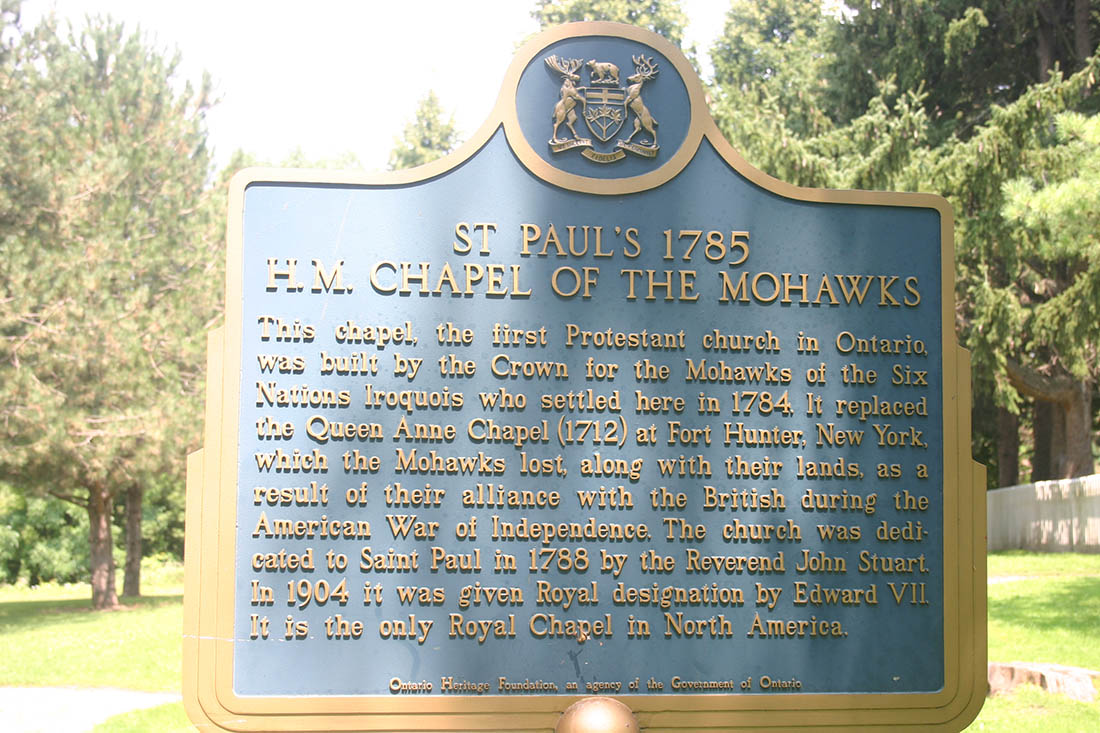
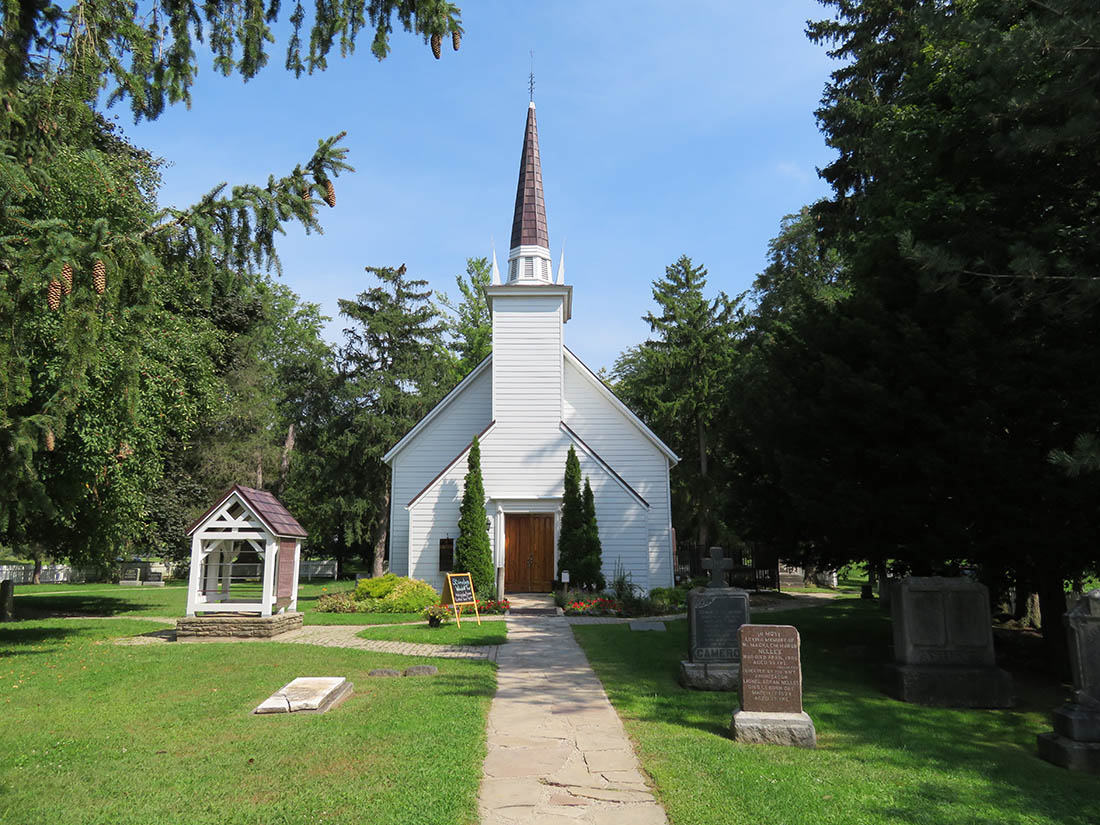
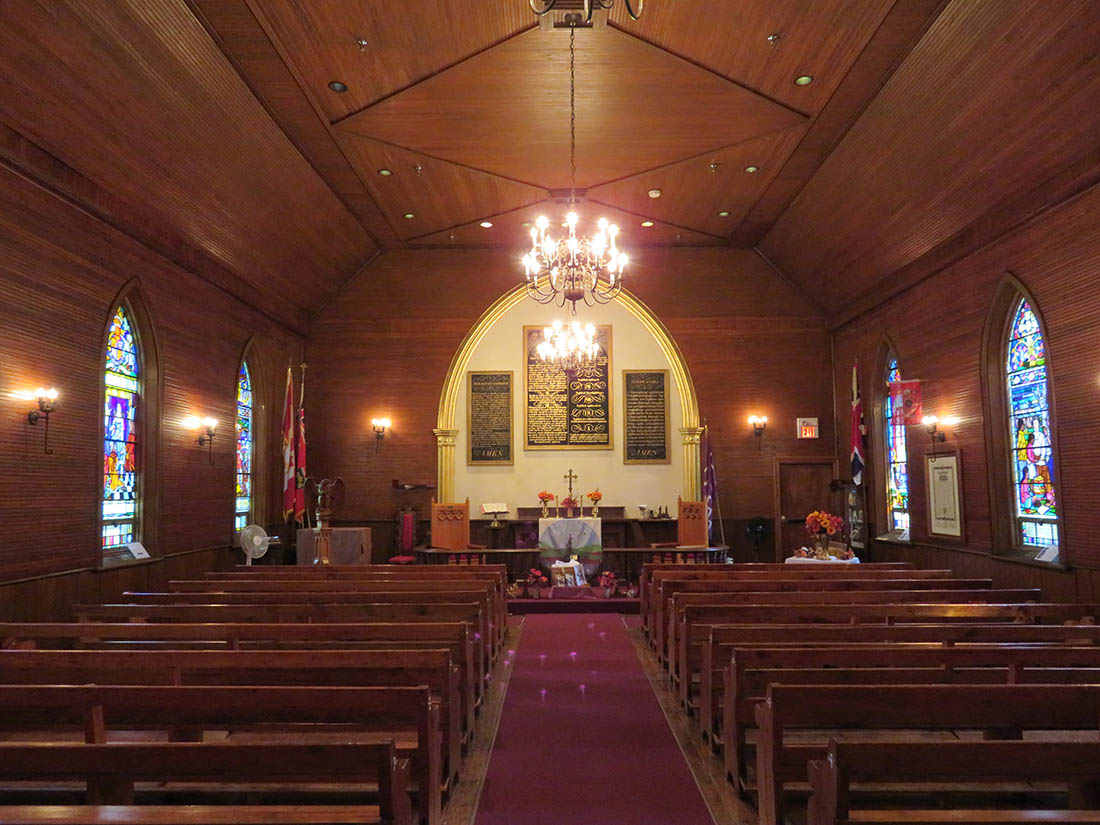
His Majesty’s Royal Chapel of the Mohawks is the oldest-standing church in Ontario. Now a part of the Anglican Church of Canada and the Six Nations of the Grand River’s Tourism Department, the chapel is located in the original location of the Kanyen’kehá:ka (Mohawk) village on the north side of the Grand River, near Brantford, Ontario. It houses at least four historic communion items and a Bible presented by Queen Anne to the Kanyen’kehá:ka in 1712 at their original church at Fort Hunter in the Mohawk Valley, New York. In 1830, the Bishop of Quebec consecrated the chapel as the Mohawk Church. In 1904, King Edward VII designated it a Royal Chapel. The chapel was renamed His Majesty’s Chapel of the Mohawks, highlighting the relationship between the Kanyen’kehá:ka and the Crown. Fires destroyed portions of the chapel in 1975, 1976 and 1994, believed to be deliberately set.
Early History
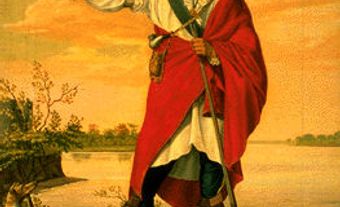
After the American Revolution in 1783, the British Crown commissioned and funded the construction of the Chapel of the Mohawks as a political gesture and gift to the Kanyen’kehá:ka for their alliance during the war. In 1785, Captain and Chief Joseph Brant (Thayendanegea) invited loyalists John Smith and John Thomas, to follow the Kanyen’kehá:ka to the Grand River. Smith and Thomas were compensated to construct St. Paul’s Chapel of the Mohawks on the north bank of the Grand River in present-day Ontario. The chapel was located in the first Kanyen’kehá:ka village, also on the north side of the Grand River, following the Haldimand Proclamation. The timbers were cut in Paris, Ontario and floated down the Grand River. The original siding was sawn by hand, and even the nails were handmade. The front entrance faced the Grand River, which was the main traffic route of that era. The bell of the chapel was cast in London, England, in 1786. It was the first bell to ring in Upper Canada. The chapel houses important historical communion items. The items were buried during the American Revolution to prevent looting and were later recovered. Four of the seven items and the Bible gifted by Queen Anne were brought to the chapel, with the remainder being sent to the Mohawks of the Bay of Quinte (Tyendinaga Mohawk Territory).
Missionary History and the Mohawk Institution
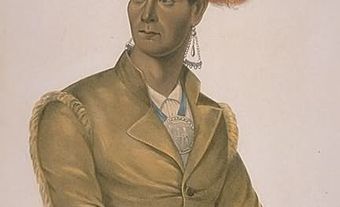
Chief Joseph Brant’s son, Lieutenant and Chief John Brant (Ahyonwaeghs), was recognized as a “sort of lay-agent” by the Society for the Propagation of the Gospel in New England and Parts Adjacent (SPGNE), a Puritan missionary society. The SPGNE reported John Brant aided them in missionary efforts among First Nations people. John Brant served as the first First Nations person appointed by the colonial government to the post of Superintendent of Six Nations. In 1788, Reverend Stuart visited the Kanyen’kehá:ka near Oswego on the Grand River, where they had a wooden chapel attended by itinerant missionaries under the jurisdiction of the Bishop of Quebec. Funding was provided by the Society for the Propagation of the Gospel in Foreign Parts (SPG), the missionary arm of the Church of England as well as the Six Nations. According to the SPG and SPGNE, Brant requested that the SPG continue to sponsor Stuart’s itinerant work as well as that of other clergy.
By 1827, the SPGNE was contributing financially toward the affairs of the chapel. The SPGNE provided for and paid the salary and benefits of a resident clergyman, Reverend Robert Lugger. The SPG permitted his occupancy in the parsonage and the SPGNE finished paying for constructing it. Lugger’s approach to education emphasized using former students to teach others in the community, a method found in the monitorial system of education, a derivative of the Bell-Lancaster method. He combined this method with spiritual conversion aimed at replacing Haudenosaunee values with Christian ones. He did this while initially being tasked by the SPGNE with creating a Kanyen’kéha (Mohawk language) grammar book. The chapel was integrated into the evolving Mohawk Institution, which by 1870 included the Mohawk Institute (an Indian residential school), the chapel, a playhouse, a parsonage and numerous outbuildings, including farm buildings and, at one point, a neighbouring farm. The Mohawk Institution was situated within the Mohawk Station, which was within a larger Grand River Station that included additional sub-stations at Tuscarora, Cayuga, and “Kanyeageh” or “Kanyenga” (previously known as Salt Springs, but now known as Sour Springs).
In 1837, Reverend Abraham Nelles, who previously supported Lugger at the Tuscarora station, was appointed to the chapel. While employed at the Church in the Tuscarora station, Nelles was paid by the SPG; however, that affiliation ended when he moved to the chapel, which the SPGNE funded. In addition to being resident clergy at the chapel, Nelles also assumed jurisdiction of the Mohawk Institute until his retirement from the school in 1872. Despite retiring from the institute, Nelles retained the rectorship of the chapel and received a new appointment as Archdeacon of Brant. Reverend Robert Ashton, and his wife, Alice, arrived in 1872. They assumed responsibility for the institute and, after Nelles died in 1884, Ashton was appointed to the position at the chapel as well. Ashton had control of the entire education of all First Nations children along the Grand River.
Ashton installed his son, Abraham Nelles Ashton, as principal of the Mohawk Institute in 1911. When Nelles Ashton departed the Mohawk Institute in 1914, following the judgment in Miller v. Nelles Ashton, Ashton departed the chapel too. Reverend Cyril Turnell assumed control of both the chapel and the Mohawk Institute in 1915. The SPGNE, however, terminated Turnell in 1917 in stark contrast to the wishes of the federal government. Between 1917 and 1919, the chapel had no incumbent. Howard W. Snell was appointed in 1919.
After Snell left the position in 1945, Reverend Canon W.J. Zimmerman was appointed to lead both the chapel and Mohawk Institute. He served as principal until the institute’s closure on 27 June 1970, and at the chapel until his retirement in 1981. He died in 1982.
Incumbents following Zimmerman include Reverend John Stables (1982–99), Reverend Norm Casey (2000–03), Reverend Larry Brown (2004–16) and Reverend Roselyn Elm (2017–present).
Memorial and Legacy
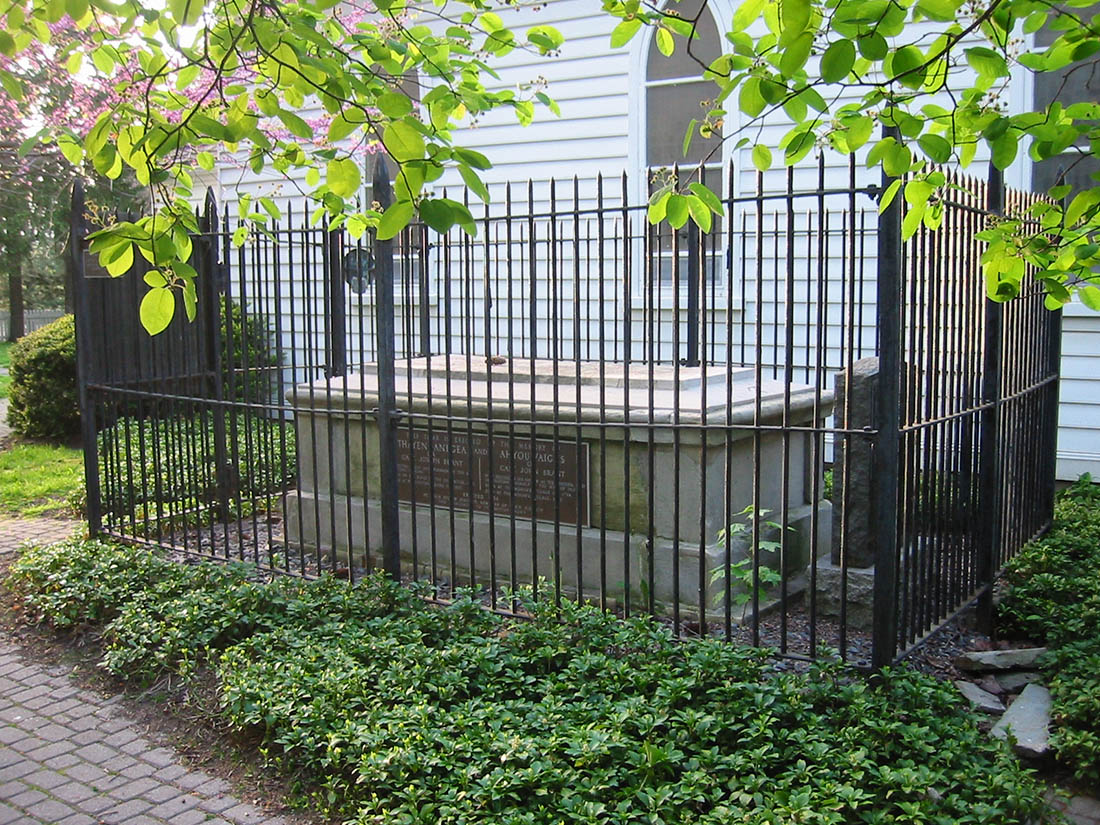
Captain and Chief Joseph Brant and his son, Lieutenant and Chief John Brant, are both interred in the cemetery at the chapel. A boulder sits in memory of Pauline E. Johnson, poet and daughter of Chief George Johnson. In addition, Reverends Nelles and Ashton and some of their relatives are interred at the chapel. The chapel is a component of Six Nations of the Grand River Tourism Department. Within the community of Six Nations of the Grand River, some continue to practise the Anglican version of the Christian faith.