Share on Facebook
 Share on X
 Share by Email
 Share on Google Classroom
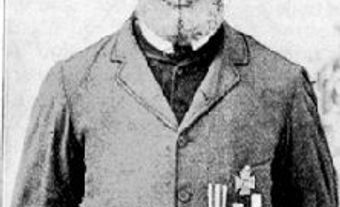
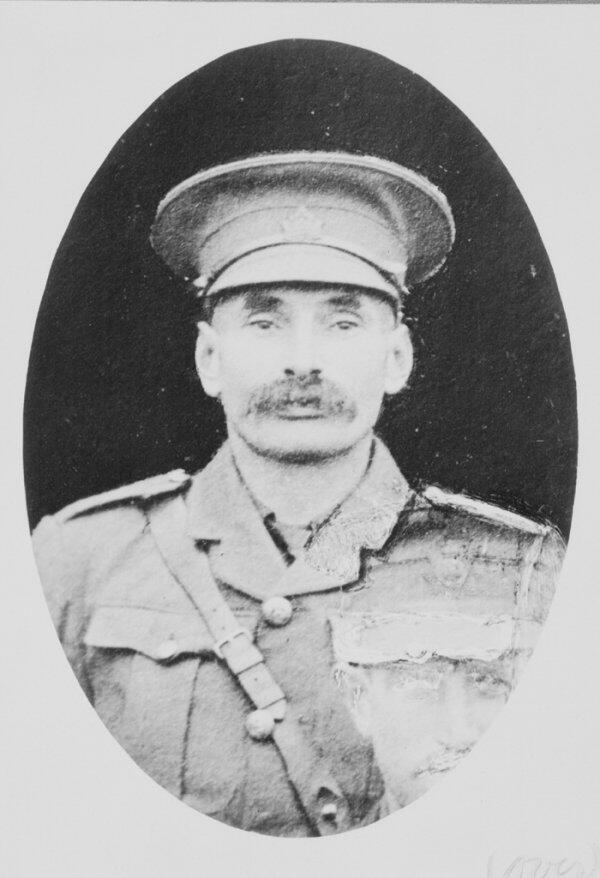
Frederick William Campbell, VC, farmer, soldier (born 15 June 1867 in Mount Forest, ON; died 19 June 1915 in Boulogne, France). A long-time militiaman, Campbell served during the South African War and the First World War. He specialized in machine guns and was recognized for his bravery during both conflicts.
Early Life and Education
Frederick Campbell was the son of Ephraim Brock and Esther (née Hunt) Campbell. Shortly after his birth, the family moved to a nearby farm. Campbell attended school in Mount Forest. In 1900, he bought a farm next to his father’s and raised horses. Three years later, he married Margaret Annie MacGillivray; they had three children.
Military Service
Frederick Campbell joined a local militia unit, the 30th Wellington Battalion of Rifles, in 1885. Around 1894, he became a member of 5 Company, 13th Battalion Volunteer Militia (Infantry) in London, Ontario.
Campbell joined the 2nd (Special Service) Battalion, Royal Canadian Regiment of Infantry on 23 October 1899 for service in the South African War. He became a member of a Maxim machine-gun section.
During an engagement at the Modder River, some of the spokes on a wheel of Campbell’s machine-gun carriage were shot off. He quickly replaced the missing spokes with legs from a table in a nearby abandoned house. Campbell was Mentioned in Dispatches for this action and was promoted to sergeant.
Campbell was discharged on 5 November 1900, after his return to Canada. He received the Queen’s South Africa Medal with four clasps. Campbell also remained in the militia; he was commissioned as a lieutenant in 1902 and later promoted to captain.
First World War
Frederick Campbell joined the Canadian Expeditionary Force (CEF) at Camp Valcartier, Quebec, as a lieutenant on 23 September 1914. At Valcartier, he was assigned to the 1st Battalion, which was composed of recruits from western Ontario.
Campbell falsified his age to enlist in the CEF, which had an upper limit of 45. He declared a birthdate of 15 June 1869 on his attestation paper, although it is obvious from other documents that he was born two years earlier.
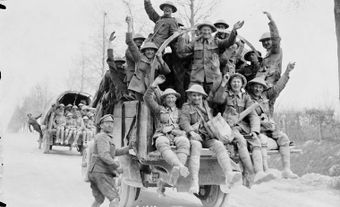
Campbell sailed to Britain with the First Canadian Contingent and arrived on 18 October. The Canadians spent a hard winter on Salisbury Plain, where they conducted basic training under terrible conditions. They lived in tents, which provided little protection from the cold, rain and mud. Sickness was rampant.
Ypres Salient
Frederick Campbell was put in charge of a machine-gun section and sailed to France on 8 February 1915. On arrival, the Canadians, now organized into a division, moved into reserve near the Belgian border. The Canadians then relieved a British division along 5,800 metres of trenches from 1 to 3 March. In April, the Canadians moved into the front lines in Belgium’s Ypres Salient.
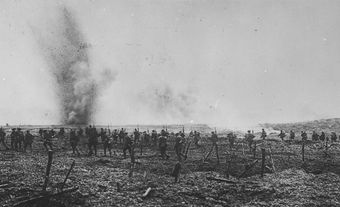
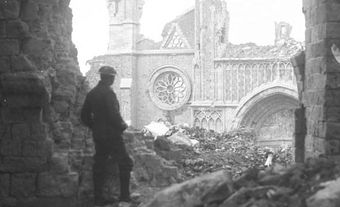
Campbell’s first engagement of the war was the German attack on the Ypres Salient on 22 April, which was the first use of poison gas on the Western Front. The untried Canadians held firm while other soldiers fled in terror.
A second gas attack on 24 April opened gaps and pushed some Canadian units back but did not break them. The next day British and French reinforcements arrived and relieved the Canadian Division. (See Canada and the Second Battle of Ypres.)
Givenchy
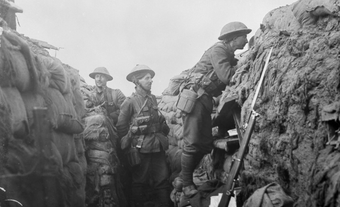
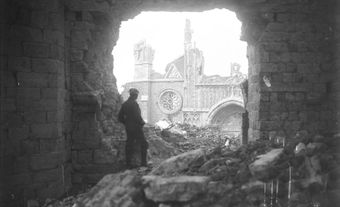
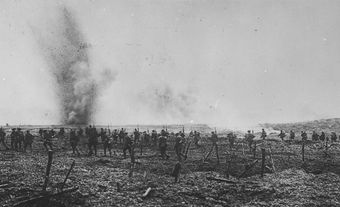
In June 1915, Frederick Campbell fought in a battle near the French village of Givenchy-lès-la-Bassée. By now, the Western Front was deadlocked by the trench warfare that became symbolic of the war. Thousands of lives were lost in attempts to gain a few metres of ground that were heavily defended by lines of trenches, barbed wire, machine guns and artillery.
At Givenchy, the Canadians were ordered to form a protective flank for two British divisions attacking the German lines. They could not do so, however, without breaking through the German line themselves. General E.A.H. Alderson therefore ordered the Canadians to capture two German strong points (H2 and H3).
Campbell and his 1st Battalion were assigned the task of capturing them. On 15 June (his 48th birthday), the battalion’s four companies attacked under a covering artillery barrage and occupied the German front lines by 6:10 a.m. They had not captured position H3, however, and German fire was taking a heavy toll on the Canadians.
By now, one of Campbell’s two machine gun crews had been wiped out, but he succeeded in getting his other machine gun into the German first line trenches. Unfortunately, the weapon’s tripod had been destroyed, so Private Harold Vincent volunteered to support the gun on his back. The two held on, despite heavy enemy fire and grenades.
Somehow, Campbell and Vincent managed to move forward to an even more exposed position. From there, Campbell fired another 1,000 rounds and succeeded in holding back a German counterattack. Then he was hit and his right thigh bone shattered.
Campbell crawled back to his lines and was rescued. Vincent managed to save the machine gun and made it back as well, but he was badly burned by the weapon. Campbell was taken to a casualty clearing station and transferred to No. 7 Stationary Hospital at Boulogne on 17 June. He was operated on, but infection set in and he lapsed into a coma. Campbell died on 19 June and was buried in Boulogne Eastern Cemetery.
Campbell was awarded a posthumous VC for his valour at Givenchy. It was presented to his widow in Mount Forest. On 15 January 1916, Campbell was posthumously promoted to temporary captain, backdated to 23 April 1915. His VC and other medals were eventually acquired by British collector Lord Ashcroft, and today they form part of his VC collection at the Imperial War Museum in London.
Memory
The Elementary School at Canadian Forces Base Borden, which opened in 1956, was named after Frederick Campbell. When the school closed in 2010, its plaque, inscribed “Édifice Frederick Campell VC Building,” was presented to Royal Canadian Legion Branch 134 in Mount Forest in 2015 and attached to the building. The branch was named after Campbell and has an historical marker in his honour, erected by the Archaeological and Historic Sites Board of Ontario.