Share on Facebook
 Share on X
 Share by Email
 Share on Google Classroom
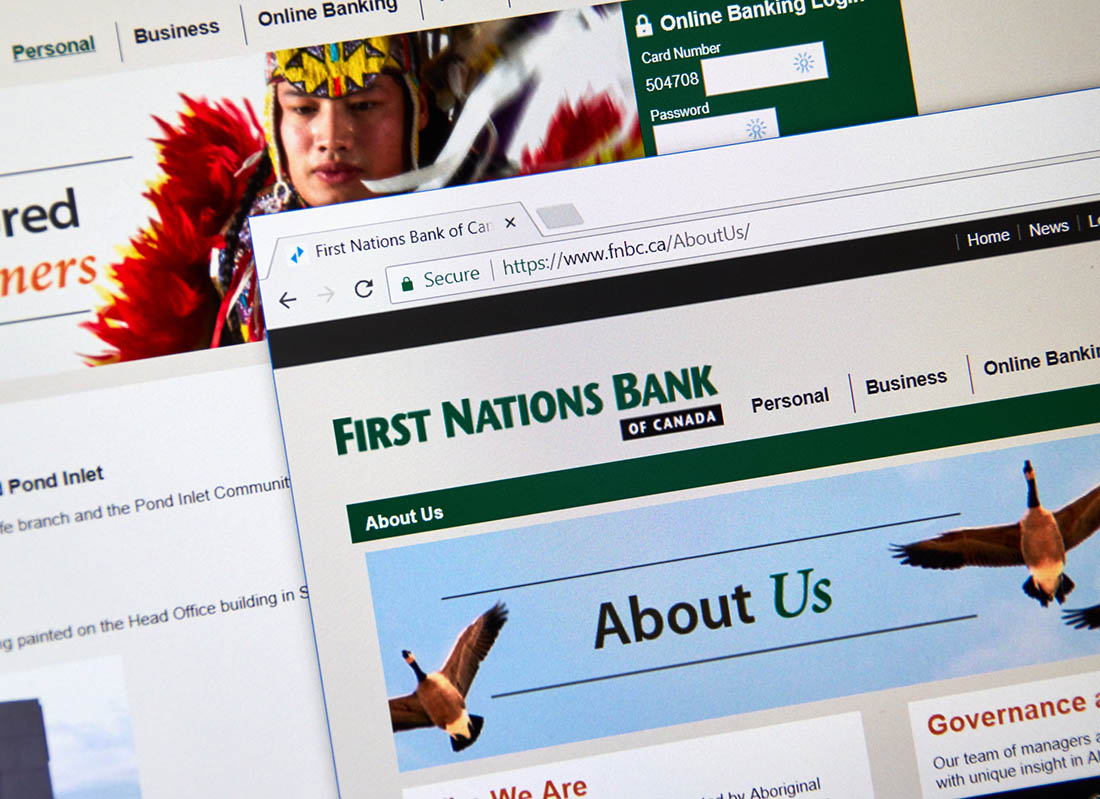
First Nations Bank of Canada (FNBC) is a Canadian chartered bank. Established in 1996 as a partnership between Saskatchewan Indian Equity Foundation (SIEF)—now Saskatchewan Indigenous Enterprise Foundation—and TD Bank, it is currently majority controlled by Indigenous shareholders. According to its mission statement, FNBC “exists to advance Indigenous prosperity and self-determination by delivering trusted, purpose-driven financial services, rooted in relationship, guided by culture and committed to long-term economic reconciliation.” (See also Reconciliation in Canada; Economic Conditions of Indigenous Peoples in Canada.)
Origins
Historically, under the Indian Act, reserve land was held in trust by the federal government, meaning that financial institutions could not accept any reserve land as collateral, which caused band councils to become loan guarantors. (See also First Nation Bands in Canada.) Established banks showed little interest in providing loans due to the risk calculations involved.
In 1993, the board of directors for SIEF (which had been established in 1982 as Canada’s first Indigenous capital corporation) wanted to create an entity that would allow Indigenous-based financial services to expand beyond lending. Developing a “national Aboriginal development bank” was also among the recommendations of the Royal Commission on Aboriginal Peoples, which delivered its final report in 1996. When potential partners were sought, only Credit Union Central of Saskatchewan (now SaskCentral) and TD submitted proposals. A partnership developed with TD, as it viewed Indigenous banking as a potential growth sector for financial management.
FNBC Launches
FNBC was officially launched in December 1996. Initial plans called for it to service loans for Indigenous businesses and band councils. (See also First Nation Bands in Canada.) TD provided $8 million in startup funding and technical expertise, while SIEF contributed $2 million. For the first decade of its operation, TD would own nearly 89 per cent of FNBC voting shares. Customers would be able to access their FNBC accounts via any TD branch. The bank would be headquartered in Saskatoon, with Keith Martell as its first chief executive officer.
The bank’s ceremonial launch took place in Toronto on 9 December 1996. Prime Minister Jean Chrétien observed that FNBC would help Indigenous peoples “run their own show.” Assembly of First Nations national chief Ovide Mercredi declined to attend due to his disagreements at the time with several Saskatchewan chiefs who supported the bank. Blaine Favel, grand chief of the Federation of Saskatchewan Indian Nations (now Federation of Sovereign Indigenous Nations), presented TD chairman Richard Thomson with a symbolic dreamcatcher. “The road to political self-determination, the road to self-government, is directly linked to the role of economic development,” said Favel. “If we are to have strong self-government, if we are to have a strong political direction, we have to have a strong economic base.” (See also Indigenous Self-Government in Canada; Economic Conditions of Indigenous Peoples in Canada.)
FNBC’s first branch opened at its Saskatoon headquarters on 23 September 1997.
First Nations Bank of Canada
A First Nations Bank of Canada building in Saskatoon, Saskatchewan, 26 April 2024.
(photographer Heywood Yu/Bloomberg via Getty Images)
Indigenous Ownership
As scheduled, TD reduced its voting shares in the bank from approximately 89 per cent to nine per cent in 2007, though the banks continued to have a business relationship. As of December 2025, FNBC was 90 per cent Indigenous owned and controlled, through a consortium of Indigenous entities.
When asked by the Toronto Star in 2021 how FNBC differed from Canada’s Big Five banks, Keith Martell noted that 90 per cent of its business involved Indigenous clients. “We’re not doing it for public relations, we’re not doing it for ESG (environmental, social and governance) credits, we’re doing it because it’s the business we’re in. Our ownership is from the communities where we bank.”
By the 2020s, FNBC operated community banking centres and kiosks in remote communities as small as 1,500 people, as Internet service in these areas was often slow, which caused banking apps to time out before customers could finish their transactions. As of 2026, FNBC operates 22 branches in Alberta, Manitoba, Yukon, Northwest Territories, Ontario, Quebec and Nunavut, as well as ATM access via numerous banks and credit unions across Canada.
21st Century
In 2020, the bank launched its FNB Trust subsidiary, which specializes in institutional trusts of $10 million or more.
In March 2024, the Canada Infrastructure Bank signed a $100-million agreement with FNBC to help Indigenous communities borrow money for infrastructural use.
In June 2025, FNBC and the Business Development Bank of Canada announced a $100-million initiative that would increase business acquisitions by Indigenous communities and economic development agencies. The move was made to take advantage of a predicted increase in the number of entrepreneurs looking to retire and sell their businesses. A press release promoted this deal as being a “model of economic reconciliation.” (See also Reconciliation in Canada.)
In October 2025, following the failure to submit suspicious transaction reports to the federal anti-money laundering and anti-terrorist financing watchdog, it was announced that FNBC was levied with a $601,139.80 penalty in September 2025 by the Financial Transactions and Reports Analysis Centre of Canada (FINTRAC). The bank hired a chief compliance officer to oversee the implementation of proper procedures.
Leadership
Bill Lomax
Bill Lomax, president and chief executive officer of First Nations Bank of Canada, 3 November 2025.
(photographer Chloe Ellingson/Bloomberg via Getty Images)
In February 2023, FNBC announced that Keith Martell, who served as chief executive officer since 1996, would retire and be replaced by William (Bill) Lomax in May. The board of directors hoped that a change in leadership would help propel moves to raise the bank’s national presence.
In a November 2025 interview with the Globe and Mail, Lomax noted that “one of our tag lines is that we do the economic part of reconciliation, the financial part of nation-building. And that is a critical part. It’s not the only part; it’s one piece of the puzzle. But if you don’t have finances, you don’t have money. You can’t pay for language revitalization. You can’t pay for drug and alcohol programs. You can’t pay for scholarships. You can’t provide jobs that keep people in the community.” (See also Reconciliation in Canada; Economic Conditions of Indigenous Peoples in Canada.)