Share on Facebook
 Share on X
 Share by Email
 Share on Google Classroom
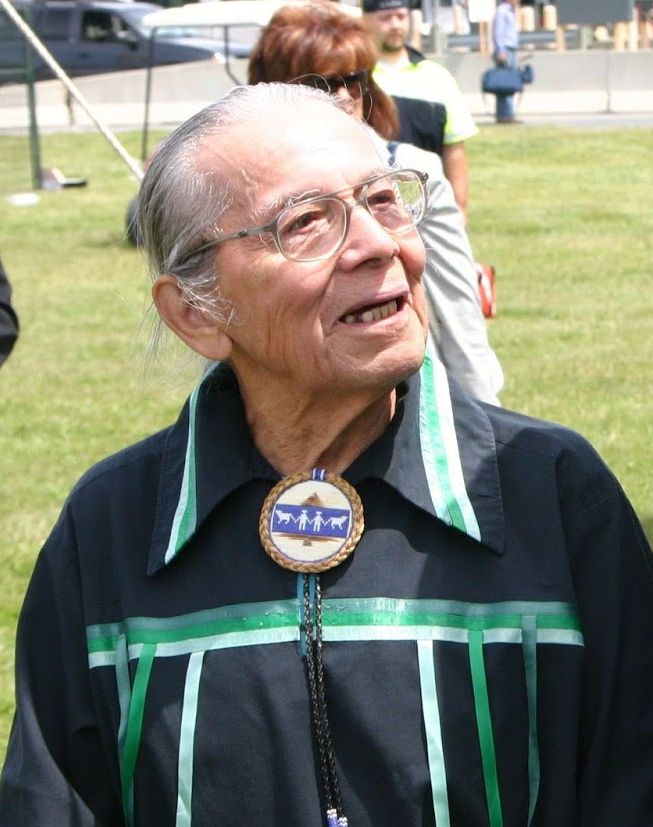
Ernest M. Kaientaronkwen Benedict, Kanyen’kehá:ka (Mohawk) educator, activist, chief (born 14 July 1918 in Hogansburg, NY; died 8 January 2011 in Cornwall, ON). Elder Ernest Benedict was renowned for a lifetime of advancing Indigenous sovereignty, cultural preservation and Indigenous-controlled education. He did this through various initiatives he started or supported.
Personal Life and Education
Elder Ernest Kaientaronkwen Benedict was the son of Charles and Julia Jandreau Benedict. He was born in Hogansburg, New York, a community in the town of Bombay on the St. Regis Mohawk Reservation, also known as Akwesasne. He completed his primary education at schools on the St. Regis Mohawk Reservation and graduated from Massena High School. Benedict attended Syracuse University and graduated from St. Lawrence University in Canton, New York, with a Bachelor of Arts degree in sociology in 1940.
On 20 September 1952, Benedict married Florence Hopps in Massena, New York. Together, they went on to have four children. Florence became a renowned Kanyen’kehá:ka basket maker and is considered a master of this art form. Several museums and galleries across North America have collected her fine works of art.
Benedict served as chief of the Mohawk Council from the 1950s through the 1970s. He also served as a grand chief of the Akwesasne Council during that time.
Activism
During the Second World War, Elder Ernest Kaientaronkwen Benedict used Haudenosaunee treaties as an argument to oppose the draft and was jailed as a result. When he succeeded in obtaining his release, he voluntarily joined the army, not as an American subject, but as an ally. He served as a radioman at the rank of technician fourth grade in the U.S. Army Signal Corps in the Pacific theatre.
In 1969, the Indian Film Crew (IFC) of the National Film Board produced a 36-minute documentary titled You Are on Indian Land. The film documents the protests of the Mohawks of Akwesasne, which straddles the Canada-U.S. border, when Canadian authorities prohibited the duty-free cross-border passage of personal purchases, a right established by the Jay Treaty of 1794. Benedict features in the film as a rational voice for his people.
You Are on Indian Land, Michael Kanentakeron Mitchell, provided by the National Film Board of Canada
Benedict also worked with Indigenous prison inmates, on drug and alcohol prevention and in Friendship Centres, among other efforts. His efforts rose to the international level when he presented an eagle feather to Pope John Paul II on behalf of Indigenous peoples in Canada on 15 September 1984 at the shrine of Sainte-Marie Among the Hurons.
Media
Elder Ernest Kaientaronkwen Benedict founded two community newspapers in Akwesasne. The War Whoop was the community’s first newspaper and ran from 1939 to 1941. Benedict was also a main creator of the journal Akwesasne Notes in 1968, perhaps the most influential publication in Indigenous history. For an entire generation, it was the most reliable and powerful Indigenous newspaper in North America. Akwesasne Notes established the means to exchange information, which in turn sparked the growth of a large network of Indigenous writers, journalists and community activists.
Teaching Career
Elder Ernest Kaientaronkwen Benedict began gathering information about North American Indigenous history and cultures through curriculum materials, visual aids, books and artifacts. At the time, this method was considered revolutionary and unique. It contributed to an educational system that had no Indigenous studies programs, cultural inclusion units or Indigenous input into the curriculum. Later, Benedict helped to develop the Indian Way School and the concept of Indigenous control of Indigenous education.
Benedict was dedicated to traditional teachings and education for the future well-being of all Indigenous peoples. He firmly believed in the power of teaching to dispel the misconceptions of colonial-led history.
In 1968, the IFC produced a nine-minute documentary titled Travelling College to show to fellow Indigenous peoples across North America. In it, Benedict speaks about a proposed travelling college he intended to establish to teach Indigenous students subjects in which they were interested.
The next year, Benedict started the North American Indian Traveling College (today the Native North American Traveling College) along with Michael Kanentakeron Mitchell, dedicated to preserving and maintaining Kanyen’kéha (Mohawk language), culture and history. The pair travelled between Indigenous communities in a van filled with resources to educate people on what it meant to be Indigenous.
Travelling College, Indian Film Crew, provided by the National Film Board of Canada
In 1974, the college established a permanent home in a building on a 1.21-hectare waterfront site on Cornwall Island in Akwesasne. Today, the college is a cultural hub that includes a museum, art gallery, gift shop and outdoor performance spaces.
Benedict went on to become a lecturer and professor at Trent University, Loyalist College, University of Ottawa, Carleton University, McGill University, Concordia University and his alma mater, St. Lawrence University.
Honours and Awards
- Canadian National Aboriginal Achievement Award (now Indspire Award) (1994)
- Honorary Doctor of Laws – Trent University (1994)
- Indspire Award in Education (1995)
- Akwesasne Achievement Award (2005)
- Lawrence University Sol Feinstone Award
- Trent University Ernest and Florence Benedict Gathering Space