Share on Facebook
 Share on X
 Share by Email
 Share on Google Classroom
Species at risk are species, subspecies or populations of animals, plants or fungi that are broadly considered to be in decline. In most cases, if the decline is not addressed, these species could be at risk of extinction. Canada is home to many species at risk, whether globally, nationally or locally (see Environmental Movements in Canada). Many pieces of legislation aim to prevent the decline or extinction of wild species in Canada, most notably the federal Species at Risk Act. Every province and territory also has its own regionally specific legislature.
Key Terms
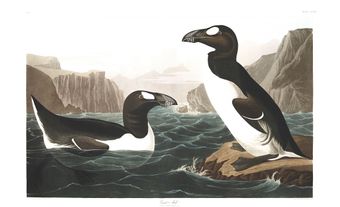
Extinct – All members of this species, subspecies or population have died, and recovery is not feasible. This may refer to long-gone species (e.g., Tyrannosaurus rex) or ones that have disappeared within recent history (e.g., sea mink and great auk). The extinction of one species can often lead to the decline or even extinction of others that rely on it, and the eventual collapse of ecosystems.
Extirpated – Local extinction. The species may still be present elsewhere, but has become locally extinct.

Why Is There Species at Risk Legislation?
Species at risk legislation aims to prevent the extinction and decline of wild species. Given that human activity is one of the leading drivers of wildlife population declines and species extinctions, regulation and legislation are often needed to slow or prevent this decline.
Maintaining healthy biodiversity is one of the key ways of preventing species loss, with countless species acting as keystone species; without them, entire ecosystems can collapse. This damage is often permanent with potential social and economic costs. For example, the now-extinct passenger pigeon influenced the species composition of forests in Eastern Canada. They were also a staple food for many Indigenous peoples. The loss of this species is thought to have played a key role in the decline of several oak species, including white oak, burr oak and black oak. Additionally, many organisms provide humans with key ecological services. Notably, according to the World Health Organization, over 75 per cent of food crops rely on pollination, 50 per cent of modern medicines are derived from natural sources, and 75 per cent of global freshwater sources originate from healthy ecosystems.
The decline of wild populations and biodiversity makes natural ecosystems less resilient, impacting human health, the economy, and many leading employment sectors (e.g., agriculture, forestry and tourism).
Global Organizations
While there is no legally binding international species-at-risk legislation, various organizations assess the status of wildlife globally. Given that most species occur in more than one country, are not necessarily hindered by political borders, and may make annual or lifetime migrations across multiple countries, the global assessment of a species' status is critical for informing countries and local organizations.
One of the best-known organizations assessing the global status of wild species is the International Union for Conservation of Nature (IUCN). Established in 1964, their Red List of Threatened Species aims to assess the conservation status of as many wild animals, plants and fungi as possible. To date, the IUCN has comprehensively assessed most species of mammals, amphibians, birds, freshwater fish, reef-building corals and trees. This organization also aims to continually reassess species to ensure up-to-date information on the status of wildlife. The IUCN categorizes species into the following classifications: data deficient, least concern, near threatened, vulnerable, endangered, critically endangered, extinct in the wild, extinct and not evaluated.
The United Nations also provides various recommendations. Signed by 150 countries, including Canada, the UN Convention on Biological Diversity (1992) was one of the launching points for modern species-at-risk legislation in Canada.

National Legislation
Several pieces of legislation and organizations are focused on assessing the status of species within Canada, as well as on enforcing laws to preserve declining species.
Some of the best-known pieces of legislation that aim to preserve species at risk are the Species at Risk Act (SARA), the Fisheries Act, the Migratory Birds Convention Act, 1994, the Canada Wildlife Act, the Oceans Act (see Marine Protected Areas of Canada), the Canada National Marine Conservation Areas Act (see National Marine Conservation Areas of Canada), and the Canada National Parks Act (see National Parks of Canada). SARA is generally the most widely known.
Species at Risk Act (SARA)
In 2002, the federal government adopted the Species at Risk Act (SARA) with the aim of preventing wildlife species in Canada from disappearing. To do this, recovery plans must be created for wild species that are extirpated, endangered or threatened as a result of human activity, and species listed as “of special concern” must be managed so that they do not become endangered or threatened. For this purpose, a series of measures were put into place, establishing how governments, organizations and individuals must work to aid in the protection and recovery of species. Some other measures also focus on sanctions for offences under SARA.
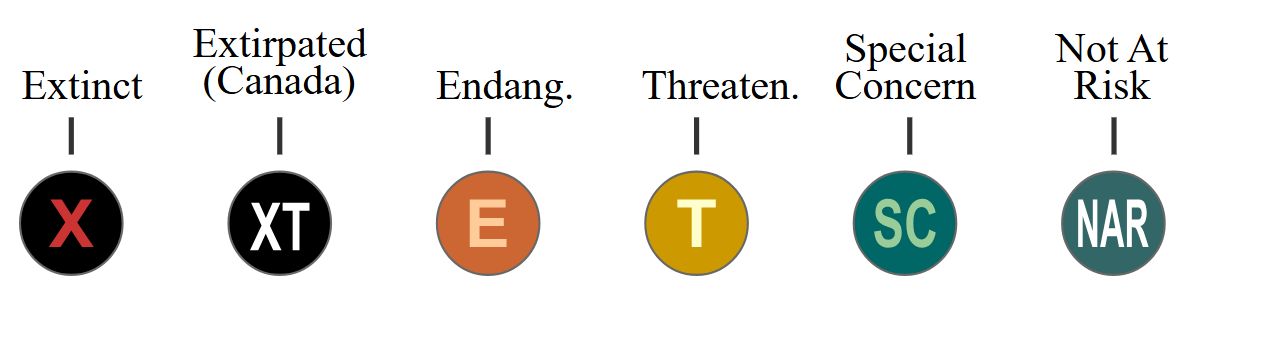
Under the Species at Risk Act, the Committee on the Status of Endangered Wildlife in Canada (COSEWIC, first established in 1977) was formally designated as an advisory committee whose status designations are taken into consideration by the federal government when it lists species on the legal list. SARA generally categorize species into “special concern,” “threatened,” “endangered” and “extirpated.” COSEWIC may also categorize a species as “not at risk,” “data deficient” or “extinct.” Status designations for a given species may vary between COSEWIC and SARA.
Provincial and Territorial Legislation
As part of the creation of the Species at Risk Act, all Canadian provinces and territories except Quebec signed the Accord for the Protection of Species at Risk. Between the Accord and the accompanying Framework for the Conservation of Species at Risk, provinces and territories had an increased obligation to create programs for the monitoring and recovery of species at risk. However, provincial approaches to addressing species at risk vary greatly.
Below is a table outlining the legislation that provinces and territories abide by, in addition to national species at risk legislation.
|
Province or Territory |
Key Legislation and/or Committee |
Taxa Included |
|
Wildlife Act |
Plants and animals |
|
|
Wildlife Act, though several other related pieces of legislation exist |
Plants, animals, lichens, fungi and slime moulds |
|
|
Endangered Species and Ecosystems Act |
Plants and animals |
|
|
Species at Risk Act and the Committee on the Status of Species at Risk in New Brunswick (COSSAR) |
Plants, animals and lichens |
|
|
Endangered Species Act |
Plants and animals (excluding marine fish) |
|
|
Species at Risk (NWT) Act and the Species at Risk Committee |
Plants and animals |
|
|
Endangered Species Act |
Plants, animals and lichen |
|
|
Wildlife Act and the Nunavut Wildlife Management Board |
Plants (excluding marine plants) and animals (excluding fish) |
|
|
Species Conservation Act, 2025, which replaced the Endangered Species Act (2007–2025) |
Plants (including moss), animals and lichen |
|
|
Wildlife Conservation Act |
Plants, animals, fungi, algae and bacteria |
|
|
Loi sur les espèces menacées ou vulnérables |
Plants and animals |
|
|
Wildlife Act |
Plants and animals |
|
|
Wildlife Act |
Vertebrate animals (excluding fish) |
Did you know?
The 2007 Endangered Species Act used to be the main vehicle through which species at risk were protected in Ontario. However, on 5 June 2025, this act was amended by the Protect Ontario by Unleashing our Economy Act. This led to the new Species Conservation Act, 2025, which removed provincial protections to many species and habitats in favour of speeding up road, housing and industrial development. This change was controversial, with environmental workers and Indigenous people highlighting the importance of healthy ecosystems for economic prosperity and the need for government transparency and indigenous consultation.