Share on Facebook
 Share on X
 Share by Email
 Share on Google Classroom
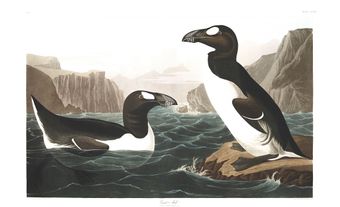
The great auk (Pinguinus impennis), the largest and only flightless auk, is extinct. All auks are expert divers which swim underwater using their wings, but the great auk had flipper-like wings, too short for flight. It was the original penguin (true penguins are unrelated birds native to the Southern Hemisphere), and the largest recent member of the family Alcidae, probably weighing 5,500–8,000 g and stretching 65 cm long.

Description
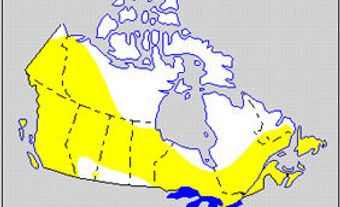
Great auks bred in large colonies at a few offshore islands in the low arctic and boreal waters of the North Atlantic, from the Bird Rocks in the Gulf of St Lawrence to northern Britain. In winter, birds ranged offshore from southern Greenland to southern Spain and Florida. They were especially numerous on the Grand Banks. The main food was probably fish.
The great auk laid a single, large egg on bare rock and the breeding cycle was completed in about 7 weeks. Their pattern of incubation and chick-rearing may have resembled that of the razorbill, their closest living relative.
The great auk was driven to extinction by humans. Flightless and colonial when breeding, it was heavily exploited by early explorers for fresh food, by fishermen for bait and, in the late 1700s, by commercial hunters for feathers. The largest and best-documented colony, on Funk Island, Newfoundland, had been destroyed by about 1800. The last known breeding pair was collected (3 June 1844) on Eldey Rock off southwestern Iceland.