Share on Facebook
 Share on X
 Share by Email
 Share on Google Classroom
Halloween is observed annually on the night of 31 October. It originated primarily as a Celtic celebration marking the division of the light and dark halves of the year. (It is exactly halfway between the September equinox and winter solstice.) It was believed that the spiritual world became visible to humans at this time, and the souls of the dead — who loved to play tricks on mortals — could mingle among the living. Halloween customs include wearing disguises to ward off ghosts and offering food to appease malevolent spirits. These practices were brought to Canada in the mid-to-late 1800s by Irish and Scottish immigrants. The first public report in North America of a jack-o’-lantern carved from a pumpkin was in Kingston, Ontario, in 1886. The first record of dressing in disguise on Halloween was in Vancouver in 1898. And the first recorded use of the term trick-or-treat was in Lethbridge, Alberta, in 1927. Halloween became increasingly popular with adults beginning in the 1990s. By 2023, it was estimated to be a $1.8-billion industry in Canada. It is the second most commercially successful holiday behind Christmas.
Origins of Halloween
The word Halloween is derived from All Hallows’ Eve. It was the evening before the Christian holiday of All Saints’ Day, or All Hallows’ Day, which took place on 1 November. The holiday took place at the same time as the ancient Celtic festival of Samhain (SAH-wane). (Samhain means “summer’s end” and is the Gaelic word for November.) According to the BBC, “It is widely accepted that the early church missionaries chose to hold a festival at this time of year in order to absorb existing native Pagan practices into Christianity, thereby smoothing the conversion process.”
The Celts believed that the beginning of this day — the evening of 31 October — marked the division between the light and dark halves of the year. (It is precisely midway between the autumnal equinox and the winter solstice.) It was believed to be a spiritually liminal time, when the boundary between the living and the dead was at its thinnest. As a result, all manner of ghosts, fairies and demons, including the souls of the dead, could visit the living. In some parts of Ireland, Halloween is called Pooky Night, in reference to the púca, an especially mischievous fairy (this is the origin of the word spooky).
Halloween Customs
In Celtic Halloween customs, people wore costumes and masks to disguise themselves and ward off harmful spirits. The bones of slaughtered animals were cast into communal fires to aid the dead on their journey. People extinguished their home fires and relit them from the bone fire (the origin of bonfire) to celebrate the triumph of light over dark. Meals were prepared for the living and the dead. Ritual offerings were left out to appease malevolent spirits that would otherwise bring bad luck.
The practice of begging for offerings from a household, originally known as souling or mumming, dates back to the Middle Ages. It is considered the precursor of the modern practice of trick-or-treating. Beginning around the 15th century, the poor would offer to sing prayers for the souls of a household’s dead in exchange for soul cakes — a form of alms for the dead. As Halloween celebrations grew more secular, this practice was adopted by children. Instead of saying prayers, they would sing songs, recite poems or perform other entertaining tricks in exchange for nuts, fruit or coins. The practice of dressing children in disguise (guising) for souling became common in the 19th century.

Other common Halloween customs included a family dinner followed by parlour games. People would typically roast nuts, bob for apples to divine one’s future, and read Robert Burns’s 1786 poem Hallowe’en. It describes many other games and customs. Halloween postcards and greeting cards were also very popular between about 1900 and 1940.

Origin of the Jack-o’-lantern
The term jack-o’-lantern comes from the 17th-century myth of Stingy Jack. In Irish folklore, Stingy Jack was refused entry into heaven (because he was a miser) and hell (because he played tricks on the devil). He was condemned to roam the dimension between the living and the dead with only an ember from hell to light his way. He kept the ember in a carved-out turnip as a lantern and was called Jack of the lantern, or Jack-o'-Lantern.

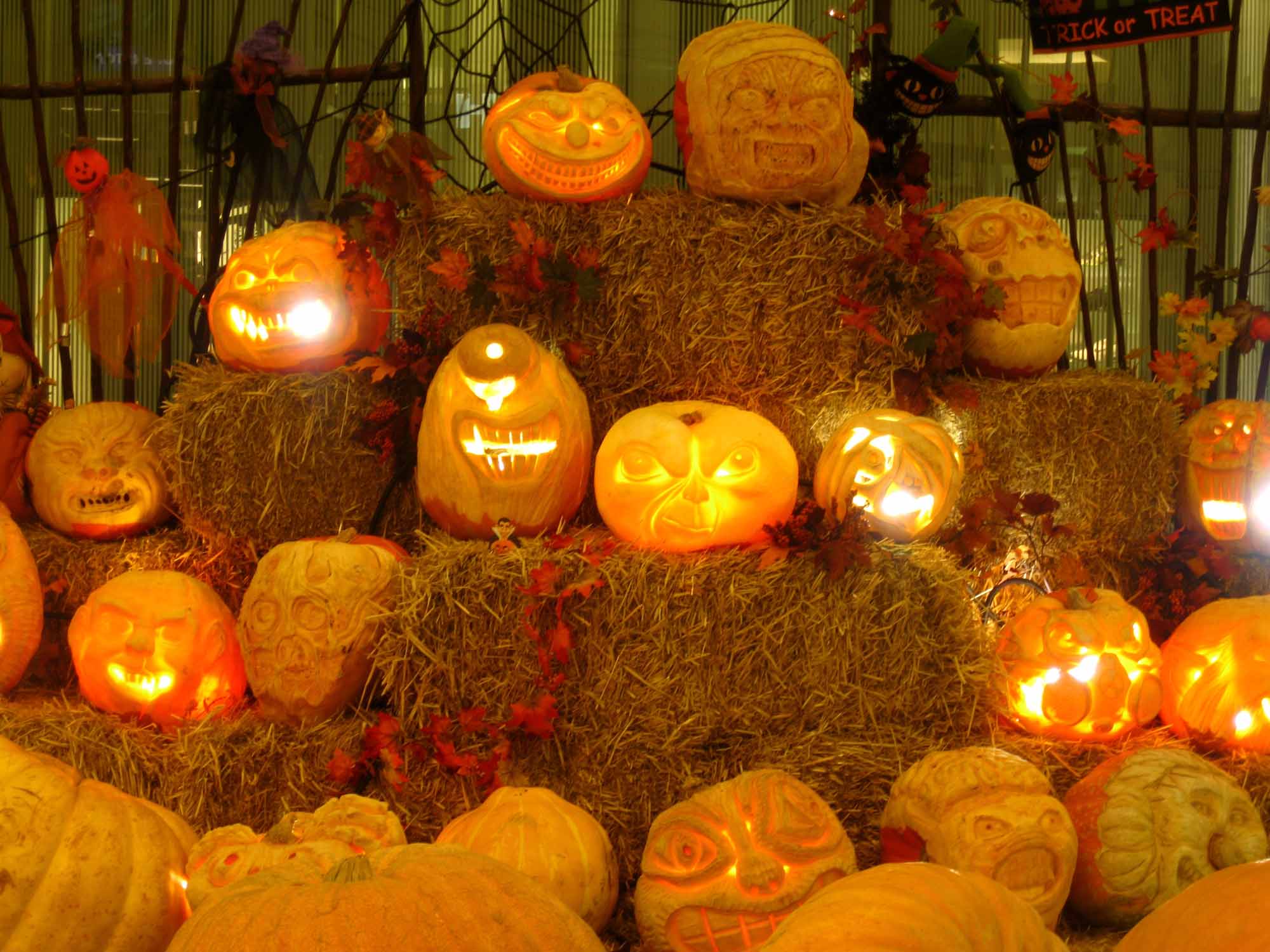
Jack-o’-lanterns in Ireland and Britain were originally hollowed-out turnips, beets or potatoes, carved to show a demonic face and lit from the inside by a candle. They were placed in the window or doorstep to ward off evil spirits. Irish and Scottish immigrants to North America adapted the custom to the larger, naturally hollow, native North American pumpkin. (It has since become equally popular in Britain.) The first public report of a Halloween jack-o’-lantern carved from a pumpkin was in the Kingston Daily News in 1886. By around 1900, the jack-o’-lantern had become the main symbol of Halloween in North America.
There is some debate about the origins of this practice. Some claim that it was derived from the old Christian custom of commemorating souls in purgatory by lighting candles. However, according to National Geographic, the “concept of using a round fruit or vegetable to depict a human face goes back thousands of years in some northern European Celtic cultures.”

Pumpkin-carving contests occur all over Canada on or around Halloween (e.g., an annual carving contest is held at Kejimkujik National Park). Norfolk County, Ontario, is known as “Canda’s pumpkin capital” due to the large amounts of pumpkins harvested there.
Halloween and Trick-or-Treating in Canada
It wasn’t until the massive influx of Irish and Scottish immigrants in the mid-1800s that Halloween celebrations were introduced to Canada. The first recorded instance in North America of children dressing in disguise on Halloween was in Vancouver,
BC, in 1898.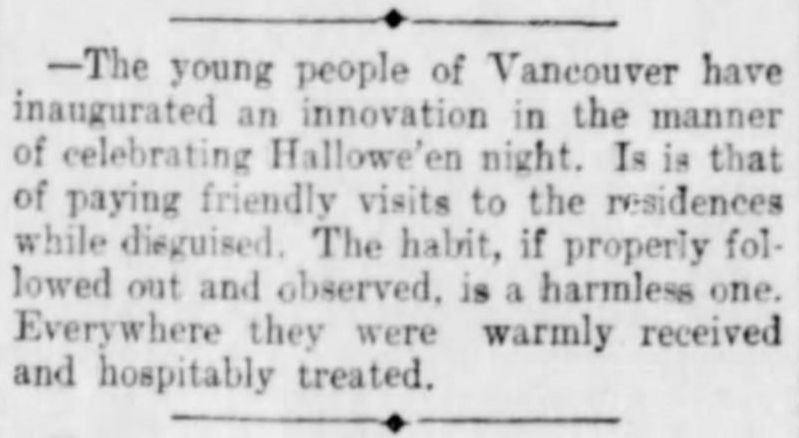
The first recorded use of the term trick-or-treat in North America was in Lethbridge, Alberta, in 1927.
“Hallowe’en provided an opportunity for real strenuous fun. No real damage was done except to the temper of some who had to hunt for wagon wheels, gates, wagons, barrels, etc., much of which decorated the front street. The youthful tormentors were at back door and front demanding edible plunder by the word ‘trick or treat’ to which the inmates gladly responded and sent the robbers away rejoicing.” — Lethbridge Herald, 4 November 1927
The kind of mischief referred to above originated in Britain in the late-18th century. It came to be associated with the night of 30 October, also known as Devil’s Night. By the 1920s, both it and trick-or-treating had become commonplace in Canada. Trick or treating waned during the Second World War, mainly due to sugar rations. But it was revived with renewed vigour with the rise of the suburbs in the 1950s.
Halloween and UNICEF
The Trick or Treat for UNICEF campaign was initiated on a small scale in Philadelphia in 1947 to help raise money for children in war-torn Europe. It was implemented across the United States by UNICEF (United Nations Children’s Fund) in 1950. The program involved giving school children an orange box worn around the neck with which they could collect money from households while trick-or-treating.
The campaign was introduced to Canada in 1955 and discontinued in 2006, when UNICEF Canada shifted its fundraising efforts to its website. The program raised an average of $3 million per year in Canada between 2000 and 2015, and more than $100 million in total during its existence. Proceeds went to the purchase of vaccines, educational materials and other forms of aid for children. The campaign continues to operate door-to-door on Halloween in the US.
Commercial Success of Halloween
The popularity of Halloween has grown tremendously since the turn of the millennium. It has morphed from a holiday observed by children to one celebrated by kids and adults alike. The commercial revenue generated by Halloween more than doubled between 2004 and 2014, making the holiday the second-most commercially successful in the world behind Christmas. The Retail Council of Canada estimated in 2014 that Halloween was a $1-billion industry in Canada. By 2023, according to Statistics Canada, it was worth $1.8 billion.
According to a 2014 survey, 68 per cent of Canadians celebrate Halloween and 33 per cent of adults attend a Halloween party. Canadians spend more per capita ($70) on costumes, candy and decorations than Americans. The holiday has also become a flashpoint for controversy, with some costumes drawing public criticism for sexualizing young girls or depicting racial and ethnic stereotypes.