Share on Facebook
 Share on X
 Share by Email
 Share on Google Classroom
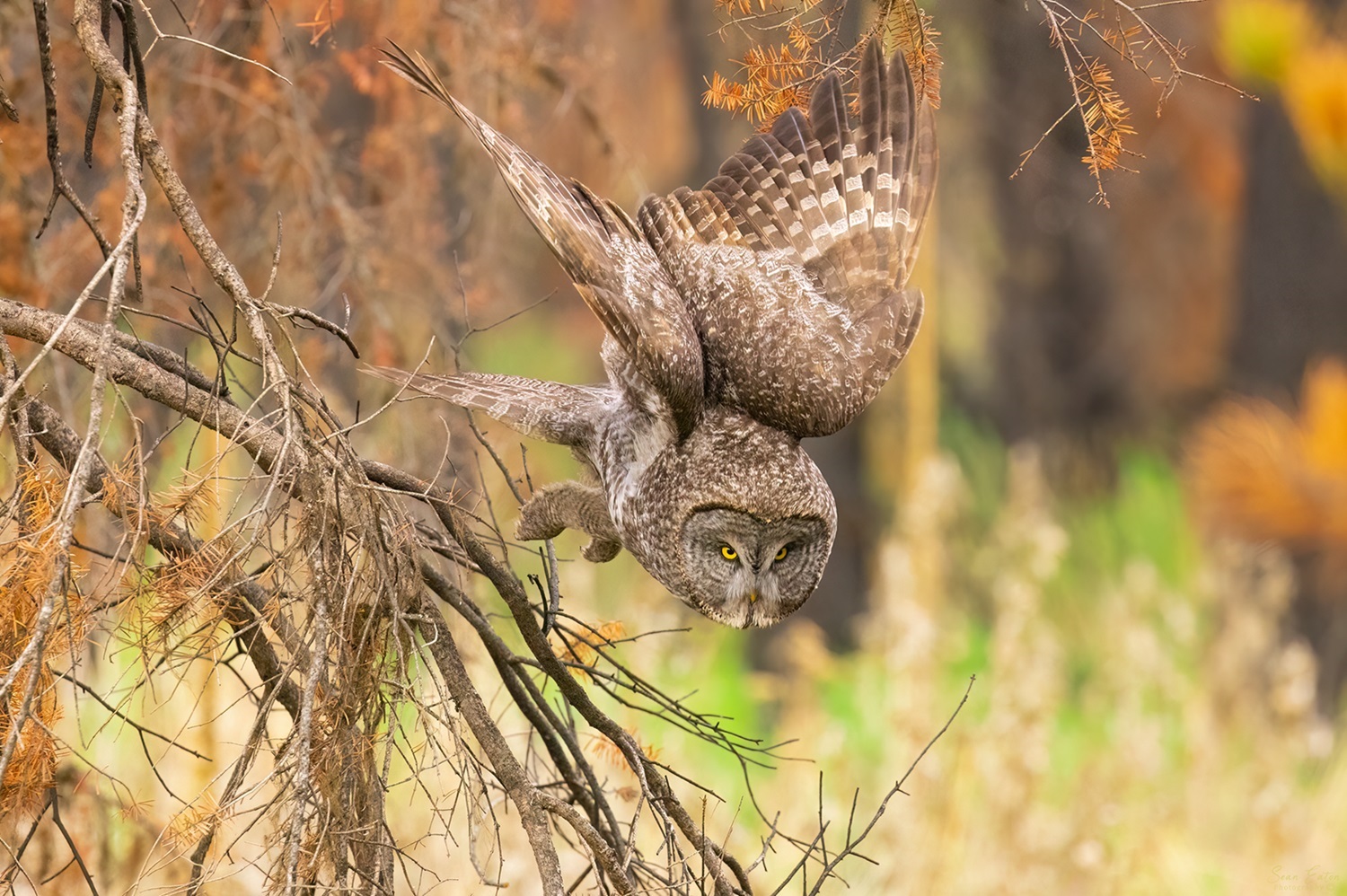
A native of northern boreal forests and taiga, the great grey owl (Strix nebulosa) is a large owl capable of near-soundless flight. Lightweight relative to its size (males average 0.9 kg, females, 1.3 kg), great grey owls are extra downy, with a high feather-to-body ratio and a unique complexity of feather composition and variety that allows it to hunt voles in the deep snow. The Tlingit name for the great grey owl is k’úkw. The great grey owl is the provincial bird of Manitoba.
Appearance
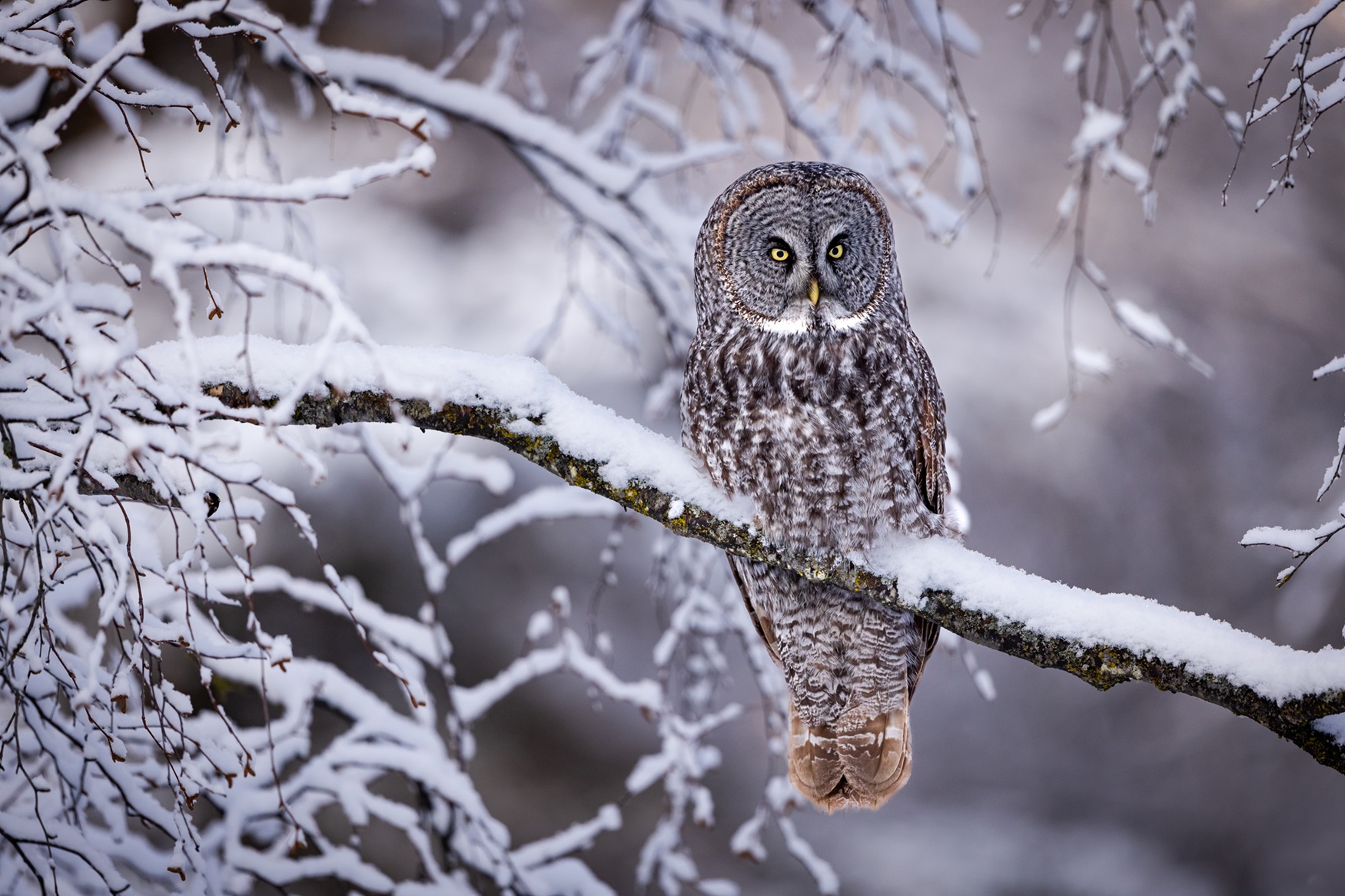
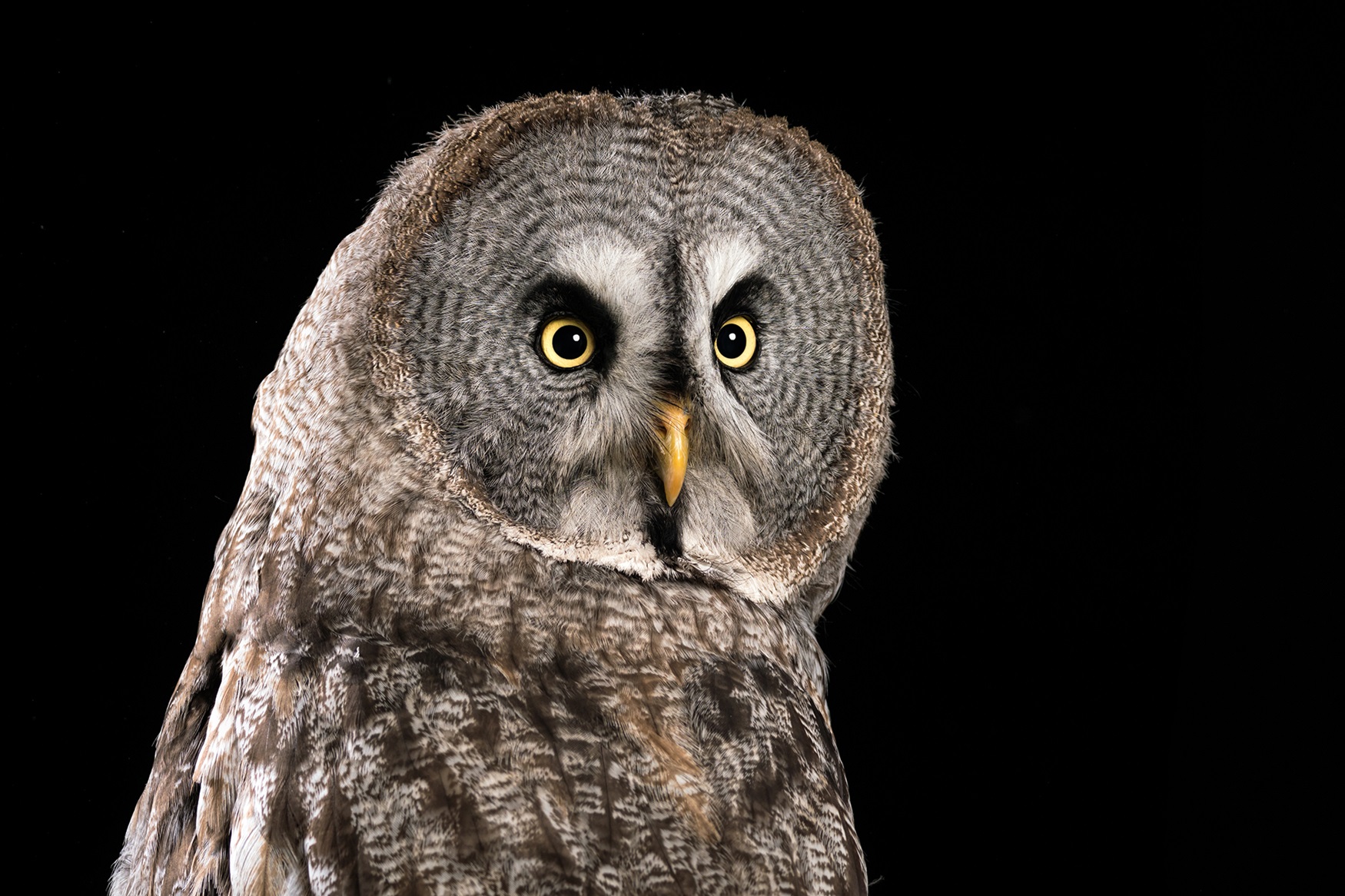
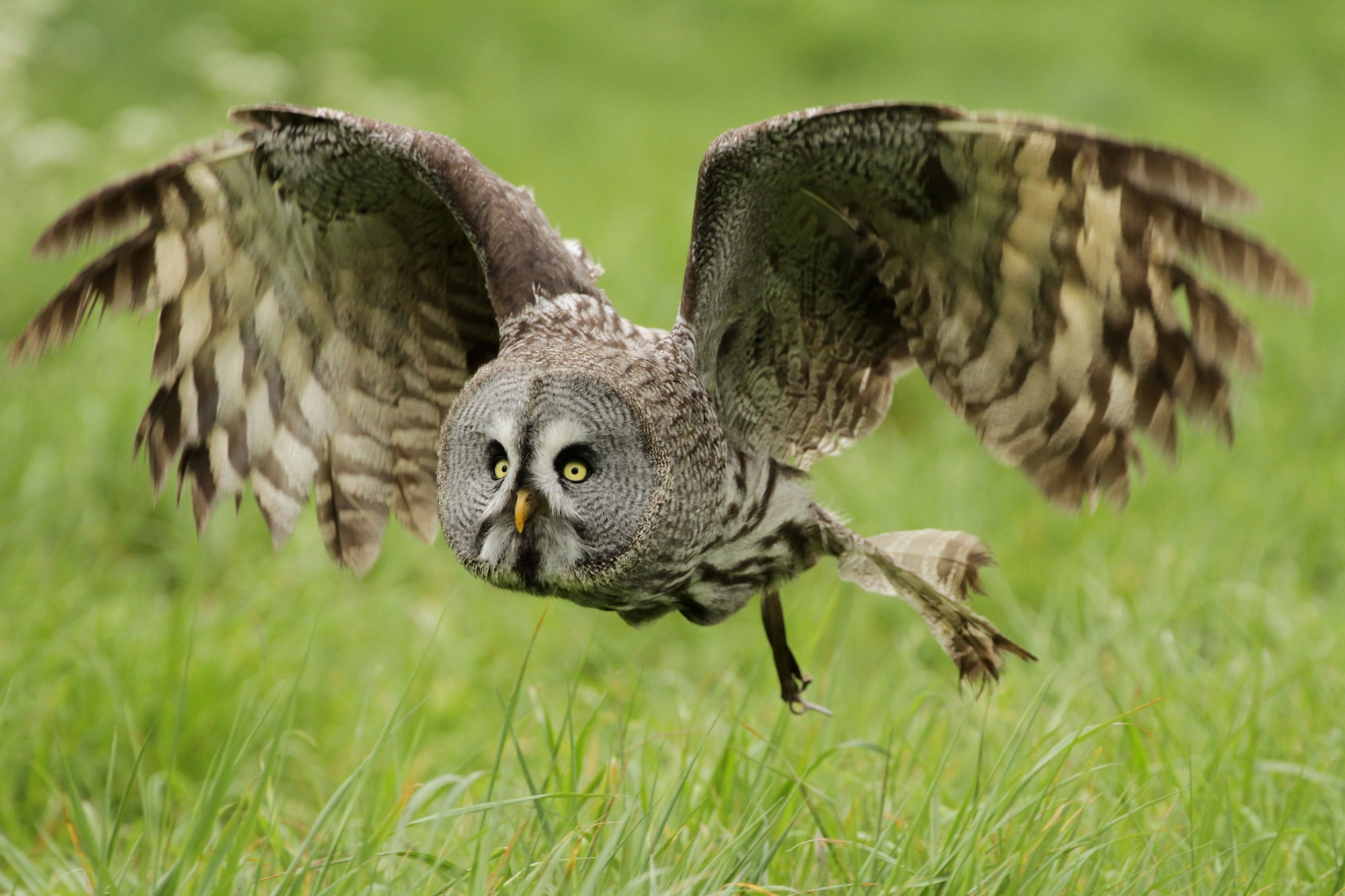
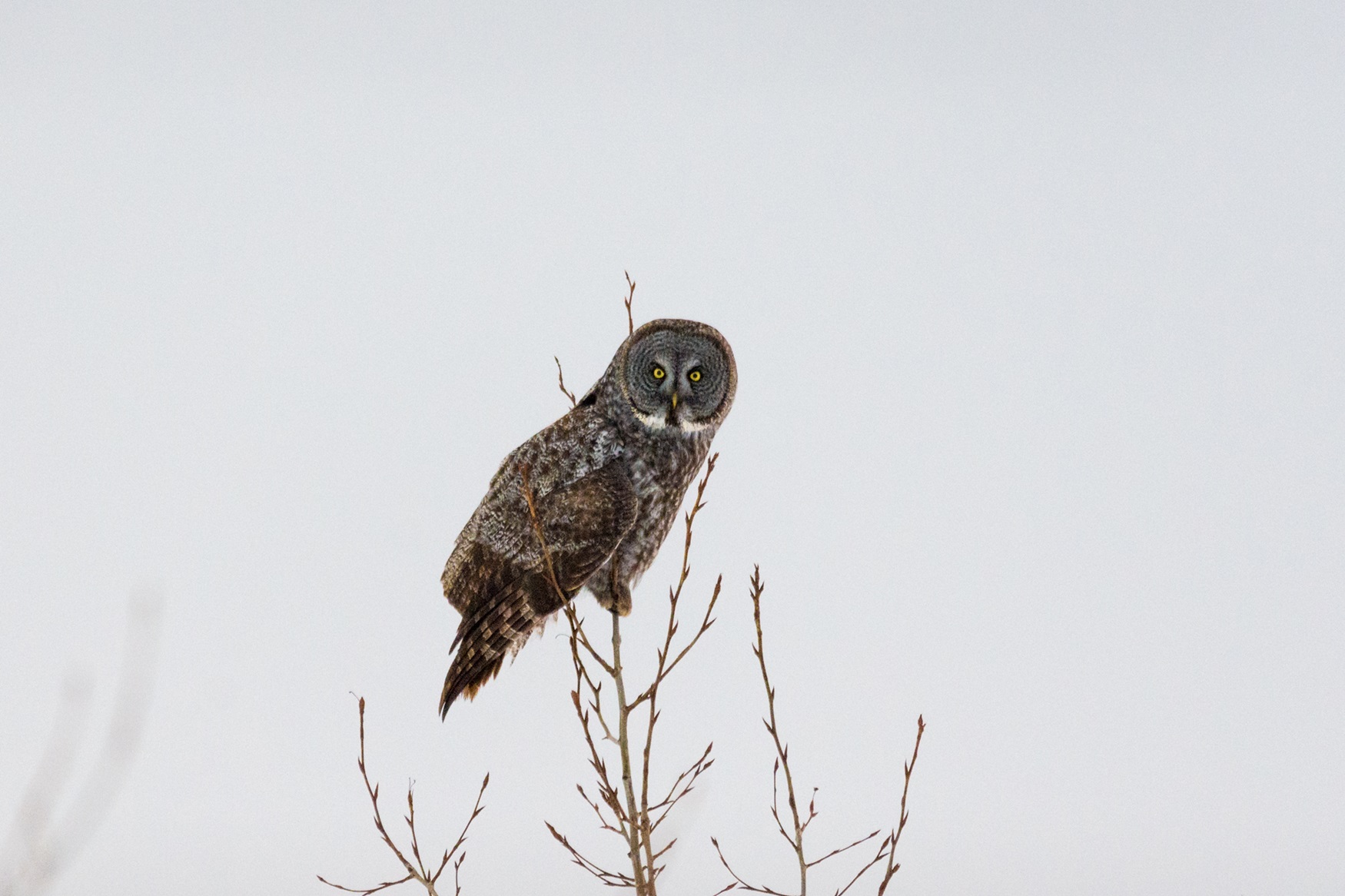
With unique silver-grey to brown patterning (barred and mottled), the great grey owl is also distinctive for its length of 60–84 cm. With a large head relative to overall size, its asymmetrical ears are tuft-free. The face is overwhelmingly comprised of two huge facial discs that extend far above the top of the skull, ringed by grey and brown rows of feathers encircling small yellow eyes. Two pale arcs of feather form a soft X between the eyes, which are edged by fine black feathers, assisting in daytime hunting by deflecting light.
Beneath a small beak is a black “chin” surrounded by white mustachios. Great grey owl talons are comparatively long and thin, specialized for catching small mammals on the ground. Their feet are covered with short and dense, light and fur-like feathers that help in running and walking on the snow.
The tail of this owl is also relatively large, but the tail feathers, reaching 30 cm long and 6 cm wide, are light to the point of transparency. Breast feathers can exceed 23 cm, with extraordinarily long and downy plumes that cause them to appear cylindrical as they respond to the slightest air movement, with the dual purpose of insulation and sound reduction in flight. At the base of the tail sits a gland that releases oil onto the bill when pressed; when distributed over the feathers during preening, it protects, conditions and contributes to sound reduction.
Habitat and Distribution
Three genetically distinct subspecies of the great grey owl are recognized. Strix nebulosa nebulosa is found from Quebec to the Pacific coast and Alaska. S. n. lapponica is found from Scandinavia to northern Asia. S. n. yosemitensis is a small and long-isolated population of 200–300 individuals largely confined to the Sierra Nevada in northern California.
Great grey owls are nomadic permanent residents of northern boreal forests and taiga. Every three to five years, there is a precipitous drop in vole numbers; as vole specialists, during these years, many great grey owls will migrate farther south for food. Because they are solitary, elusive, silent, non-confrontational and adept at camouflage, population and distribution can be difficult to assess.
Did you know?
The great grey owl is seen more regularly in Manitoba than anywhere else in Canada, and was declared Manitoba's provincial bird emblem in 1987. In a joint forestry wildlife agreement, a portion of the Sandilands Provincial Forest southeast of Winnipeg — an important research site for the species — has been declared a “Great Grey Owl Ecologically Significant Area.”
Reproduction and Development
The male will hunt for the entire family for two and a half months, from the first egg being laid to the departure of the last fledgling from the nest; therefore, his courtship demonstrates hunting prowess, from displays of flight and snow-plunging techniques to exhibiting a multitude of captured prey.
The bonded pair will begin searching for a nest site together as early as mid-February, nesting in tree snags, old raven or hawk nests, large clumps of mistletoe, and sometimes man-made nest platforms. The female makes the final choice of nest site, dropping several of her feathers into the base of the nest to insulate the nest from below, while forming a brood patch for insulation from above.
Great grey owls lay 2–9 chalk-white ovoid eggs at intervals over the course of 3–12 days, which hatch after 28–36 days of incubation. By two weeks, the young are able to swallow voles whole. Fallen nestlings use their beaks and talons to claw their way back up trees. Gradually, the fledglings will depart the nest; at this point, the female, no longer having to feed and act as permanent shelter, will leave the nest while the male continues hunting for their offspring; by winter, they will be completely independent.
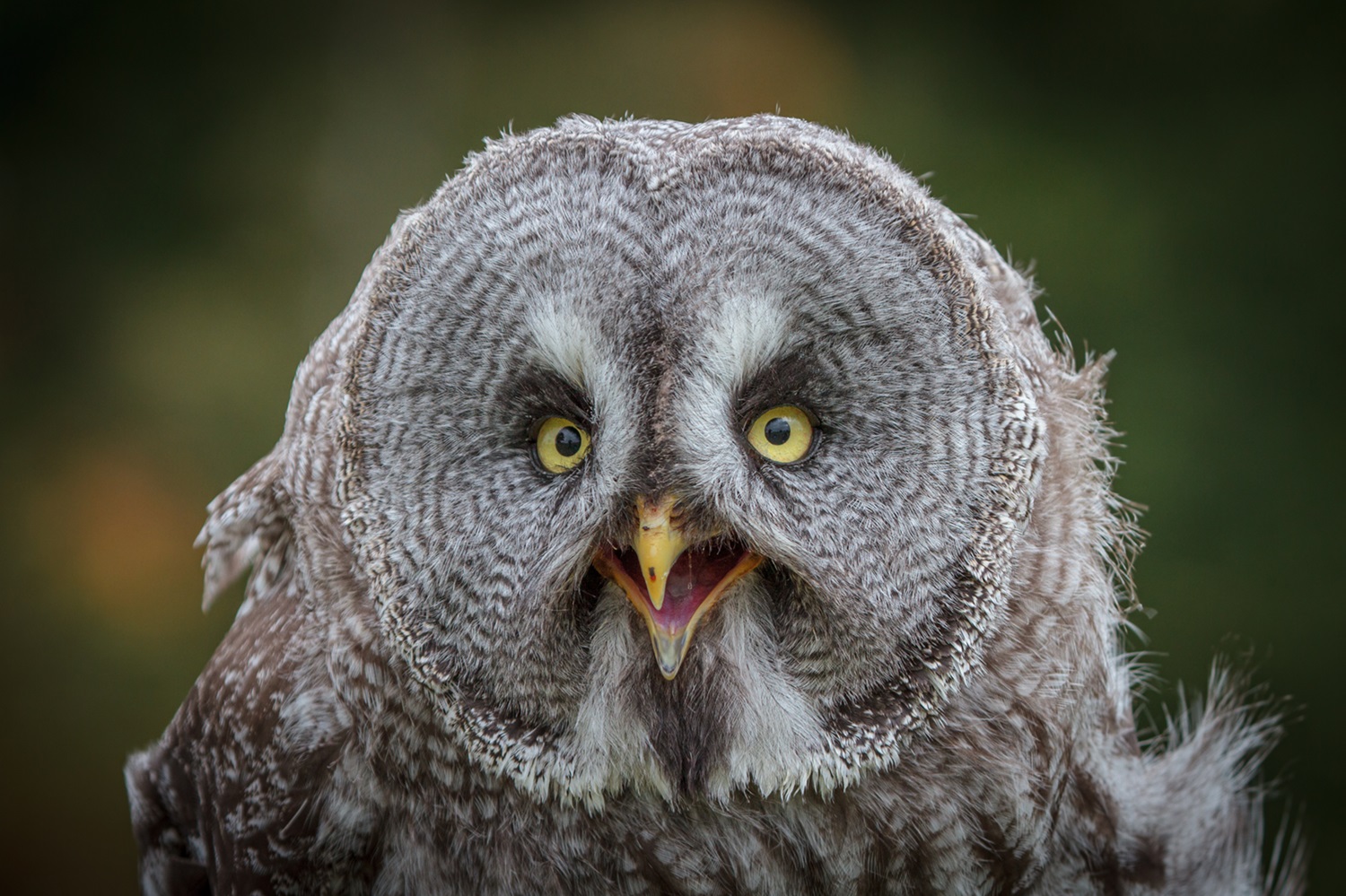
Although known for their silence, great grey owls are capable of making a wide variety of calls. The territorial breeding season call of the male, composed of 8–12 low hoots of equal measure, with fade-out, can be heard from 800 m away. Possibly the loudest and most bizarre call is the female's defensive distraction display, used when nestlings are threatened.
Diet and Predation
With an impressive 63 per cent hunting success rate, the great grey owl's specialty prey are voles that tunnel beneath the snow. The owl will sit and wait on a low perch beside open ground, and glide low with its satellite face down and parallel to the ground. The feathers of this “phantom of the north” are elaborately adapted for silent flight so that the owl can hear its prey under deep snow that muffles and refracts sound.
A great grey owl’s facial feather structure serves to channel all sound to the ears, which are asymmetrical down to the skull. Such asymmetry causes each ear to receive high frequencies differently, allowing a comparison that, through triangulation, constructs a two-dimensional audio map, resulting in extremely high localization accuracy.
When the owl has pinpointed its prey during a brief and silent hover, it dives headfirst, often “face-planting” into the snow. At the last minute, it brings its feet down, punching through hard-packed snow as deep as 50 cm, with wings partially closed as a brake, and to help in getting back out of the hole. The vole, trapped within a collapsed portion of tunnel, is easily captured and killed with sharp, strong talons.
Conservation Status and Threats
Because of its extensive habitat range, the IUCN lists the great grey owl as a species of least concern. Populations are, however, negatively affected by human development, including clear-cutting, agriculture and meadowland overgrazing. Other threats include automobiles, hunting, invasive species (see Invasive Species in Canada: Animals, Invasive Species in Canada: Plants), pollution, human recreational activities and climate change. One subspecies, S. n. yosemitensis, is listed as endangered by California.
Avian influenza and West Nile virus infections result in almost immediate death in great grey owls.