Share on Facebook
 Share on X
 Share by Email
 Share on Google Classroom
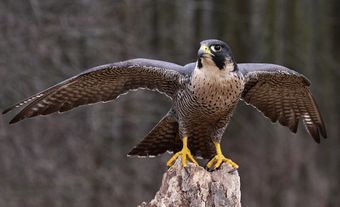
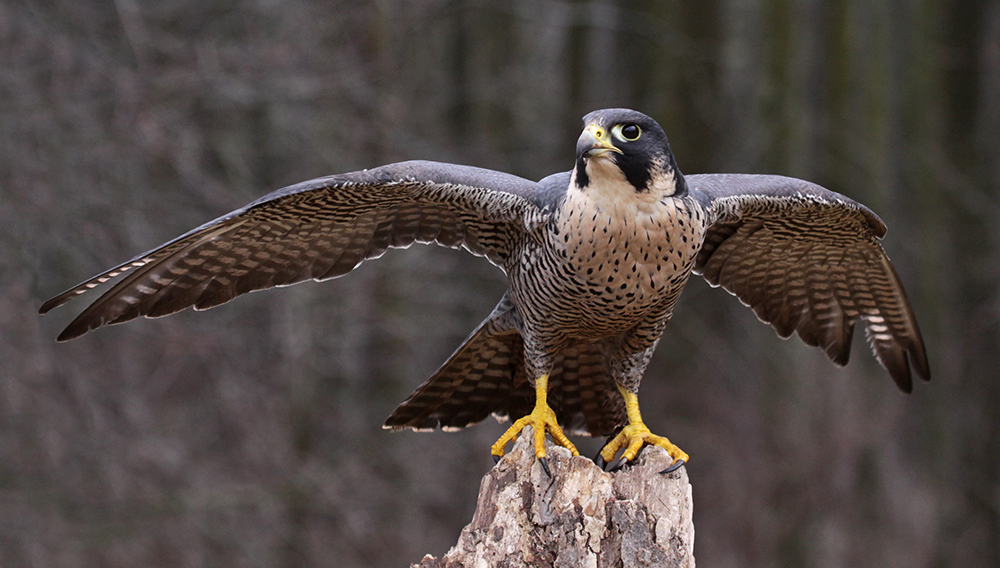
The peregrine falcon (Falco peregrinus) is a crow-sized, long-winged bird of prey, generally acknowledged to be the swiftest bird (attaining speeds of over 320 km/h). The name, which means "wandering," is well suited to this species, which is represented by 18 races and breeds on every continent (except Antarctica).
Description
Adults are dark blue-grey to blue-black above, with dark bars on a salmon-to-white breast and belly. They have either very dark cheeks or moustache-like markings on the side of the head. Immature birds have brownish plumage with darker, longitudinal stripes on the breast. Both sexes have similar plumages, although males frequently have much paler breasts. Males (tiercels) are about one-third smaller than females (falcons).
Reproduction and Development
Normally, 3–5 eggs are laid on a cliff ledge in a slight depression scraped out of earth or gravel by the female. There is little or no nest. Eggs are incubated, mainly by the female, for about 33 days. The male's role is primarily to protect the territory and provide food for the female and young. When the young are half-grown, the female may help provide food.
Young leave the nest at about 5 weeks but remain nearby and depend on parents for food until they can hunt for themselves. Shortly thereafter, the birds leave the nesting area and begin migration. The first year is very difficult for the young. Band-recovery data indicate that only about 1 in 4 live long enough to return to the breeding grounds.
Distribution
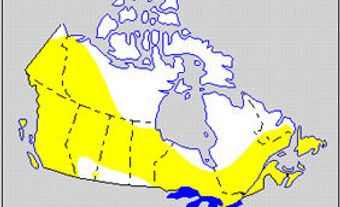
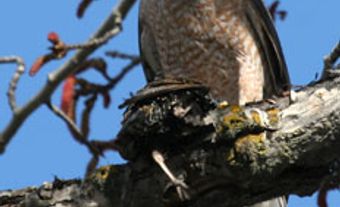
Whether peregrines migrate depends on food supply and climatic conditions. The Canadian tundra peregrine (F. peregrinus tundrius) winters as far south as southern South America, whereas the west coast peregrine (F. p. pealei) is essentially nonmigratory. The third race breeding in Canada is the endangered anatum peregrine (F. p. anatum), which bred across Canada wherever adequate food and nesting habitat were available. These birds wintered from the southern US through Central America into northern South America. The peregrine preys almost exclusively on bird species in most parts of its range (coastal and inland cliffs).
Conservation and Threats
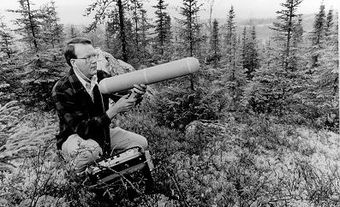
The anatum peregrine declined to near-extinction across most of its breeding range over the second half of the 20th century. The decline was well documented, and studies indicate that the principal cause was reproductive failure due to pesticide contamination (especially DDT), which leads to eggshell thinning. The bird has become a symbol of the problems caused by environmental misuse. In Canada and the US, specific conservation programs and some pesticide regulation have been very successful, and many young anatum peregrines bred in captivity have been released in the wild. One subspecies found in Canada, Falco peregrinus pealei, is still classified as a species of special concern under the Canadian Species at Risk Act.