Share on Facebook
 Share on X
 Share by Email
 Share on Google Classroom
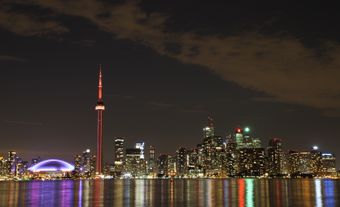
The CN Tower (Canada’s National Tower) is a communications and observation tower located in Toronto, Ontario (see Telecommunications). Constructed from between 1973 and 1975 at a cost of $63 million, the tower officially opened to the public in 1976. The CN Tower was the world's tallest free-standing structure until 2007, when the Burj Khalifa in Dubai, United Arab Emirates, surpassed it. The tower was also the world's tallest tower, until 2010, when the Canton Tower in Guangzhou, China was completed. Measuring 553.33 metres, the CN Tower remains a unique feature of Toronto’s skyline and a popular tourist destination, welcoming nearly 2 million visitors annually.

History and Design
As the city of Toronto expanded in the 1960s, existing transmission towers could no longer reliably transmit radio and television signals over the city’s growing skyscrapers (see Telecommunications). A taller communications tower was needed to improve broadcast transmission and reception. In partnership with the Canadian Broadcasting Corporation (CBC), the Canadian National Railway Company (CN) and Canadian Pacific Railway (CPR) planned to include a new transmitter in the Metro Centre, a redevelopment plan for the Railway Lands in downtown Toronto. The CBC and CPR eventually withdrew from the project, but CN proceeded to construct the new transmission tower, which would be called the “Canadian National Tower” or “CN Tower.”
The project's architects were John Andrews, Roger du Toit, and the Webb Zerafa Menkès Housden Partnership; the structural engineer was R.R. Nicolet. The original 1968 design concept for the communications tower consisted of three vertical pillars connected by bridges. By the 1970s, the tower’s design evolved to the tall, free-standing structure, recognizable to Torontonians today.
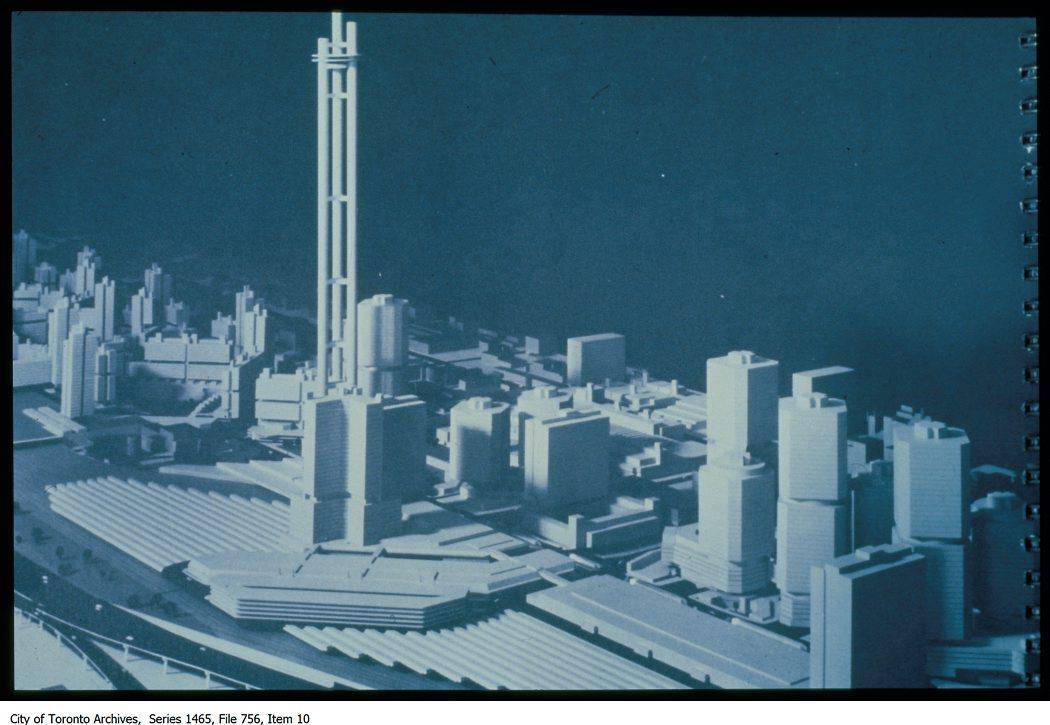
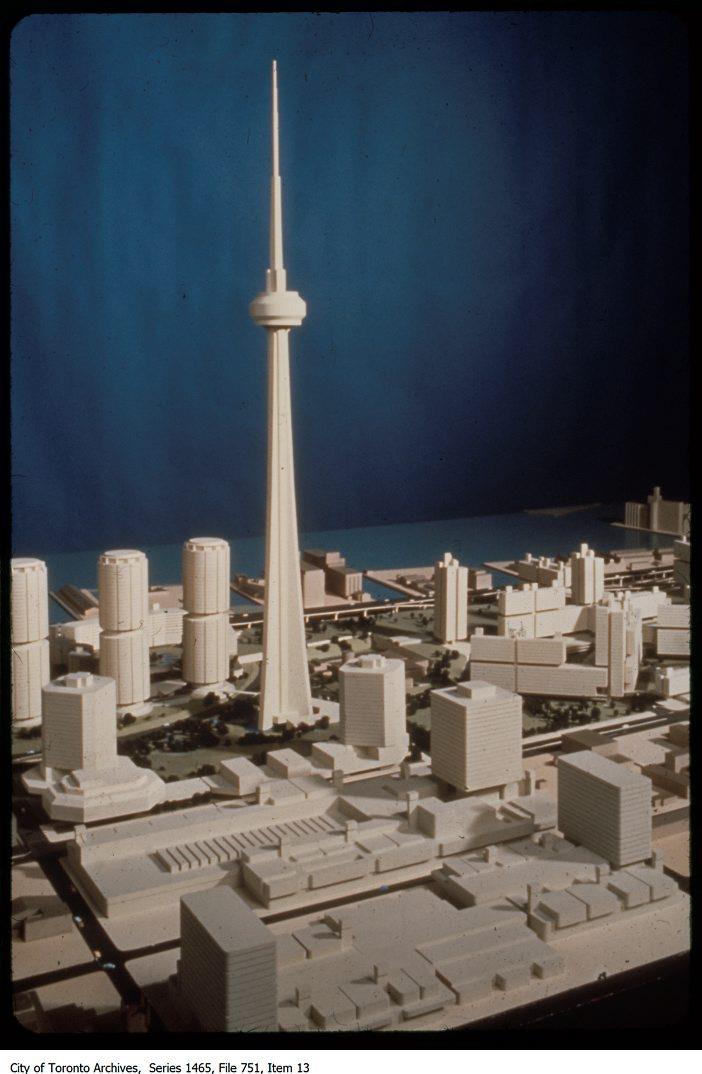
The CN Tower was the subject of criticism. Pilots reportedly expressed safety concerns and naturalists argued that the structure’s height and lights would kill migratory birds. Developers countered these concerns and noted that lights could be dimmed or extinguished to lessen the threat to birds. Despite opposition, the CN Tower was authorized for construction.
Construction
Construction Site
Construction site of the CN Tower, 17 April 1973.
(photo by Boris Spremo/Toronto Star via Getty Images)
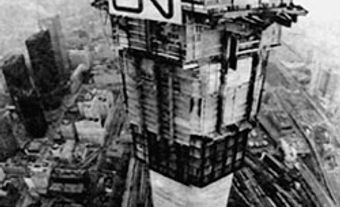
Construction of the CN Tower began on 6 February 1973 with CN employing 1,537 workers. Workers removed 56 metric tonnes of earth for the tower’s foundation and used a slipform method to pour concrete and shape the tower’s shaft. The hexagonal post-tensioned concrete tower was built to be braced by three wings to form a broad "Y" in plan at the ground. The tapering wings rose to 330 m and the concrete tower to 450 m. Built at a cost of $63 million, the tower was topped off by a sophisticated 102 m communications antenna for transmission of both broadcast and microwave signals on 2 April 1975. Once completed, the tower’s total height was 553.33 m.
CN Tower During Construction
View of the CN Tower during its construction, 22 February 1974.
(photo by Dick Loek/Toronto Star via Getty Images)
The CN Tower was opened to the public on 26 June 1976. Over 2,000 people visited the tower on its grand opening (with more than 500 people lined up at midnight to gain entry). Each year the tower attracts about 2 million visitors who ride its glassed-in elevators 342 m to the skypod, which houses both wide observation decks and a revolving restaurant with the world's highest wine cellar.
Did you know?
The CN Tower is struck by lightning an average of 75 times per year. Copper strips run through the length of the tower and connect to grounding rods buried below the surface, which help disperse the lightning and prevent damage to the tower’s structure.
Ownership and Refurbishment
In 1995, CN sold the tower to Canada Lands Company, and the tower’s official name was changed to “Canada’s National Tower.” Under Canada Lands Company, major refurbishments and expansions of the tower's entertainment, shopping and restaurant facilities were undertaken, which included a film theatre and meeting rooms. In 2011, in celebration of its 35th anniversary, the CN Tower opened the EdgeWalk, a ledge 1.5 m wide encircling the tower's main pod allowing visitors to circumnavigate the tower 356 m above the ground. To help improve access, the main observation level was renovated in 2018 to feature floor-to-ceiling glass “window walls.” A second phase of renovations was unveiled in 2026 to mark the tower’s fiftieth anniversary. The renovations, which amounted to $21 million, included interactive video displays in the tower’s lower observation level.
Legacy
Of the world's observation and communications towers, the CN Tower is perhaps the most elegant. In 1995 the CN Tower was designated as one of the seven wonders of the modern world by the American Society of Civil Engineers, a designation it shares with San Francisco's Golden Gate Bridge, the Chunnel beneath the English Channel, the Empire State Building and the Itaipu Dam on the Brazil/Paraguay border. (See also Civil Engineering.) In 2017, the Royal Architectural Institute of Canada and the National Trust for Canada recognized the architectural significance of the CN Tower with the 2017 Prix du XXe Siècle.
In 1999, Canada Post released a stamp of the CN Tower as part of its Millennium Collection, a series of stamps commemorating people, events and innovations from Canada. To mark the CN Tower’s 50th anniversary, the Royal Canadian Mint released a new $2 glow-in-the-dark circulation coin depicting the CN Tower and Toronto’s skyline.