Share on Facebook
 Share on X
 Share by Email
 Share on Google Classroom
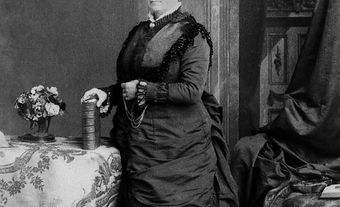
Agathe de Saint-Père, merchant, entrepreneur, trailblazer (born 27 February 1657 in Montreal, QC; died 19 August 1747 in Quebec City, QC). Agathe de Saint-Père was the daughter of French pioneers who settled in the colony of Ville-Marie, New France, in the mid-17th century. She distinguished herself in the emerging business world and opened the first fabric workshop. Saint-Père did this with the king's approval at a time when goods were exclusively imported from metropolitan France and when women were considered minors and lived under the guardianship of their husbands. (See also History of Gender Roles in Canada.)
Family and Education
Agathe de Saint-Père was born in the French colony of Ville-Marie. She was the daughter of Mathurine Godé and Jean de Saint-Père, pioneers of French origin who settled with their respective families in New France in the 17th century.
Saint-Père's father was the first royal notary of Ville-Marie. He also served as clerk and trustee. He died when she was about eight months old. Her mother remarried on 12 November 1658 to a merchant, Jacques Le Moyne de Sainte-Marie, the brother of Charles Le Moyne de Longueuil and Châteauguay.
In 1672, her mother died during the birth of her tenth child. Saint-Père became the mother figure of her ten half-siblings at the age of 15.
In November 1685, Saint-Père married Pierre Legardeur de Repentigny, a soldier and heir in a line of lords. She had one son and seven daughters. Only five of their children survived to adulthood.
Businesswoman
As a child, Agathe de Saint-Père watched her stepfather manage his business near Pointe-à-Callière, the supply port for the Montreal colony and for exports to metropolitan France. (See also Montreal.) At that time, the fur trade, sourced from Indigenous peoples, was the main driver of economic development in New France. Saint-Père began working around 1680 in the family fur trade business, located at the corner of Saint-Paul and Notre-Dame streets. She grew more comfortable in business, and in 1683 she travelled to trading posts in the Ottawa and Fort Michilimackinac area to buy animal hides from the Indigenous communities.
Pierre Legardeur’s military career in the navy regularly took him on expeditions far from his family. He granted power of attorney to Saint-Père, who became the designated administrator of the couple's assets. She even signed contracts in her own name. She enjoyed financial independence at a time when women, even if married, were considered minors and were under the guardianship of their husbands. (See also History of Gender Roles in Canada.) It is also said that Agathe's enterprising spirit contrasted with her husband's nonchalant and lavish personality, and she often had to pay his debts.
In addition to her role in the fur trade, Saint-Père managed her land and real estate holdings, some of which she had inherited from her parents. She diversified her sources of income and even exported maple sweets, a delicacy prized by King Louis XIV. (See also Maple Syrup Industry.)
The First Fabric Workshop
In 1704, the British hijacked a ship named La Seine, which was carrying a year's worth of supplies (food, fabric and clothing) from France. This is when Agathe de Saint-Père was inspired to start manufacturing fabrics, since the price of imports had become exorbitant.
Saint-Père recognized the potential of textile production in the colony, which would enable New France to no longer depend on imports. (See also Textile Industry.) Since childhood, she had been fascinated by the fabrics and colours worn by Indigenous people, so she experimented with the production of plant-based textiles. She sent a few samples of fabric to the King of France, Louis XIV, who was impressed by the quality of the product and thus lifted the ban on textile manufacturing in the colonies. To support Saint-Père's fabric factory, he paid her an annual financial aid of 200 livres from 1705 to 1712.
Saint-Père continued her entrepreneurial journey and set up a fabric workshop on her property on Rue Saint-Joseph (now Rue Saint-Sulpice) in 1704. She commissioned Joseph Chevalier, a local carpenter, to make about 20 looms based on a model already found in the colony. She hired nine English weavers — prisoners for whom she posted bail — and local apprentices. Workers weaved the fabric from native plants, such as nettles, milkweed and the inner bark of linden trees.
She was innovative. To brighten up her fabrics, she dyed them with red, orange and yellow pigments from native plants. She used dyeing and fixing processes borrowed from Indigenous peoples. Ingeniously, she also dyed animal hides and even created fabrics that blended animal and plant fibers.
Despite the colony's enthusiasm for its local and affordable products, a group of upper middle class turned up their noses. They prefered clothing and textiles imported from France, which were 25 to 50 per cent more expensive.
Retirement and Final Years
In 1712, Agathe de Saint-Père closed her fabric workshop on rue Saint-Joseph. The following autumn, she rented the property to master baker Pierre Thuot Duval.
For several years, she continued to manage her land and income properties, and possibly her fur trade.
Pierre Legardeur de Repentigny died in Montreal on 18 November 1736. Saint-Père then moved to the boarding house of the Hôpital général de Québec for the rest of her life. (See also Quebe City.) From 1740 onwards, she granted powers of attorney to her children for the management of certain assets. After that, all traces of her activities are lost.
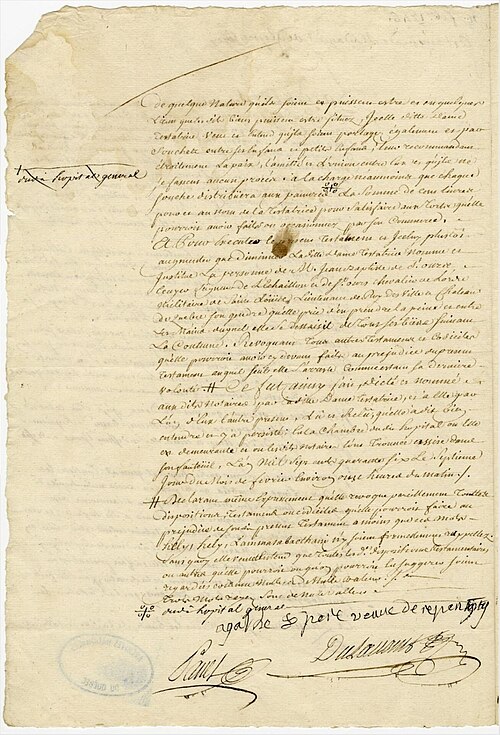
She died on 19 August 1747 at the age of 90 at the Hôpital général de Québec and was buried there, as she had requested in her will signed on 6 February 1746.
Distinction
On 5 March 2020, Minister of Culture and Communications Nathalie Roy names Agathe de Saint-Père as a historical figure, "one of the rare 'businesswomen' in New France."