
Browse "Communities & Sociology"
-
Editorial
Celebrating Black History Month in Canada
The following article is an editorial written by The Canadian Encyclopedia staff. Editorials are not usually updated. As we mark Black History Month in Canada in February, it’s worth reflecting on the legacy of Canada’s Black communities and the prejudice Black people have faced.
"https://d3d0lqu00lnqvz.cloudfront.net/media/media/dd01025c-fc65-449e-9f14-b7ad5a585d3b.jpg" // resources/views/front/categories/view.blade.php
https://d3d0lqu00lnqvz.cloudfront.net/media/media/dd01025c-fc65-449e-9f14-b7ad5a585d3b.jpg
-
Article
Celebrating National Indigenous History Month in Canada
The history of Indigenous peoples in Canada begins much earlier than any other group living here — and is far more complex.
"https://d3d0lqu00lnqvz.cloudfront.net/media/media/c8645ca0-1fb2-4b94-8eaf-44c8d250e845.jpg" // resources/views/front/categories/view.blade.php
https://d3d0lqu00lnqvz.cloudfront.net/media/media/c8645ca0-1fb2-4b94-8eaf-44c8d250e845.jpg
-
Article
Celtic Languages
The Celtic languages belong to the family of languages known as Indo-European and as such are related to most of the languages of Europe and many others found as far east of Europe as India. Linguists recognize 2 main divisions of Celtic: Continental Celtic and Insular Celtic.
"https://thecanadianencyclopedia.ca/images/tce_placeholder.jpg?v=e9dca980c9bdb3aa11e832e7ea94f5d9" // resources/views/front/categories/view.blade.php
https://thecanadianencyclopedia.ca/images/tce_placeholder.jpg?v=e9dca980c9bdb3aa11e832e7ea94f5d9
-
Article
Cemeteries
Cemeteries are designated consecrated places in which the dead are deposited. The word comes from the Greek koimeterion or the Latin coemeterium, meaning "to lie down to rest" or "to sleep."
"https://d3d0lqu00lnqvz.cloudfront.net/media/media/da0840cf-ea67-4b6e-8a75-62b89d517d96.jpg" // resources/views/front/categories/view.blade.php
https://d3d0lqu00lnqvz.cloudfront.net/media/media/da0840cf-ea67-4b6e-8a75-62b89d517d96.jpg
-
Article
Census Metropolitan Area
Census Metropolitan Area (CMA) is a geographical area created by Statistics Canada for the purposes of collecting and organizing data for large urbanized areas.
"https://thecanadianencyclopedia.ca/images/tce_placeholder.jpg?v=e9dca980c9bdb3aa11e832e7ea94f5d9" // resources/views/front/categories/view.blade.php
https://thecanadianencyclopedia.ca/images/tce_placeholder.jpg?v=e9dca980c9bdb3aa11e832e7ea94f5d9
-
Article
Centrale de l'enseignement du Québec
The Corporation des instituteurs et institutrices catholiques (CIC), co-founded by Laure GAUDREAULT came into being in 1946. Its name became the Corporation des enseignants du Québec in 1967, and was finally changed to The Centrale de l'enseignement du Québec (CEQ) in 1972.
"https://thecanadianencyclopedia.ca/images/tce_placeholder.jpg?v=e9dca980c9bdb3aa11e832e7ea94f5d9" // resources/views/front/categories/view.blade.php
https://thecanadianencyclopedia.ca/images/tce_placeholder.jpg?v=e9dca980c9bdb3aa11e832e7ea94f5d9
-
Article
Centralization of Mi'kmaq in Nova Scotia
Centralization of Mi’kmaq in Nova Scotia was a federal government policy in operation in the 1940s. Under the policy, the government aimed to relocate all Mi’kmaw people living in Nova Scotia to two isolated reserves (see also Reserves in Nova Scotia). The policy failed, though not before the forced removal uprooted half of the Mi’kmaw population and disrupted Mi’kmaw society. In the 1970s, Mi’kmaw leaders called centralization “a phase of cultural genocide.”
"https://d3d0lqu00lnqvz.cloudfront.net/CentralizationofMikmaq/e008311942-v8-centralization-map.jpg" // resources/views/front/categories/view.blade.php
https://d3d0lqu00lnqvz.cloudfront.net/CentralizationofMikmaq/e008311942-v8-centralization-map.jpg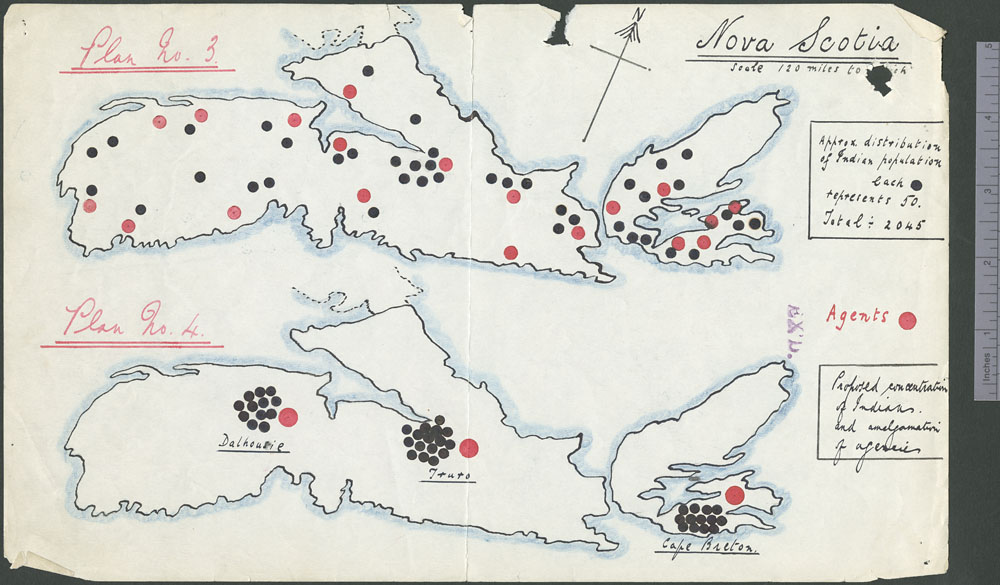
-
Article
Centre de recherche en civilisation canadienne-française (CRCCF)
Le Centre de recherche en civilisation canadienne-française (CRCCF) (translation: Centre for Research on French Canadian Culture), was founded on 2 October 1958 at the University of Ottawa by four professors of literature: Father Bernard Julien, OMI; Jean Ménard; Réjean Robidoux; and Paul Wyczynski, who was its director for 15 years. They began by organizing the methodical teaching and study of French-Canadian literature at the university level (see French Language Literature). The centre's scope broadened in 1963 to include history and the fine arts, and in 1977 the CRCCF became a multidisciplinary research body.
"https://thecanadianencyclopedia.ca/images/tce_placeholder.jpg?v=e9dca980c9bdb3aa11e832e7ea94f5d9" // resources/views/front/categories/view.blade.php
https://thecanadianencyclopedia.ca/images/tce_placeholder.jpg?v=e9dca980c9bdb3aa11e832e7ea94f5d9
-
Article
Champlain Society
The Champlain Society was founded 1905 in Toronto by Sir Edmund Walker to increase public awareness of, and accessibility to, Canada's rich store of historical records. Membership, limited at first to 250, is now approximately 800.
"https://thecanadianencyclopedia.ca/images/tce_placeholder.jpg?v=e9dca980c9bdb3aa11e832e7ea94f5d9" // resources/views/front/categories/view.blade.php
https://thecanadianencyclopedia.ca/images/tce_placeholder.jpg?v=e9dca980c9bdb3aa11e832e7ea94f5d9
-
Article
Chanukah in Canada
Chanukah (also Hanukkah, Chanukkah, Chanuka, and the Festival of Lights) is the Hebrew word for dedication. In Canada, Chanukah has been celebrated since 1760 when the first Jewswere allowed to immigrate. Chanukah in Canada is a celebration for friends and families to gather, socialize, eat, and exchange gifts. It is arguably the first non-Christian settler holiday that was widely and publicly celebrated in Canada.
"https://d3d0lqu00lnqvz.cloudfront.net/media/media/57bd8748-3caa-48d0-8d34-2eb38b8b0f92.jpg" // resources/views/front/categories/view.blade.php
https://d3d0lqu00lnqvz.cloudfront.net/media/media/57bd8748-3caa-48d0-8d34-2eb38b8b0f92.jpg
-
Article
Charismatic Renewal
Charismatic Renewal, a transdenominational Christian movement, theologically diverse and ecumenical, begun in the 1950s, currently characterizes significant segments of the church and is frequently referred to as neo-Pentecostal.
"https://thecanadianencyclopedia.ca/images/tce_placeholder.jpg?v=e9dca980c9bdb3aa11e832e7ea94f5d9" // resources/views/front/categories/view.blade.php
https://thecanadianencyclopedia.ca/images/tce_placeholder.jpg?v=e9dca980c9bdb3aa11e832e7ea94f5d9
-
Article
Charities
There are more than 75 000 charities in Canada. They range in size from low-budget, neighbourhood-centred Meals on Wheels services to national healthcare and educational institutions with budgets of almost $1 billion. The majority of registered charities, some 40%, are places of worship.
"https://thecanadianencyclopedia.ca/images/tce_placeholder.jpg?v=e9dca980c9bdb3aa11e832e7ea94f5d9" // resources/views/front/categories/view.blade.php
https://thecanadianencyclopedia.ca/images/tce_placeholder.jpg?v=e9dca980c9bdb3aa11e832e7ea94f5d9
-
Article
Charles Vance Millar
Charles Vance Millar, lawyer (born 28 June 1854 in Aylmer, Ontario; died 31 October 1926 in Toronto, Ontario). A lawyer, sportsman and practical joker, Millar is best known as creator of the Stork Derby.
"https://d3d0lqu00lnqvz.cloudfront.net/media/new_article_images/Charles_Vance_Millar.jpg" // resources/views/front/categories/view.blade.php
https://d3d0lqu00lnqvz.cloudfront.net/media/new_article_images/Charles_Vance_Millar.jpg
-
Article
Chiac
Chiac (also spelled chiak or chiaque) is a specific type of discursive switching between French and English among individuals who are highly bilingual and have Acadian French as their mother tongue but Canadian English as their first or second language.
"https://d3d0lqu00lnqvz.cloudfront.net/media/media/051052d9-c140-4d7a-9768-aa1d64cedeb3.jpg" // resources/views/front/categories/view.blade.php
https://d3d0lqu00lnqvz.cloudfront.net/media/media/051052d9-c140-4d7a-9768-aa1d64cedeb3.jpg
-
Article
Tsilhqot'in (Chilcotin)
The Tsilhqot'in (Chilcotin) are an Indigenous people who live between the Fraser River and the Coast Mountains in west-central British Columbia. Traditionally Dene (Athabascan) speaking, their name means "people of the red river" and also refers to the Chilcotin Plateau region in British Columbia. The Tsilhqot’in National Government is a tribal council established in 1989 that represents the six member First Nations of the Chilcotin Plateau. In 2014, the Tsilhqot’in people won a Supreme Court of Canada case that focused on the issue of Aboriginal title. In 2018, Prime Minister Justin Trudeau formally apologized to the Tsilhqot’in people for the wrongful conviction and hanging of Tsilhqot’in chiefs during the Chilcotin War of 1864.
"https://d3d0lqu00lnqvz.cloudfront.net/media/media/1209caa7-baef-416b-85cf-5a9975513dd9.jpg" // resources/views/front/categories/view.blade.php
https://d3d0lqu00lnqvz.cloudfront.net/media/media/1209caa7-baef-416b-85cf-5a9975513dd9.jpg