
Browse "People"
-
Article
François Tousignant
François Tousignant, composer, teacher (born 26 Apr 1955 in Montreal, QC; died 26 March 2019 in Montreal). François Tousignant’s catalogue of compositions includes some 30 works, in which serialism is a dominant influence. Among these are La Chevelure... for three sopranos and electric piano (1978), a commission from the French government on the occasion of the centenary of Alfred Cortot's birth and the 50th anniversary of the hall named after him; Portrait, a music-theater work inspired by Beaudelaire (1984); Concerto for piano and orchestra (1985); and Diptyque for orchestra (1988).
"https://thecanadianencyclopedia.ca/images/tce_placeholder.jpg?v=e9dca980c9bdb3aa11e832e7ea94f5d9" // resources/views/front/categories/view.blade.php
https://thecanadianencyclopedia.ca/images/tce_placeholder.jpg?v=e9dca980c9bdb3aa11e832e7ea94f5d9
-
Article
François Vézina
(Xavier) François Vézina. Master painter, bassoonist, clarinetist, conductor, b Quebec City 10 May 1812, d there 12 Feb 1891.
"https://thecanadianencyclopedia.ca/images/tce_placeholder.jpg?v=e9dca980c9bdb3aa11e832e7ea94f5d9" // resources/views/front/categories/view.blade.php
https://thecanadianencyclopedia.ca/images/tce_placeholder.jpg?v=e9dca980c9bdb3aa11e832e7ea94f5d9
-
Article
François-Xavier-Antoine Labelle
An ardent supporter of building the CPR in 1872, he was sent as an envoy to Europe by the Canadian government in 1885 and the Québec government in 1890. In 1888 Premier Honoré MERCIER appointed him deputy minister of agriculture and colonization.
"https://thecanadianencyclopedia.ca/images/tce_placeholder.jpg?v=e9dca980c9bdb3aa11e832e7ea94f5d9" // resources/views/front/categories/view.blade.php
https://thecanadianencyclopedia.ca/images/tce_placeholder.jpg?v=e9dca980c9bdb3aa11e832e7ea94f5d9
-
Article
François-Xavier Garneau
He excelled in primary school, but lack of money apparently barred his way to a classical education. His self-education and natural reserve explain the "proud independence" which impressed his contemporaries.
"https://d3d0lqu00lnqvz.cloudfront.net/media/media/a75df73a-e1e0-4b27-ba7a-76631cfc6a0e.jpg" // resources/views/front/categories/view.blade.php
https://d3d0lqu00lnqvz.cloudfront.net/media/media/a75df73a-e1e0-4b27-ba7a-76631cfc6a0e.jpg
-
Article
François-Xavier Mercier
François-Xavier Mercier (Merçay). Tenor, teacher, b Quebec City, 13 Aug 1867, d Quebec City 22 Dec 1932. He sang in Quebec City from his early childhood, especially at the Church of the Congregation of Notre-Dame (now Jacques-Cartier).
"https://thecanadianencyclopedia.ca/images/tce_placeholder.jpg?v=e9dca980c9bdb3aa11e832e7ea94f5d9" // resources/views/front/categories/view.blade.php
https://thecanadianencyclopedia.ca/images/tce_placeholder.jpg?v=e9dca980c9bdb3aa11e832e7ea94f5d9
-
Article
François-Xavier Tessier
François-Xavier Tessier, doctor, politician (b at Québec C 15 Sept 1799; d there 1835). Tessier studied in Québec City and New York and was admitted to the practice of medicine in 1823.
"https://thecanadianencyclopedia.ca/images/tce_placeholder.jpg?v=e9dca980c9bdb3aa11e832e7ea94f5d9" // resources/views/front/categories/view.blade.php
https://thecanadianencyclopedia.ca/images/tce_placeholder.jpg?v=e9dca980c9bdb3aa11e832e7ea94f5d9
-
Article
Françoise Aubut
Françoise Aubut-Pratte (née Aubut), organist, educator (born 5 September 1922 in St-Jérôme, QC; died 8 October 1984 in Montréal, QC).
"https://thecanadianencyclopedia.ca/images/tce_placeholder.jpg?v=e9dca980c9bdb3aa11e832e7ea94f5d9" // resources/views/front/categories/view.blade.php
https://thecanadianencyclopedia.ca/images/tce_placeholder.jpg?v=e9dca980c9bdb3aa11e832e7ea94f5d9
-
Article
Françoise Faucher
Françoise Faucher, actor, director, and moderator (b at Montmorency, France, 1929). Trained in drama in France under René Simon and Bernard Bimont, Faucher immigrated to Canada in the early 1950s with her husband Jean Faucher, also involved in theatre.
"https://thecanadianencyclopedia.ca/images/tce_placeholder.jpg?v=e9dca980c9bdb3aa11e832e7ea94f5d9" // resources/views/front/categories/view.blade.php
https://thecanadianencyclopedia.ca/images/tce_placeholder.jpg?v=e9dca980c9bdb3aa11e832e7ea94f5d9
-
Article
Françoise Loranger
Françoise Loranger, dramatist, novelist (b at St-Hilaire, Qué 18 June 1913; d 8 April 1995). Her novel, Mathieu (1949), a gloomy portrayal of Québec society in the DUPLESSIS era, received critical acclaim, but it is chiefly on her dramatic texts, many televised nationally, that her reputation rests.
"https://thecanadianencyclopedia.ca/images/tce_placeholder.jpg?v=e9dca980c9bdb3aa11e832e7ea94f5d9" // resources/views/front/categories/view.blade.php
https://thecanadianencyclopedia.ca/images/tce_placeholder.jpg?v=e9dca980c9bdb3aa11e832e7ea94f5d9
-
Article
Françoise-Marie de Saint-Étienne de La Tour
Françoise-Marie de Saint-Étienne de La Tour, née Jacquelin, Acadian heroine (b in France 1602; d at Ft La Tour [NB] 1645). Civil war raged in Acadia in 1640 when she married Charles de Saint-Étienne de LA TOUR, one of 2 claimants to the colony's governorship.
"https://d3d0lqu00lnqvz.cloudfront.net/media/media/4fc6b68c-735c-4311-b452-cbbdfebe9ce7.jpg" // resources/views/front/categories/view.blade.php
https://d3d0lqu00lnqvz.cloudfront.net/media/media/4fc6b68c-735c-4311-b452-cbbdfebe9ce7.jpg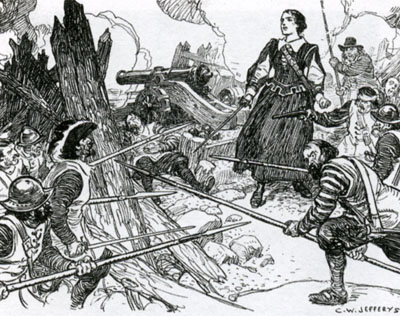
-
Article
Françoise Sullivan
Françoise Sullivan, sculptor, painter, dancer and choreographer (b at Montréal 10 Jun 1925). Sullivan studied at the École des beaux-arts de Montréal between 1941 and 1945.
"https://thecanadianencyclopedia.ca/images/tce_placeholder.jpg?v=e9dca980c9bdb3aa11e832e7ea94f5d9" // resources/views/front/categories/view.blade.php
https://thecanadianencyclopedia.ca/images/tce_placeholder.jpg?v=e9dca980c9bdb3aa11e832e7ea94f5d9
-
Article
Francophone
In Canada, the term francophone can refer to someone whose first language is French. They might most often use it to speak, read, write or think. French might also be their most often used language at home. Being francophone can also simply mean being able to speak the language fluently. According to the 2021 census, approximately 10.67 million Canadians, or 29.1 per cent of the population, stated that they were able to communicate in French. Around 7.65 million (20.9 per cent of Canadians) reported having French as a mother tongue.
"https://d3d0lqu00lnqvz.cloudfront.net/TCE_placeholder.png" // resources/views/front/categories/view.blade.php
https://d3d0lqu00lnqvz.cloudfront.net/TCE_placeholder.png
-
Article
Francophones of Alberta (Franco-Albertains)
In the Prairies, the names of rivers and trading posts bear the mark of explorers and voyagers who travelled the region during the 18th and 19th centuries. Agriculture and the petroleum industry attracted many migrants from Quebec, Acadia, Ontario and neighbouring provinces, but also from New-England, France and Belgium. In 2016, 418,000 Albertans (10.5 per cent of the population) were of French or French-Canadian origins (see: Francophone; Alberta; History of Settlement in the Canadian Prairies).
"https://d3d0lqu00lnqvz.cloudfront.net/media/new_article_images/francoalbertains/franco_albertan_flag_drapeau.jpg" // resources/views/front/categories/view.blade.php
https://d3d0lqu00lnqvz.cloudfront.net/media/new_article_images/francoalbertains/franco_albertan_flag_drapeau.jpg
-
Article
Francophones of British Columbia
The francophone presence in British Columbia has its origins in the colonization of the Pacific Northwest by Europeans at the turn of the 19th century.
"https://d3d0lqu00lnqvz.cloudfront.net/media/media/bfb65c27-6395-4d1f-b12b-84c6f760fb29.png" // resources/views/front/categories/view.blade.php
https://d3d0lqu00lnqvz.cloudfront.net/media/media/bfb65c27-6395-4d1f-b12b-84c6f760fb29.png
-
Article
Francophones of Manitoba
Manitoba’s “francophonie” is the term used to designate French-speakers in Manitoba, historically referred to as “Franco-Manitobans.” Changes in 2017 to the name of the Société de la francophonie manitobaine (formerly the Société franco-manitobaine) and the definition of “francophone” in the provincial law on French language services reflect the changing nature of the community itself. The core of Manitoba’s francophones is formed by descendants of voyageurs as well as settlers from Québec and Europe, but since the early 2000s the community has seen a growing number of immigrants from non-European countries as well as an increasing integration of francophones for whom French is not their first language.
"https://d3d0lqu00lnqvz.cloudfront.net/media/media/bc92f05e-a646-436a-b90f-69d490ba42f5.png" // resources/views/front/categories/view.blade.php
https://d3d0lqu00lnqvz.cloudfront.net/media/media/bc92f05e-a646-436a-b90f-69d490ba42f5.png