
Browse "History/Historical Figures"
-
Article
Campbell Mellis Douglas
Campbell Mellis Douglas, surgeon, soldier, writer, inventor and sportsman (b at Grosse Ile, Qué 5 Aug 1840; d at Wells, Somerset, Eng 31 Dec 1909).
"https://d3d0lqu00lnqvz.cloudfront.net/Campbell_Douglas_VC.jpg" // resources/views/front/categories/view.blade.php
https://d3d0lqu00lnqvz.cloudfront.net/Campbell_Douglas_VC.jpg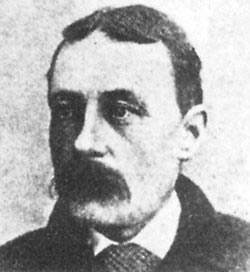
-
Article
Canada Committee
Canada Committee, a British parliamentary committee established 2 May 1828 to settle political disputes which were paralysing representative government in Lower Canada and creating difficulties in Upper Canada.
"https://thecanadianencyclopedia.ca/images/tce_placeholder.jpg?v=e9dca980c9bdb3aa11e832e7ea94f5d9" // resources/views/front/categories/view.blade.php
https://thecanadianencyclopedia.ca/images/tce_placeholder.jpg?v=e9dca980c9bdb3aa11e832e7ea94f5d9
-
Article
Canada Company
Canada Company, brainchild of John GALT, established in late 1824 and chartered in 1825 as a land and COLONIZATION COMPANY in Upper Canada. In 1826 the company purchased from the government about 2.5 million acres (1 million ha) of land for $295 000.
"https://d3d0lqu00lnqvz.cloudfront.net/media/media/a03fa073-a395-45c8-a7a3-8ae328595103.jpg" // resources/views/front/categories/view.blade.php
https://d3d0lqu00lnqvz.cloudfront.net/media/media/a03fa073-a395-45c8-a7a3-8ae328595103.jpg
-
Article
Canada First
Canada First, nationalist movement founded 1868 by Ontarians George Denison, Henry Morgan, Charles Mair and William Foster and by Robert Grant Haliburton, a Nova Scotian living in Ottawa.
"https://d3d0lqu00lnqvz.cloudfront.net/media/media/c77c043b-6130-478d-afe6-495c56f807bd.jpg" // resources/views/front/categories/view.blade.php
https://d3d0lqu00lnqvz.cloudfront.net/media/media/c77c043b-6130-478d-afe6-495c56f807bd.jpg
-
Collection
Canada in the 1930s
From the Great Depression to the outbreak of the Second World War, Canadians faced hardship and disruption. Government responses included work camps, economic and social legislation, and limits to immigration. By 1940, Canada had a national bank, broadcaster, film board and unemployment insurance scheme. But government help was limited and many people struggled in the “Dirty Thirties.” Canadians staged strikes and protests and joined populist political movements. Some embraced radical alternatives like fascism or communism,...
"https://d3d0lqu00lnqvz.cloudfront.net/media/media/4b5beb76-524c-45d8-81fb-a0228fb51abf.jpg" // resources/views/front/categories/view.blade.php
https://d3d0lqu00lnqvz.cloudfront.net/media/media/4b5beb76-524c-45d8-81fb-a0228fb51abf.jpg
-
Article
Canada’s Century: Sir Wilfrid Laurier’s Bold Prediction
“Let me tell you, my fellow countrymen, that all the signs point this way, that the 20th century shall be the century of Canada and Canadian development.… For the next 100 years, Canada shall be the star towards which all men who love progress and freedom shall come.” — Prime Minister Sir Wilfrid Laurier speaking at Toronto’s Massey Hall on 14 October 1904.
"https://d3d0lqu00lnqvz.cloudfront.net/media/media/adc9e102-e290-429c-8225-2fbbc673880f.jpg" // resources/views/front/categories/view.blade.php
https://d3d0lqu00lnqvz.cloudfront.net/media/media/adc9e102-e290-429c-8225-2fbbc673880f.jpg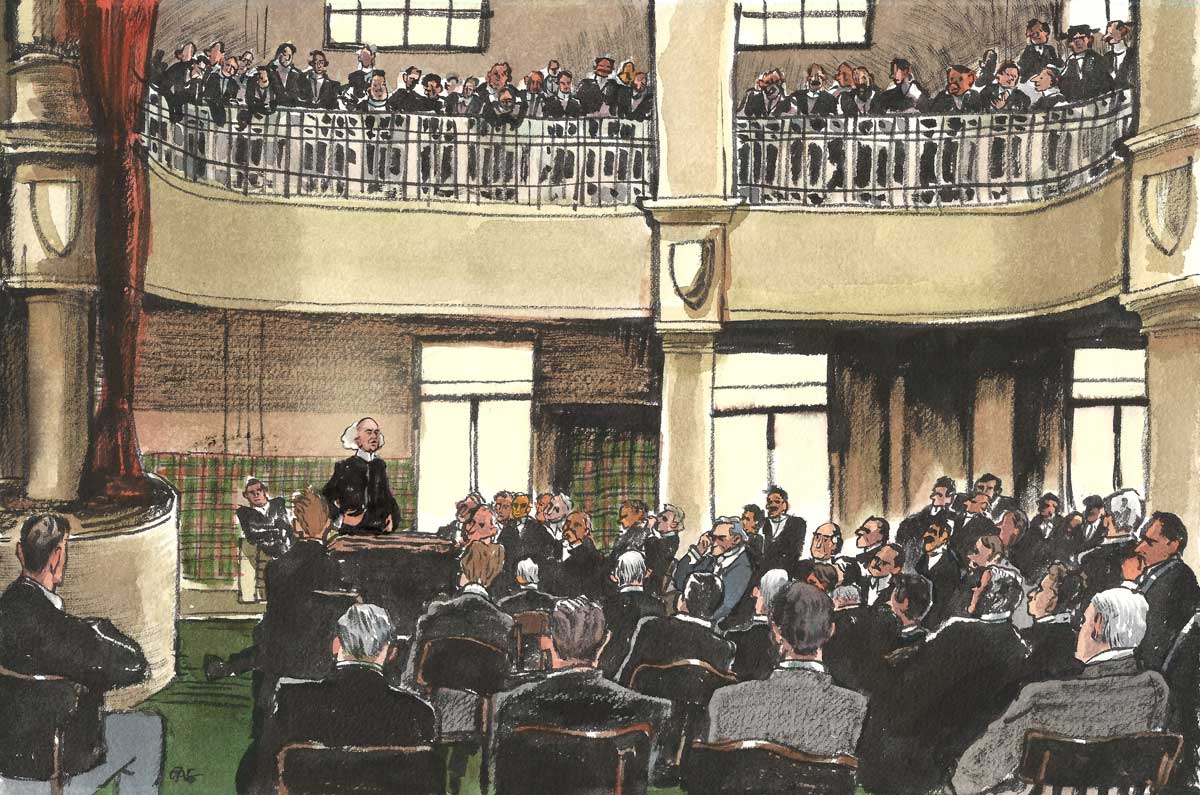
-
Editorial
Cupids, Newfoundland: Canada's First English Settlement
The following article is an editorial written by The Canadian Encyclopedia staff. Editorials are not usually updated. "Thomas Willoughby, thou art a ne'er-do-well! Get thee to Cupers Cove and reform thyself." Young Willoughby, 19, may not have heard exactly those words, but he was sent to Cupers Cove, Newfoundland in 1612 to "reform himself."
"https://d3d0lqu00lnqvz.cloudfront.net/media/media/f6135562-666e-484f-bcfd-e38d471d2c42.jpg" // resources/views/front/categories/view.blade.php
https://d3d0lqu00lnqvz.cloudfront.net/media/media/f6135562-666e-484f-bcfd-e38d471d2c42.jpg
-
Article
Canada's Road to the Second World War
As the threat of another world war loomed ever larger, Canadians, far from the conflict, would face a difficult choice of whether to stand again with Britain or remain isolated and safe in North America.
"https://d3d0lqu00lnqvz.cloudfront.net/media/Twitter_Cards/Wartime leaders.jpg" // resources/views/front/categories/view.blade.php
https://d3d0lqu00lnqvz.cloudfront.net/media/Twitter_Cards/Wartime leaders.jpg
-
Article
Canadian Army Medical Corps Nursing Sisters
More than 2,800 trained civilian nurses enlisted with the Canadian army during the First World War, becoming the first women in the modern world to hold military commissions as officers. As members of the Canadian Army Medical Corps (CAMC), the nursing sisters treated and cared for wounded soldiers overseas and at home. At least 58 died from disease or enemy action during the war.
"https://d3d0lqu00lnqvz.cloudfront.net/media/media/271eb18d-51cb-46d8-b660-42a54e9557c5.jpg" // resources/views/front/categories/view.blade.php
https://d3d0lqu00lnqvz.cloudfront.net/media/media/271eb18d-51cb-46d8-b660-42a54e9557c5.jpg
-
Article
Canadian Children and the Great War
The vast majority of Canada's eight million people fought the Great War at home.
"https://d3d0lqu00lnqvz.cloudfront.net/media/media/3103720d-0fac-454d-92f1-89bd5e70dfa3.jpg" // resources/views/front/categories/view.blade.php
https://d3d0lqu00lnqvz.cloudfront.net/media/media/3103720d-0fac-454d-92f1-89bd5e70dfa3.jpg
-
Article
Canadian Children and the Second World War
The Second World War forever altered Canada. Among those most affected were young Canadians. The war had a profound impact on their lives and families.
"https://d3d0lqu00lnqvz.cloudfront.net/media/media/e06cd521-88ae-4f9d-8950-02a0c45141f9.jpg" // resources/views/front/categories/view.blade.php
https://d3d0lqu00lnqvz.cloudfront.net/media/media/e06cd521-88ae-4f9d-8950-02a0c45141f9.jpg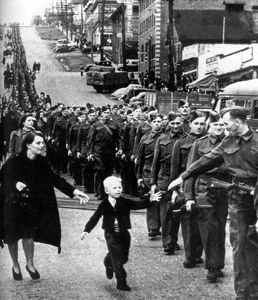
-
Article
Canadian Command during the Great War
The Canadian Expeditionary Force (CEF), of some 630,000 men during the Great War of 1914–18, consisted almost entirely of civilian soldiers. Pre-war farmers, clerks, students, and workers voluntarily enlisted to serve King and Country, although close to 100,000 were conscripted for service in the last year of the war. Most of the Canadian senior officers were drawn from the middle class — lawyers, engineers, professional soldiers, businessmen, farmers, and even a dentist.
"https://d3d0lqu00lnqvz.cloudfront.net/media/media/9a0a96ba-10cb-49e8-98bc-20c7dbecd49d.jpg" // resources/views/front/categories/view.blade.php
https://d3d0lqu00lnqvz.cloudfront.net/media/media/9a0a96ba-10cb-49e8-98bc-20c7dbecd49d.jpg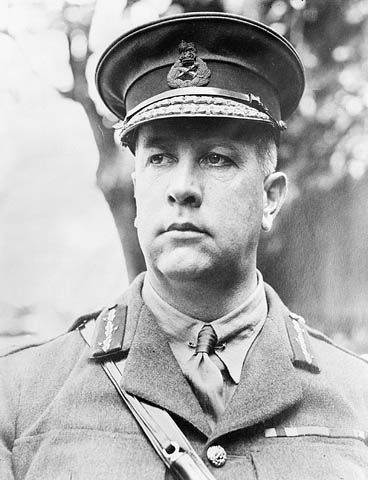
-
Article
Canadian Film History: 1939 to 1973
Filmmaking is a powerful form of cultural and artistic expression, as well as a highly profitable commercial enterprise. From a practical standpoint, filmmaking is a business involving large sums of money and a complex division of labour. This labour is involved, roughly speaking, in three sectors: production, distribution and exhibition. The history of the Canadian film industry has been one of sporadic achievement accomplished in isolation against great odds. Canadian cinema has existed within an environment where access to capital for production, to the marketplace for distribution and to theatres for exhibition has been extremely difficult. The Canadian film industry, particularly in English Canada, has struggled against the Hollywood entertainment monopoly for the attention of an audience that remains largely indifferent toward the domestic industry. The major distribution and exhibition outlets in Canada have been owned and controlled by foreign interests. The lack of domestic production throughout much of the industry’s history can only be understood against this economic backdrop. This article is one of four that surveys the history of the film industry in Canada. The entire series includes: Canadian Film History: 1896 to 1938; Canadian Film History: 1939 to 1973; Canadian Film History: 1974 to Present; Canadian Film History: Regional Cinema and Auteurs, 1980 to Present.
"https://d3d0lqu00lnqvz.cloudfront.net/media/media/365bfdc3-53d4-4033-b13f-5a89a83a85d5.jpg" // resources/views/front/categories/view.blade.php
https://d3d0lqu00lnqvz.cloudfront.net/media/media/365bfdc3-53d4-4033-b13f-5a89a83a85d5.jpg
-
Article
Canadian Film History: 1974 to Present
Filmmaking is a powerful form of cultural and artistic expression, as well as a highly profitable commercial enterprise. From a practical standpoint, filmmaking is a business involving large sums of money and a complex division of labour. This labour is involved, roughly speaking, in three sectors: production, distribution and exhibition. The history of the Canadian film industry has been one of sporadic achievement accomplished in isolation against great odds. Canadian cinema has existed within an environment where access to capital for production, to the marketplace for distribution and to theatres for exhibition has been extremely difficult. The Canadian film industry, particularly in English Canada, has struggled against the Hollywood entertainment monopoly for the attention of an audience that remains largely indifferent toward the domestic industry. The major distribution and exhibition outlets in Canada have been owned and controlled by foreign interests. The lack of domestic production throughout much of the industry’s history can only be understood against this economic backdrop. This article is one of four that surveys the history of the film industry in Canada. The entire series includes: Canadian Film History: 1896 to 1938; Canadian Film History: 1939 to 1973; Canadian Film History: 1974 to Present; Canadian Film History: Notable Films and Filmmakers 1980 to Present.
"https://d3d0lqu00lnqvz.cloudfront.net/media/media/4fd4ee50-6f27-491b-aeb7-2f5cd3c95f9e.jpg" // resources/views/front/categories/view.blade.php
https://d3d0lqu00lnqvz.cloudfront.net/media/media/4fd4ee50-6f27-491b-aeb7-2f5cd3c95f9e.jpg
-
Article
Canadian Intervention in the Russian Civil War
The Allies accordingly undertook to support anticommunist White Russian forces if they would, once back in power, resume war on the Eastern Front against Germany and Austria, a strategy warmly supported by those in London and Paris, in any case, to see the eradication of Bolshevism from Russia.
"https://d3d0lqu00lnqvz.cloudfront.net/media/media/1cbd0c0f-04ae-42a7-ab4d-16f63b46e397.jpg" // resources/views/front/categories/view.blade.php
https://d3d0lqu00lnqvz.cloudfront.net/media/media/1cbd0c0f-04ae-42a7-ab4d-16f63b46e397.jpg