
Browse "Asian Canadians"
-
Article
Aziz Ahmad
Aziz Ahmad, novelist, short story writer, critic, translator, historian (born 11 November 1914 in Hyderabad Deccan [present-day India]; died 16 December 1978 in Toronto, ON).
"https://thecanadianencyclopedia.ca/images/tce_placeholder.jpg?v=e9dca980c9bdb3aa11e832e7ea94f5d9" // resources/views/front/categories/view.blade.php
https://thecanadianencyclopedia.ca/images/tce_placeholder.jpg?v=e9dca980c9bdb3aa11e832e7ea94f5d9
-
Article
Celebrating Asian Heritage in Canada
Many Canadians today see our diverse population as a source of pride and strength — for good reason. More than one in five Canadians were born elsewhere. That is the highest percentage of immigrants in the G7 group of large industrialized nations. Asia (including people born in the Middle East) has provided the greatest number of newcomers in recent years. Since the 1990s, Canadians — who once thought primarily of Europe when they considered events abroad — now define themselves, and the world, differently. As former prime minister Jean Chrétien said: “The Pacific is getting smaller and the Atlantic is becoming wider.”
"https://d3d0lqu00lnqvz.cloudfront.net/media/media/adef87b1-6957-4124-95cc-3d0682f22ba6.jpg" // resources/views/front/categories/view.blade.php
https://d3d0lqu00lnqvz.cloudfront.net/media/media/adef87b1-6957-4124-95cc-3d0682f22ba6.jpg
-
Article
Chinese Music in Canada
The migration of Chinese to Canada began in 1858 as a result of the Fraser River Gold Rush in British Columbia. Most of the 19th-century migrants, including those contracted for CPR labour from 1882 to 1885, came from Kwangtung (Canton) Province, some via the USA.
"https://thecanadianencyclopedia.ca/images/tce_placeholder.jpg?v=e9dca980c9bdb3aa11e832e7ea94f5d9" // resources/views/front/categories/view.blade.php
https://thecanadianencyclopedia.ca/images/tce_placeholder.jpg?v=e9dca980c9bdb3aa11e832e7ea94f5d9
-
Article
Chinese Canadians
Chinese Canadians are one of the largest ethnic groups in the country. In the 2021 census, more than 1.7 million people reported being of Chinese origin. Despite their importance to the Canadian economy, including the construction of the Canadian Pacific Railway (CPR), many European Canadians were historically hostile to Chinese immigration. A prohibitive head tax restricted Chinese immigration to Canada from 1885 to 1923. From 1923 to 1947, the Chinese were excluded altogether from immigrating to Canada. (See Chinese Immigration Act.) Since 1900, Chinese Canadians have settled primarily in urban areas, particularly in Vancouver and Toronto. They have contributed to every aspect of Canadian society, from literature to sports, politics to civil rights, film to music, business to philanthropy, and education to religion. This is the full-length entry about Chinese Canadians. For a plain-language summary, please see Chinese Canadians (Plain-Language Summary).
"https://d3d0lqu00lnqvz.cloudfront.net/media/media/bff27f89-2e99-43af-a42e-36f38dbcdf8d.jpg" // resources/views/front/categories/view.blade.php
https://d3d0lqu00lnqvz.cloudfront.net/media/media/bff27f89-2e99-43af-a42e-36f38dbcdf8d.jpg
-
Article
Chinese Head Tax in Canada
The Chinese head tax was enacted to restrict immigration after Chinese labour was no longer needed to build the Canadian Pacific Railway. Between 1885 and 1923, Chinese immigrants had to pay a head tax to enter Canada. The tax was levied under the Chinese Immigration Act (1885). It was the first legislation in Canadian history to exclude immigration on the basis of ethnic background. With few exceptions, Chinese people had to pay at least $50 to come to Canada. The tax was later raised to $100, then to $500. During the 38 years the tax was in effect, around 82,000 Chinese immigrants paid nearly $23 million in tax. The head tax was removed with the passing of the Chinese Immigration Act in 1923. Also known as the Chinese Exclusion Act, it banned all Chinese immigrants until its repeal in 1947. In 2006, the federal government apologized for the head tax and its other racist immigration policies targeting Chinese people. This is the full-length entry about the Chinese Head Tax. For a plain-language summary, please see Chinese Head Tax in Canada (Plain-Language Summary).
"https://d3d0lqu00lnqvz.cloudfront.net/media/media/d0c5f1d6-6030-4a96-900c-3efed6463116.jpg" // resources/views/front/categories/view.blade.php
https://d3d0lqu00lnqvz.cloudfront.net/media/media/d0c5f1d6-6030-4a96-900c-3efed6463116.jpg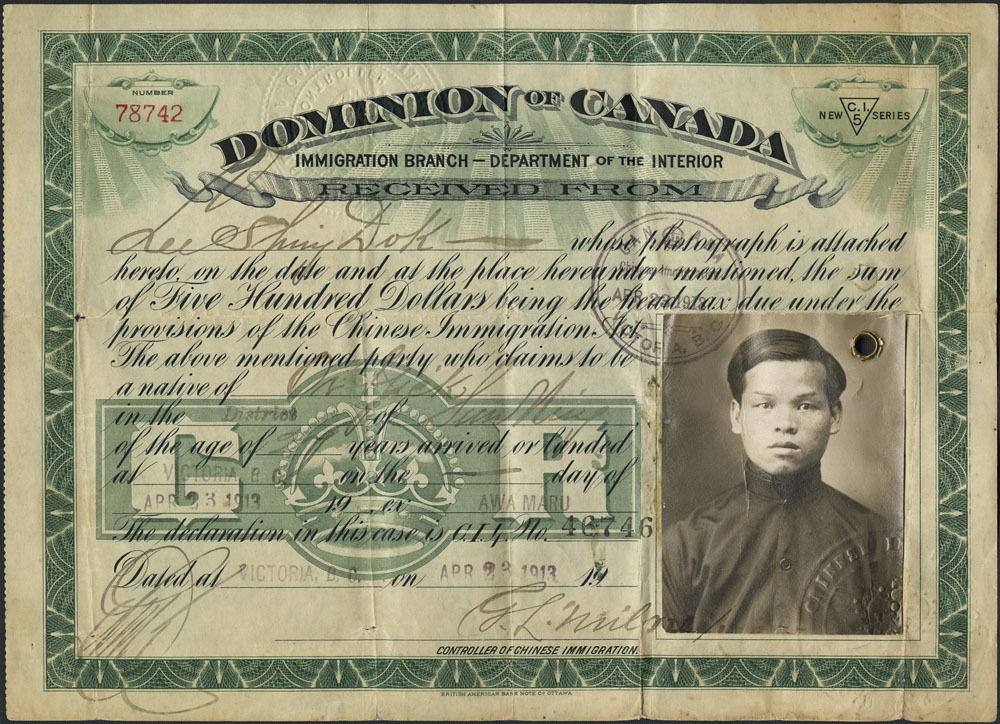
-
Article
Lunar New Year in Canada
The Lunar New Year — also known as the Spring Festival, Chinese New Year, Tet for Vietnamese Canadians, or Solnal for Korean Canadians — is celebrated in Canada and several other countries. It is one of the largest celebrations for Canada’s Chinese population, it is also celebrated by Canadians from Vietnam, Korea and Southeast Asia. Although it is not a statutory holiday in Canada, many Asian Canadian businesses are closed or have reduced hours for the occasion. Since 1 June 2016, this celebration has been recognized as an official holiday in Canada.
"https://d3d0lqu00lnqvz.cloudfront.net/media/media/e1474526-547c-47b7-90e4-afda069c28bf.jpg" // resources/views/front/categories/view.blade.php
https://d3d0lqu00lnqvz.cloudfront.net/media/media/e1474526-547c-47b7-90e4-afda069c28bf.jpg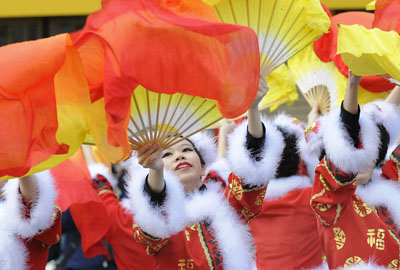
-
Article
Douglas Jung
Douglas Jung, CM, OBC, politician, lawyer, soldier (born 25 February 1924 in Victoria, BC; died 4 January 2002 in Vancouver, BC). Douglas Jung was a member of Force 136, a group of Chinese Canadian soldiers who fought behind enemy lines in the Pacific theatre during the Second World War. After the war, Jung became a lawyer in British Columbia and was the first Chinese Canadian lawyer to appear before the BC Court of Appeal in 1955. On 10 June 1957, Douglas Jung was elected as the first Chinese Canadian member of Parliament.
"https://d3d0lqu00lnqvz.cloudfront.net/media/new_article_images/DouglasJung/10984373226_bd88f4308b_k.jpg" // resources/views/front/categories/view.blade.php
https://d3d0lqu00lnqvz.cloudfront.net/media/new_article_images/DouglasJung/10984373226_bd88f4308b_k.jpg
-
Article
Indonesian Canadians
Immigration from Indonesia to Canada began after the Second World War. In the wake of the decolonization process, 300,000 “Indos” (Indische Nederlander), persons of mixed Dutch and Asian ancestry, were repatriated to the Netherlands. Some of them decided to continue their journeys, settling in Australia, the United States and Canada. Throughout the 1960s and early 1970s, political instability also led many Indonesians to immigrate to Canada. According to the 2016 census, 21,395 individuals indicated that they had Indonesian origins. Notable Indonesian Canadians include violin maker Piet Molenaar and Toronto filmmaker Mike Hoolboom.
"https://d3d0lqu00lnqvz.cloudfront.net/media/media/dac2bfbe-b7bb-4080-83aa-a7a2cab9cc08.jpg" // resources/views/front/categories/view.blade.php
https://d3d0lqu00lnqvz.cloudfront.net/media/media/dac2bfbe-b7bb-4080-83aa-a7a2cab9cc08.jpg
-
Interview
Interned in Canada: an Interview with Pat Adachi
Pat Adachi was born and raised in Vancouver, the daughter of Japanese immigrants. She grew up in the heart of the city’s Little Tokyo neighbourhood, within walking distance of the local grounds where her father would take her on Sundays to watch her favourite baseball team, the Vancouver Asahi. Adachi and her family lived normal lives, until she and her community were uprooted in 1942, when the federal government ordered Japanese Canadians to internment camps in rural British Columbia (see Internment of Japanese Canadians). In this interview, Adachi shares her story and relates the experiences of the 22,000 Japanese Canadians who were interned in Canada during the Second World War. This interview has been edited for length and clarity.
"https://d3d0lqu00lnqvz.cloudfront.net/media/new_article_images/Pat Adachi.jpg" // resources/views/front/categories/view.blade.php
https://d3d0lqu00lnqvz.cloudfront.net/media/new_article_images/Pat Adachi.jpg
-
Macleans
Iran to Investigate Journalist's Death
Zahra Kazemi was not the first journalist to die for her job in Iran. Nor is she the first to die of beatings while in state custody.This article was originally published in Maclean's Magazine on July 28, 2003
"https://thecanadianencyclopedia.ca/images/tce_placeholder.jpg?v=e9dca980c9bdb3aa11e832e7ea94f5d9" // resources/views/front/categories/view.blade.php
https://thecanadianencyclopedia.ca/images/tce_placeholder.jpg?v=e9dca980c9bdb3aa11e832e7ea94f5d9
-
Article
Ken Sim
Ken Sim, entrepreneur, politician, mayor of Vancouver 2022– (born 18 October 1970 in Vancouver, BC). Ken Sim worked as an accountant and investment banker before co-founding two successful businesses: Nurse Next Door and Rosemary Rocksalt bagels. Sim made an unsuccessful bid to become mayor of Vancouver in 2018, losing to Kennedy Stewart by 957 votes. In 2022, he and his A Better City (ABC) Party won a majority government with a platform that stressed law and order and public safety. Sim is the first Chinese Canadian to be elected mayor of Vancouver.
"https://d3d0lqu00lnqvz.cloudfront.net/vancouver-mayor-ken-sim-290x227.jpg" // resources/views/front/categories/view.blade.php
https://d3d0lqu00lnqvz.cloudfront.net/vancouver-mayor-ken-sim-290x227.jpg
-
Article
Kim Thúy
Kim Thúy, CQ, writer (born 18 September 1968 in Saigon, Vietnam). The winner of several prestigious literary awards for her first novel, Ru, this Quebec writer of Vietnamese origin is known for her short and elegant stories. Her novels deal with the migrant experience and the challenges of adapting to a new culture. Written in French, which Thúy calls her “second mother tongue,” they have been translated into 15 languages.
"https://d3d0lqu00lnqvz.cloudfront.net/media/media/c21c847d-d32a-4aea-9d70-2160aa06f1f2.jpg" // resources/views/front/categories/view.blade.php
https://d3d0lqu00lnqvz.cloudfront.net/media/media/c21c847d-d32a-4aea-9d70-2160aa06f1f2.jpg
-
Article
Korean Music in Canada
In the 1986 Census of Canada, 29,705 listed Korean as their single or multiple ethnic origin. Half of these lived in the Metropolitan Toronto area.
"https://thecanadianencyclopedia.ca/images/tce_placeholder.jpg?v=e9dca980c9bdb3aa11e832e7ea94f5d9" // resources/views/front/categories/view.blade.php
https://thecanadianencyclopedia.ca/images/tce_placeholder.jpg?v=e9dca980c9bdb3aa11e832e7ea94f5d9
-
Article
Korean Music and Dance
The first significant wave of immigration to Canada from Korea began in the late 1960s and the early 1970s.
"https://thecanadianencyclopedia.ca/images/tce_placeholder.jpg?v=e9dca980c9bdb3aa11e832e7ea94f5d9" // resources/views/front/categories/view.blade.php
https://thecanadianencyclopedia.ca/images/tce_placeholder.jpg?v=e9dca980c9bdb3aa11e832e7ea94f5d9
-
Article
Korean Canadians
Korea was a single, independent country for 1,300 years before splitting in two after the Second World War. North Korea is today an isolated military dictatorship while South Korea is a liberal democracy. Almost all Korean immigration to Canada has been from South Korea. In 2016, the census recorded 198,210 Canadians of Korean origin (177,925 single and 20,290 multiple responses.)
"https://d3d0lqu00lnqvz.cloudfront.net/media/new_article_images/KoreanCanadians/Koreatown_Toronto.jpg" // resources/views/front/categories/view.blade.php
https://d3d0lqu00lnqvz.cloudfront.net/media/new_article_images/KoreanCanadians/Koreatown_Toronto.jpg