Share on Facebook
 Share on X
 Share by Email
 Share on Google Classroom
In Tsilhqot’in Nation v. British Columbia (2014), the Supreme Court of Canada issued the first-ever declaration of Aboriginal title in Canadian history. It recognized the Tsilhqot’in Nation’s rights over 1,700 km² of their traditional territory (see also Indigenous Territory). This landmark ruling clarified the legal test for Aboriginal title. It also affirmed Indigenous land rights based on historical occupation (see also Rights of Indigenous Peoples in Canada). The decision overturned colonial-era assumptions like terra nullius, marked a significant step in reconciliation and set a powerful precedent for Indigenous nations across Canada pursuing land claims (see also Doctrine of Discovery; Colonialism in Canada).

Background
In or about 1650, the Tsilhqot’in people migrated into their present-day territory in the central interior of British Columbia. Almost 150 years later, Alexander Mackenzie reached the Pacific Ocean by land. During this expedition, he passed through the territory of the Tsilhqot’in. By 1828, the Hudson’s Bay Company opened a fort close to Tsilhqot’in territory in an effort to establish trade. In December 1838, Tsilhqot’in Chief Allaw ordered the traders off the land, expressing frustration with the fort.
In 1989, the Tsilhqot’in released a declaration in response to logging licenses granted by the British Columbia government to areas in their territory. The declaration stated that there would be no logging permitted on the territory. Additionally, it stated that the Tsilhqot’in would protect their Aboriginal rights in that area (see Rights of Indigenous Peoples in Canada).
The following year, the Tsilhqot’in Nation filed an action against the logging companies and the BC government seeking injunctions pertaining to the logging permits. This legal action was followed by a blockade in 1993. In 1998, the legal action was amended to include a claim of Aboriginal title to 1,700 km² of land in central BC.
Early Legal Battles
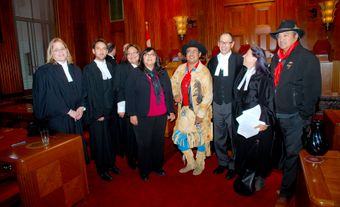
In 2002, the Tsilhqot’in Nation’s claim of Aboriginal title against the provincial and federal governments proceeded to trial. The trial ran for 339 days spanning five years. During the trial, the trial judge spent time in the claim area and heard evidence from Tsilhqot’in Elders, historians and other experts. In 2007, the trial judge released his decision finding that the Tsilhqot’in had proven their right to the title lands. However, for procedural reasons, he refused to make a declaration of title. The Tsilhqot’in Nation appealed that decision to the British Columbia Court of Appeal (BCCA) (see also Court System of Canada). In 2012, the BCCA rejected the finding of Aboriginal title on the basis that the Tsilhqot’in could not show the intensive occupation necessary to ground Aboriginal title. The Tsilhqot’in Nation appealed this decision to the Supreme Court of Canada, and, on 7 November 2013, their appeal was heard before a panel of eight judges.
Supreme Court of Canada Decision
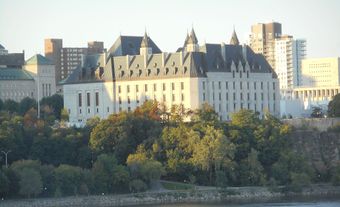
In a unanimous decision, the Supreme Court of Canada ruled that the appeal of the Tsilhqot’in Nation should be allowed and a declaration of Aboriginal title over their claim area should be granted.
To arrive at this conclusion, the Court first clarified the legal test required to make a declaration of Aboriginal title. Following legal principles set out in Guerin v. The Queen (1984) and Delgamuukw v. British Columbia (1997), the Court determined that an Indigenous group seeking to prove Aboriginal title to land must show that their occupation of land was sufficient, continuous and exclusive. The Court emphasized that sufficiency, continuity and exclusivity must be understood from both the Indigenous and common law perspectives, considering the “context and characteristics of the Aboriginal society.” By emphasizing an Indigenous perspective, the Court determined that an Indigenous group could prove Aboriginal title based upon the regular use of territory through hunting, fishing, trapping and foraging rather than requiring evidence of villages or farms.
Having set out the legal test for Aboriginal title, the Court determined that the trial judge had made no error in concluding that the evidence supported a finding of Aboriginal title. It found that the trial judge applied the correct legal test to the evidence before him. Following the trial judge’s findings, the Court held that the Tsilhqot’in had proven that their occupation of the title claim area was sufficient, continuous and historically exclusive.
As this was the first time the Court had made a finding of Aboriginal title, it also addressed two further ramifications of its decision: the content of Aboriginal title and the relationship between Aboriginal title lands and provincial regulations. The Court held that a declaration of Aboriginal title granted the Tsilhqot’in the right to use the land, enjoy it and profit from its economic development. However, the Court put forward one restriction; the land could not be used in ways that would deprive future generations of its benefits. Finally, the Court diverged from early jurisprudence and held that regulations passed by provinces could apply on Aboriginal title lands. This would allow provinces to infringe upon Aboriginal rights, subject to the legal test for infringement set out in R. v. Sparrow (1990).
Impact
For the Tsilhqot’in Nation, the Supreme Court’s decision was a resounding success. It granted recognition and legal protection to their longstanding claim of right to their lands and concluding their 30 years of legal action. The Tsilhqot’in were now able to enjoy the lands and the full rights that flowed from it as their ancestors had at the time of contact with the first European traders and settlers.
For Indigenous groups across Canada, the Court’s decision was understood to be a major victory, breathing life into claims for recognition of Aboriginal title. While there have only been two legal cases since the Court’s decision in Tsilhqot’in that have made a finding of Aboriginal title, those decisions have come recently, in April 2024 and August 2025.
Finally, the Court’s decision in Tsilhqot’in was understood by many to be a major step forward in the process of reconciliation. It overturned a long-held legal principle, terra nullius (see also Doctrine of Discovery). In the context of Canada, terra nullius was the idea that land in Canada was not owned by anyone prior to European settlement (see also Colonialism in Canada). It was used to justify the taking of Indigenous lands. Despite this rejection of terra nullius, scholar John Borrows has remarked that Canadian law continues to be threaded through with this principle. The decision also emphasized the need for Indigenous perspectives to be given equal weight in determinations of Aboriginal title. As Chief Justice Beverley McLachlin wrote in the decision, “Aboriginals and non-Aboriginals are ‘all here to stay’ and must of necessity move forward in a process of reconciliation.”