Share on Facebook
 Share on X
 Share by Email
 Share on Google Classroom
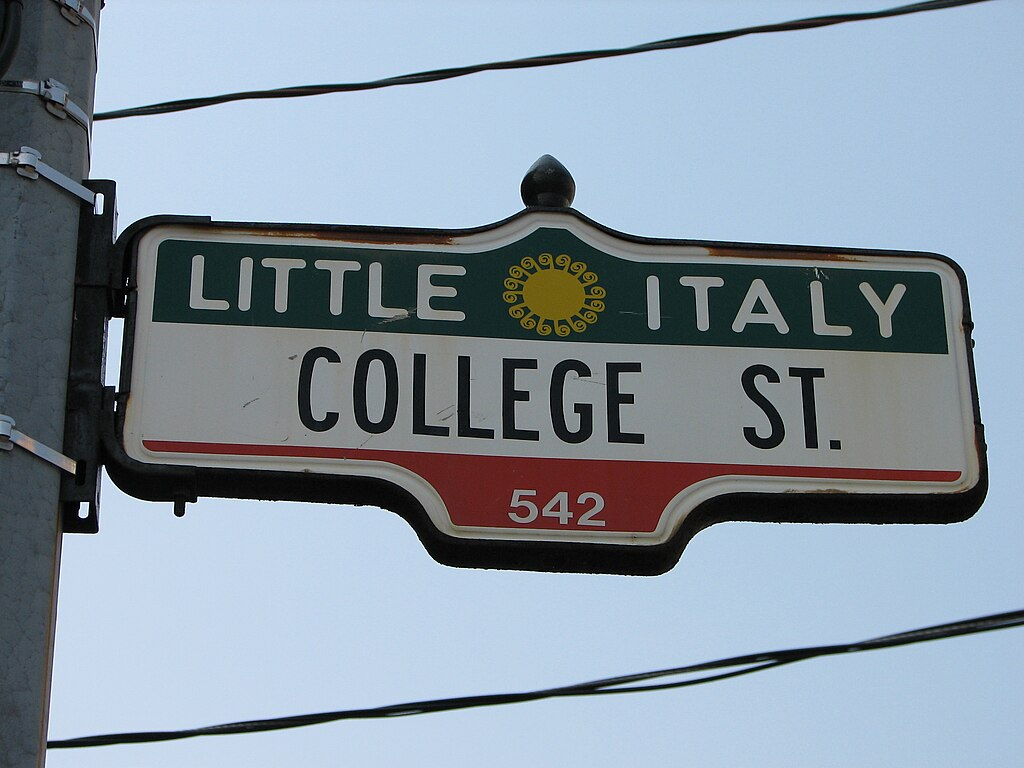
Toronto’s Little Italy is in the city’s downtown area. It lies on the stretch of College Street between Bathurst Street and Ossington Avenue. The area falls within the boundaries of Treaty 13, signed with the Mississaugas of the Credit. Little Italy was home to many cohorts of Italian immigrants in the 19th and 20th centuries. Now, it hosts many small businesses and cultural events. Today, most Italian Canadians reside in other parts of the Greater Toronto Area. These include Corso Italia (located near Dufferin Street and St. Clair Avenue). However, Little Italy still enjoys a lasting cultural legacy.
Settlement History
For millennia, the land on which Little Italy is situated has been home to Indigenous nations such as the Wendat, Anishnaabe and Haudenosaunee. The area falls within the boundaries of Treaty 13, signed with the Mississaugas of the Credit.
In the late 19th century, Italian immigrants began to settle in the area which would become Little Italy. They were part of the first major cohort of Italian immigration to Toronto. (See also Immigration to Canada.) Initially, many settled in St. John’s Ward, a poor neighbourhood also known as “The Ward.” Large development projects such as the Toronto General Hospital forced many to relocate to Little Italy.
As the 20th century began, Little Italy’s population remained consistent. Many small businesses popped up to cater to the Italian Canadian community. A 1926 survey reported that over 60 per cent of businesses located on College St. between Bathurst and Grace streets were Italian or used Italian terms in their names. According to historian Franca lacovetta, the area’s population included about 10,000 Italians.
The Great Depression and the Second World War slowed Little Italy’s development. During the war, the federal government feared that Italian Canadians had ties to Italy’s fascist regime. As a result, Canada interned about 600 Italian Canadians. (See Internment in Canada.) The government also forced 31,000 of them to register as “enemy aliens.” This caused major harm to the Italian Canadian community. In Little Italy, fear of internment slowed immigration and business development rates.
After the Second World War, College Street became a settlement hub for another new cohort of Italian immigrants. From 1940 to 1971, over 460,000 Italians came to Canada. Many chose Toronto as their home. According to lacovetta, over 40 per cent of those entering Canada in 1951–61 settled in the city. Changing Canadian immigration policy caused these patterns. In the late 1940s, the government allowed in new immigrants for certain workplaces. This attracted many Italian men to come to Canada. This group came especially from the farming regions of Southern Italy. Most of these men ended up working construction, manufacturing, logging and mining jobs. Many settled in Toronto’s Little Italy because of its cheap housing rates and pre-existing Italian community. They then often sponsored their family members and paesani (people from the same town or village) to come to Canada. The large majority of Italian immigrants in this period arrived through family sponsorships.
New immigrants’ arrivals led to more businesses and institutions to address their needs. Many Italian shops, clubs and cafés popped up on College Street as the years progressed. Little Italy also supported a vibrant cinema culture and various independent theatres. Social sites such as Café Diplomatico and the Mod Club Theatre remain popular today. Many Italians joined Catholic congregations in the area, particularly the Church of St. Agnes on Grace Street. The community organized feast day celebrations based on Roman Catholic traditions.
Beyond Little Italy, Italians also clustered in areas such as the Junction as well as on Danforth and Coxwell. Many Italian Canadians moved to both these areas and to Corso Italia, located on the stretch of St. Clair Avenue between Lansdowne Avenue and Dufferin Street.
In the late 1950s and early 1960s, Corso Italia became a popular destination for Italian clothing, restaurants and cafés. By 1961, Corso Italia was the fastest-growing Italian community in Toronto. At that time, it was more than double the size of Little Italy. To this day, the community is home to many Italian Canadians and their businesses.
Did you know?
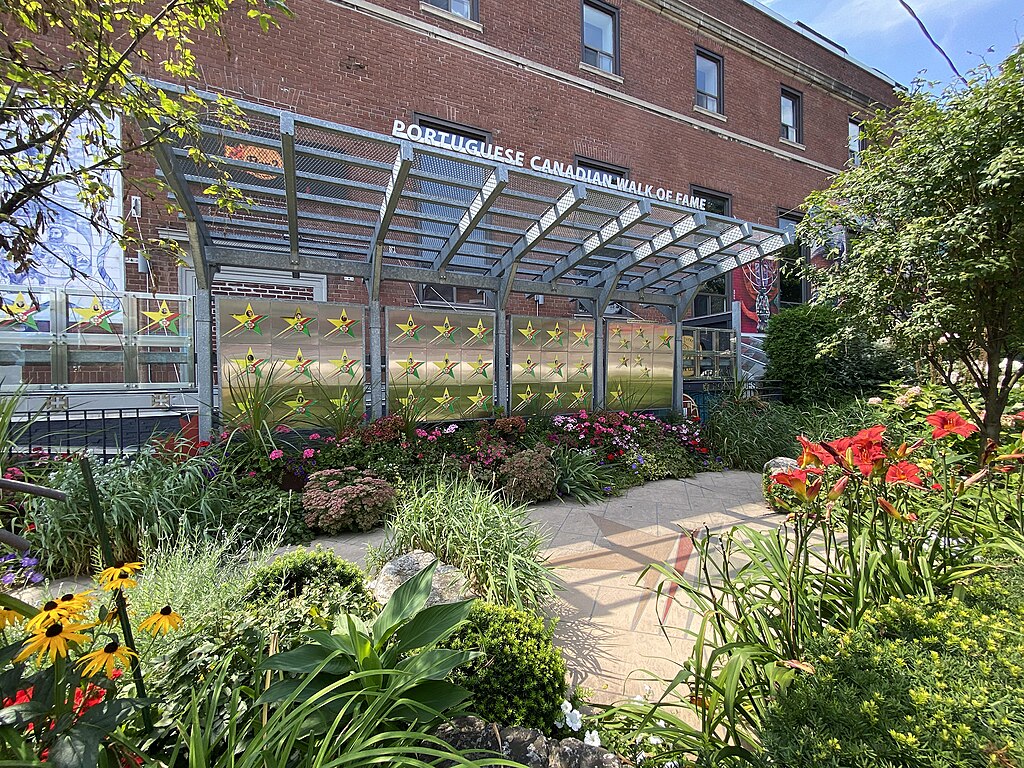
In the late 20th century, both Little Italy and Corso Italia welcomed large Portuguese and Latin Canadian communities as they immigrated to Toronto. The Portuguese Canadian Walk of Fame at the corner of College and Crawford streets is one icon of the areas’ shared heritage.
Over time, Toronto continued to develop and gentrify. As a result, it’s common knowledge in the Italian community that many families who made more lucrative livings moved out of Little Italy and Corso Italia. Many relocated to suburbs such as Woodbridge, King City and Vaughan during this time.
As of 2025, College Street Little Italy has a relatively small Italian Canadian population. However, the area retains its cultural significance to both the community and the city.
Business, Community Life and Culture
Toronto’s Little Italy is home to cultural events, small businesses and institutions which reflect the neighbourhood’s history.
Every mid-June, the community organizes The Taste of Little Italy festival. During the festival, College Street is blocked off to cars and public transit. The street then hosts performances, food tastings and a carousel. There is also a yearly cavalcade of lights at Christmastime.
Little Italy is the birthplace of one of Canada’s oldest multilingual radio stations, CHIN FM. The station is housed in the CHIN building, at the intersection of College and Grace streets. Initially, entrepreneur Johnny Lombardi founded the station by buying time slots on different radio stations. He used those to broadcast Italian-language programs. CHIN now broadcasts in 37 different languages programs, catering to Toronto and Ottawa’s diverse communities. (See Multiculturalism.)
Il Corriere Canadese, an Italian-language daily newspaper which started publishing in 1954, also has roots in Little Italy. Il Corriere still routinely publishes issues, although its headquarters have moved to North York.
In 1968, Rocco and Paul Mastrangelo opened Cafe Diplomatico at the corner of College and Clinton streets. The restaurant was among the first to include outdoor dining in Toronto. It notably incorporated elements of Italian bar and café cultures. Cafe Diplomatico quickly became a popular place for new Italian immigrants to socialize. It remains a popular restaurant to this day. (See Italian Canadians.)
Corso Italia hosts a variety of other cultural events, reflecting its diverse population. There are annual community events near Halloween and Christmas. In 2025, Toronto’s annual Portugal Day Parade was hosted in the neighbourhood for the first time.