Share on Facebook
 Share on X
 Share by Email
 Share on Google Classroom
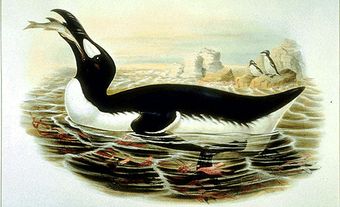
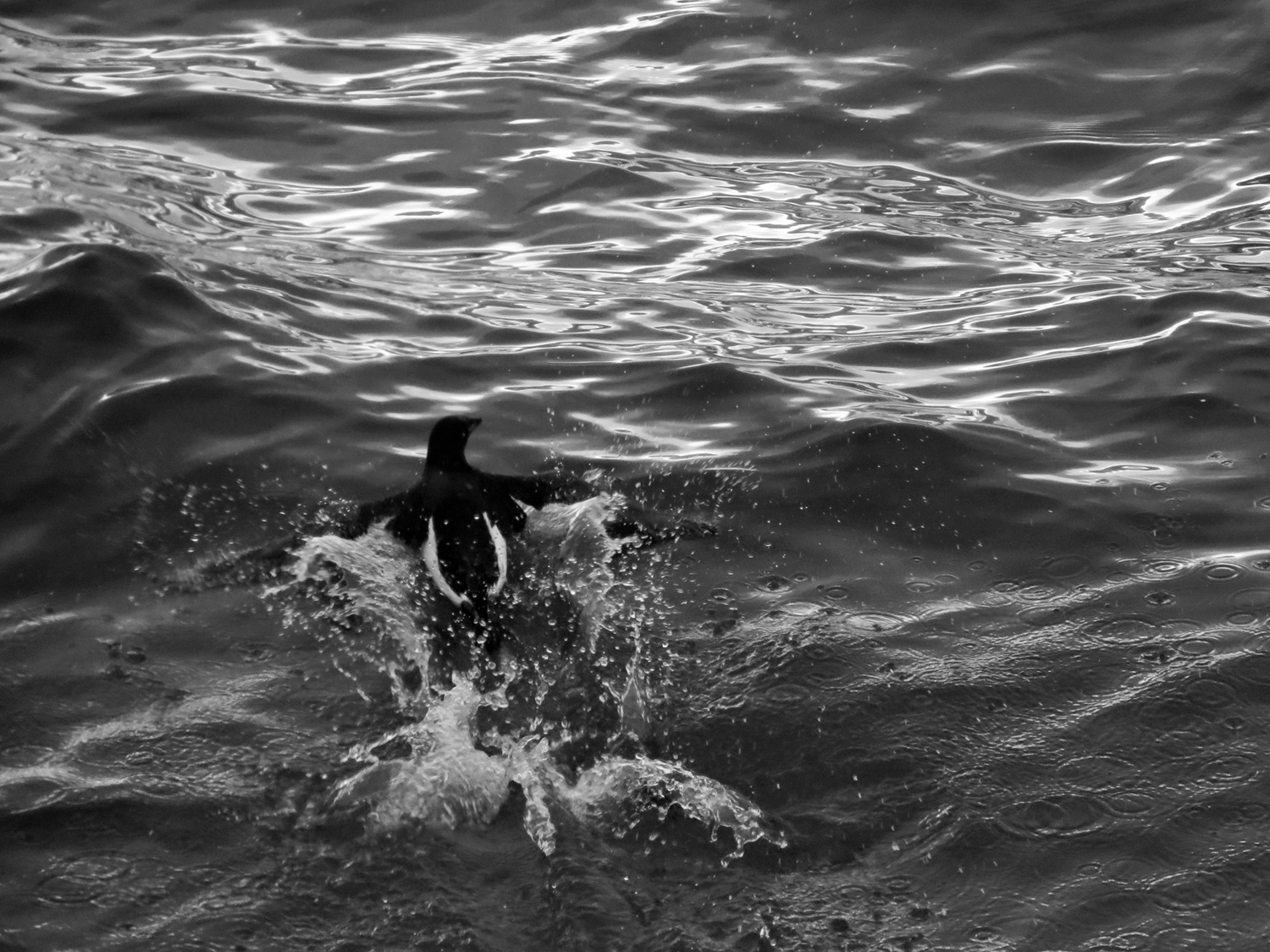
The term murre refers to two species, common murre (Uria aalge) and thick-billed murre (U. lomvia), the largest extant members of the auk family, though smaller than the recently extinct great auk. Murres weigh 800–1,100 g and are up to 46 cm long. Plumage is dark brown to black above, mostly pure white below. Like all auks, murres come to land only to breed.
Distribution and Reproduction
Murres occur in the cooler waters of the North Pacific and North Atlantic oceans and adjacent parts of the Arctic Ocean. Common murres breed primarily in boreal and low arctic waters; most thick-billed murres breed farther north in low and high arctic waters.
Murres often breed in dense colonies on coastal cliffs and islands, laying a single, large egg on bare rock ledges on the cliff face or surface. They normally first breed when 5 years old. Incubation, shared by both parents, takes 32–34 days. A single chick is fed at a breeding site for 15–20 days and then taken to sea by one parent (usually the male), who remains to guard and feed the chick for about 4–8 weeks.
In Canada, both species are most abundant on the Atlantic coast. Small numbers of common murres breed in BC; thick-bills in the western Arctic. Almost 90 per cent of eastern North American common murres breed in Newfoundland, with about 67 per cent (400,000 to 450,000 pairs) at Funk Island.
Breeding distribution of thick-bills is also restricted; most breed at 11 sites in the eastern Arctic. The thick-billed murre population in eastern Canada totals 1.6 million pairs, representing the entire population in eastern North America and 75 per cent of all thick-bills breeding in the western North Atlantic. Numbers of both species have been seriously reduced over the last century because of human disturbance, hunting, oil pollution and probably commercial fisheries development.

Hunting and Conservation
Murres are hunted by residents of Newfoundland and Labrador and by Indigenous people. Newfoundland residents were granted hunting rights soon after entering Confederation in 1949. However, until 1994, hunters could kill as many murres as they could access, with daily takes often exceeding 500 birds per hunter. Totals of about 600,000 to 900,000 were shot annually during the 1970s and 1980s. This resulted in both species of murres being below ideal population levels. Today, the annual harvest of murres in Canada ranges from 60,000 to 120,000, and harvests are regulated. Both species of murres are currently considered secure.