Share on Facebook
 Share on X
 Share by Email
 Share on Google Classroom
The Village is Montreal's gay neighbourhood, centered around Sainte-Catherine Street between Berri and Papineau Streets. It is a vibrant cultural hub, shaped by and for the 2SLGBTQ+ community and a neighbourhood that is constantly reinventing itself. It is the result of decades of resilience in the face of adversity and socio-economic constraints.
History and Evolution
In the 1970s, the Gay Village was first known informally by gay communities. It existed without bearing the official name. At the time, the Gay Village was anchored in the west end of downtown Montreal, especially near the intersection of Peel and Sainte-Catherine streets.
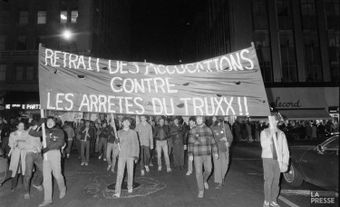
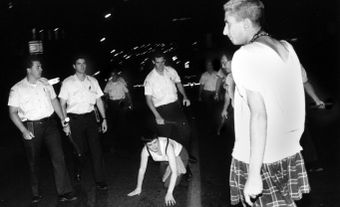
Police raids targeting the gay community were frequent. These "clean-up" operations aimed to bring the downtown more in line with the moral norms of a society that was hostile towards gay people. (See Police Raid on Truxx Bar.) These police operations and socio-economic factors forced many establishments to close or move to the east end of the city near the Red Light District.
In 1982, the "New East Village" was created, later becoming known as the Gay Village in 1984. In 2021, the area was renamed simply “Village” to promote inclusivity. The neighbourhood is part of the Ville-Marie borough.
For many, the Village was previously an exclusive space for gay cisgender men. There was also a small lesbian community. (See Homosexuality.) Members of the community frequented establishments on Saint-Denis Street or the Plateau-Mont-Royal neighbourhood before migrating to the Village at the turn of the 1990s.
Economic Life and Social Issues
Before the Village was established, this working-class neighbourhood was one of the poorest places in Canada. Initially, half of the businesses in the district were vacant and many of the homes were dilapidated. However, their affordability made them a prime location despite the poverty that was rampant there.
Economic life revolves around the sexual wellness store Priape. In the 1970s, this adult store catered to heterosexual customers. Over time, it played an increasingly central role with gay male clientele. Eventually, the store shifted the focus of its product offering fully to this clientele. Gay bars and saunas opened around the shop and gay men gradually settled in the area. Today, Priape targets only gay men and has expanded its product range, while focusing on underground and fetish scenes.
Did you know?
In October 2013, Priape was forced to temporarily close its doors. Already financially strapped, Priape suffered from Health Canada's ban on the sale of the recreational drug poppers.
In 1984, the L'Actuel clinic was created, a clinic specializing in sexual health of the 2SLGBTQ+ community. In the 1980s, AIDS was wreaking havoc, weakening the thriving community. Some people even moved away out of fear to escape the disease.
Sex work was also a reality. Sex workers' rights activists argued that their interests overlapped with those of the Village's 2SLGBTQ+ communities. They called attention to the invisibility of 2SLGBTQ+ sex work in the neighborhood. These activists also criticized the fact that they were targeted by similar police repression and affected by the same crises, including AIDS.
In 2006, the creation of the Village's Commercial Development Corporation (SDC) helped increase the number of businesses. There are now about 255 shops, including 80 bars and restaurants.
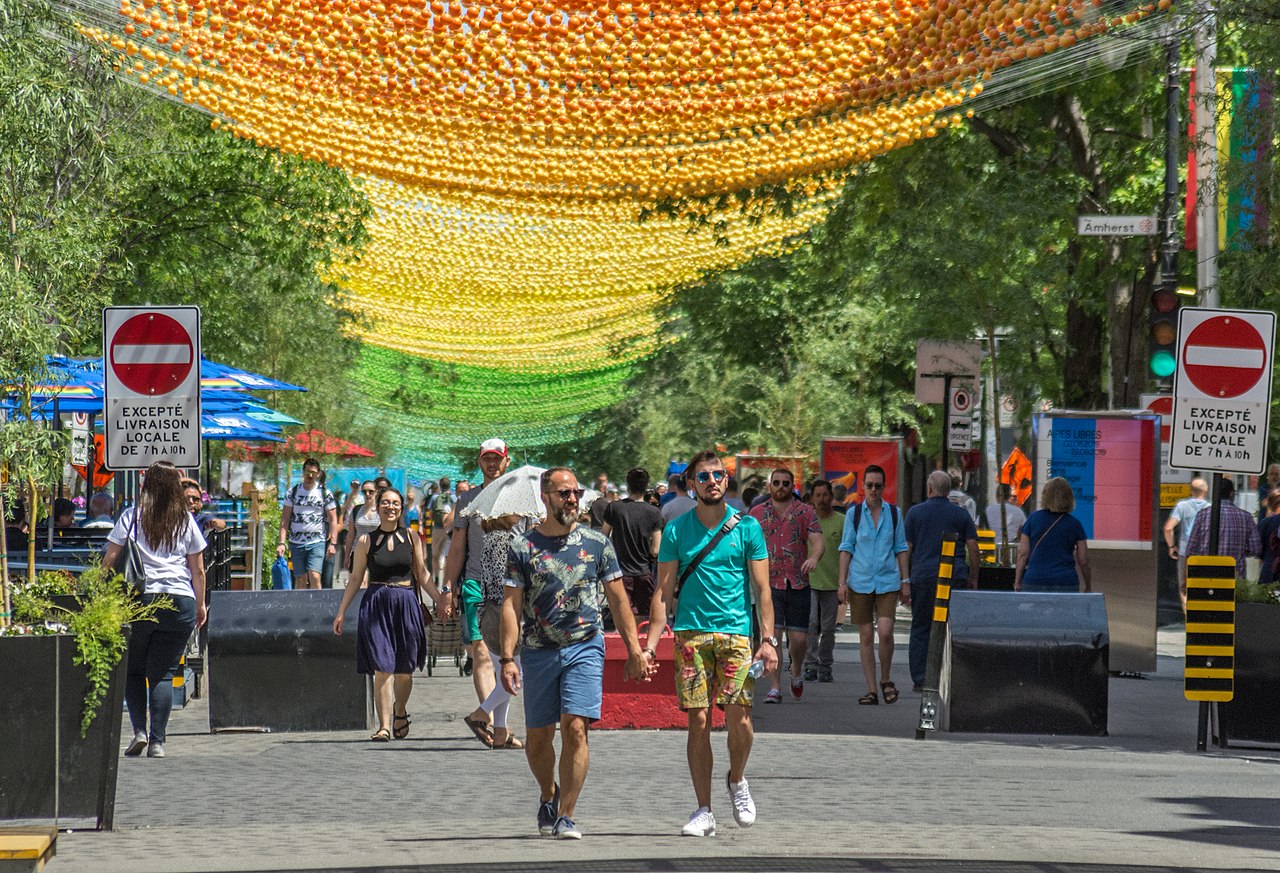
Today, the Village welcomes more than a million people annually. For the past 20 years, the neighbourhood has also been turned into a pedestrian zone in the summer to facilitate pedestrian access and boost the local economy.
Over time, the opening of businesses has encouraged the gay community to settle there. Although the neighbourhood has become gentrified, poverty persists. Many people experiencing homelessness, some with mental health or addiction issues, find refuge there. With the COVID-19 pandemic, this situation has worsened. There are more people experiencing homelessness than resources to help them. This problem bothers many business owners and their customers. Some believe that an increased police presence is needed to prevent the decline of this iconic place. Others believe that it would lead to racial profiling.
In 2020, the SDC believed that gentrification and the mainstreaming of gay and lesbian culture was causing harm to the neighbourhood's economy. According to many, the advent of the internet and dating apps has also diminished the economic strength of the Village.
Real estate speculation and the housing crisis are also hurting businesses. Most merchants do not own their buildings. They are experiencing sharp rent increases, and some have been forced to close shop.
A wide variety of different community organizations work in the Village.
Culture
Despite the socio-economic challenges, the Village has established itself as the most important cultural hub for the 2SLGBTQ+ community in Quebec. There are cultural shops and many theatres, performance venues, cinemas and drag clubs. Outdoor exhibitions, urban art and murals are also a familiar sight in the Village.
In 2002, Luc Provost (stage name Mado Lamotte), a theatre student at UQAM, founded the Cabaret Mado, which stages drag shows. The cabaret, Café Cléopâtre and other venues have helped make Montreal a hub for 2SLGBTQ+ culture in Quebec.
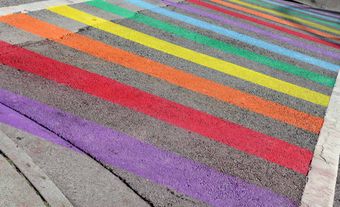
Installed in 2011, landscape architect Claude Cormier's Boules roses decorates the heart of the Village with its 170,000 pink balls suspended over a kilometre above Sainte-Catherine Street. It has since become an internationally recognized and celebrated work. In 2017, the installation was renamed 18 Shades of Gay: 180,000 balls took on the colours of the rainbow, resembling the Pride flag, until 2019.
The COVID-19 pandemic and public health measures had a significant negative impact on the cultural life of the Village. Businesses were hit hard while many were concerned about the problems related to homelessness and crime. Valérie Plante's administration is developing a revitalization plan that is due to be completed in 2030, and which will give the Village a makeover.
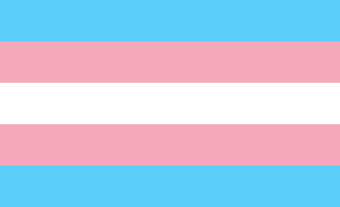
The decision made in 2021 to change the name of the neighbourhood from Gay Village to Village is backed by concrete actions to promote inclusion and accessibility. The goal is to move away from a gay- and cisgender-centered approach to promote the inclusion of other members of the 2SLGBTQ+ community. (See Intersectionality.) In this regard, there has been an increase in investment in cultural life, both day and night. To support underrepresented and marginalized communities, more activities, shows and parties are offered free or at low prices.
Today, the Village is still the epicentre of tourism and 2SLGBTQ+ festivities. Nevertheless, several 2SLGBTQ+ communities gather outside of the neighbourhood, including at Club DD's, the Champs bar in Le Plateau-Mont-Royal, lesbian nights at Cinéma L'Amour and other venues across the city.
In addition, some impromptu parties, which are more accessible, take place in parks or other outdoor places. However, the police often monitor and shut down these events, sometimes in an abusive manner.
This decentralization is partly explained by the fact that more marginalized people do not feel safe in the Village, especially racialized and/or trans people. Some are deterred by too many heterosexual people attending 2SLGBTQ+ bars. In addition, some impromptu events are more accessible financially.