Share on Facebook
 Share on X
 Share by Email
 Share on Google Classroom
According to Indigenous oral histories in Newfoundland and Labrador, Indigenous peoples have lived in this territory since time immemorial. According to archaeology, the history of early Indigenous peoples in Newfoundland and Labrador begins at least 9,000 years ago. Archaeological cultures are defined by archaeologists based upon material culture, sustenance practices, Indigenous oral histories and other aspects of how people lived. These definitions do not necessarily align with how Indigenous peoples in the past and present identify themselves. Archaeologists organize early Indigenous peoples into three main groups. They are the First Nations Archaeological Cultures, Paleo-Inuit Archaeological Cultures and Inuit Archaeological Cultures. Each group developed unique tools and subsistence practices, while coastal and inland groups shared notable similarities.
History of Early Indigenous Peoples in Canada
There are varying understandings about how early Indigenous peoples arrived in the Americas. Some Indigenous oral histories indicate that their peoples have been in the Americas since time immemorial. Archaeologists and anthropologists have speculated on three main ways that people arrived in the Americas. These theories include the Bering Land Bridge (Clovis-First) Theory, the Coastal Migration Theory and the Solutrean Hypothesis.
Bering Land Bridge (Clovis-First) Theory
The Bering Land Bridge (Clovis-First) Theory proposes that early Indigenous peoples moved into North America through a land bridge connecting modern-day Siberia and Alaska about 14,000 years ago. Archaeologists believe early Indigenous peoples made their way into the central region of North America through an ice-free corridor between two massive sheets of ice. During this time, Newfoundland and Labrador was covered in a massive ice sheet called the Laurentide Ice Sheet. These peoples are commonly called the “Clovis,” as they shared a similar tool type. This is the most widely accepted theory on how early Indigenous peoples arrived in the Americas.
Coastal Migration Theory
The Coastal Migration Theory also speculates that early Indigenous peoples crossed from Siberia to Alaska. However, it argues early Indigenous peoples accessed the Americas using a coastal route along the Pacific coast of Alaska and British Columbia.
Solutrean Hypothesis
The Solutrean Hypothesis is the least accepted hypothesis for how early Indigenous peoples arrived in North America. It states that early Indigenous peoples entered the Americas from Europe via the Atlantic Ocean (by boat and ice). It argues a connection between early Indigenous peoples in the Americas and Solutrean peoples, who lived in what is now Portugal, Spain and southern France.
Each of these theories speculates that early Indigenous peoples arrived in the Americas around the same time, approximately 14,000 to 20,000 years ago. However, Dr. Paulette Steeves, a Cree-Métis archaeologist, believes that Indigenous peoples arrived in the Americas over 130,000 years ago. Her argument is based on Indigenous oral histories, archaeological evidence and a decolonized approach to archaeology. Regardless of how early Indigenous peoples arrived in the Americas, many early Indigenous groups are the ancestors of Indigenous peoples in Canada, including in Newfoundland and Labrador.
Early Indigenous Peoples in Newfoundland and Labrador
According to Indigenous oral histories, their ancestors have been living in what is now Newfoundland and Labrador since time immemorial. Archaeological evidence (e.g., past human belongings) dates back to about 9,000 years ago. Archaeologists call early peoples, including early Indigenous peoples, “Archaeological Cultures,” and group them into three main categories: First Nations Archaeological Cultures, Paleo-Inuit Archaeological Cultures, and Inuit Archaeological Cultures. Each of these cultures had their own tools, subsistence patterns, settlement structures and other cultural practices. Archaeologists used these characteristics to classify them into groups.
First Nations Archaeological Cultures
First Nations Archaeological Cultures may share common ancestry with contemporary First Nations. These were the first humans to call Newfoundland and Labrador home. It is not entirely clear where these first people came from, but they may have arrived in Labrador from what is now Quebec or the north-eastern seaboard. They descended from early Indigenous peoples living there. This category includes Archaic First Nations, Intermediate First Nations and Recent First Nations.
Archaic First Nations
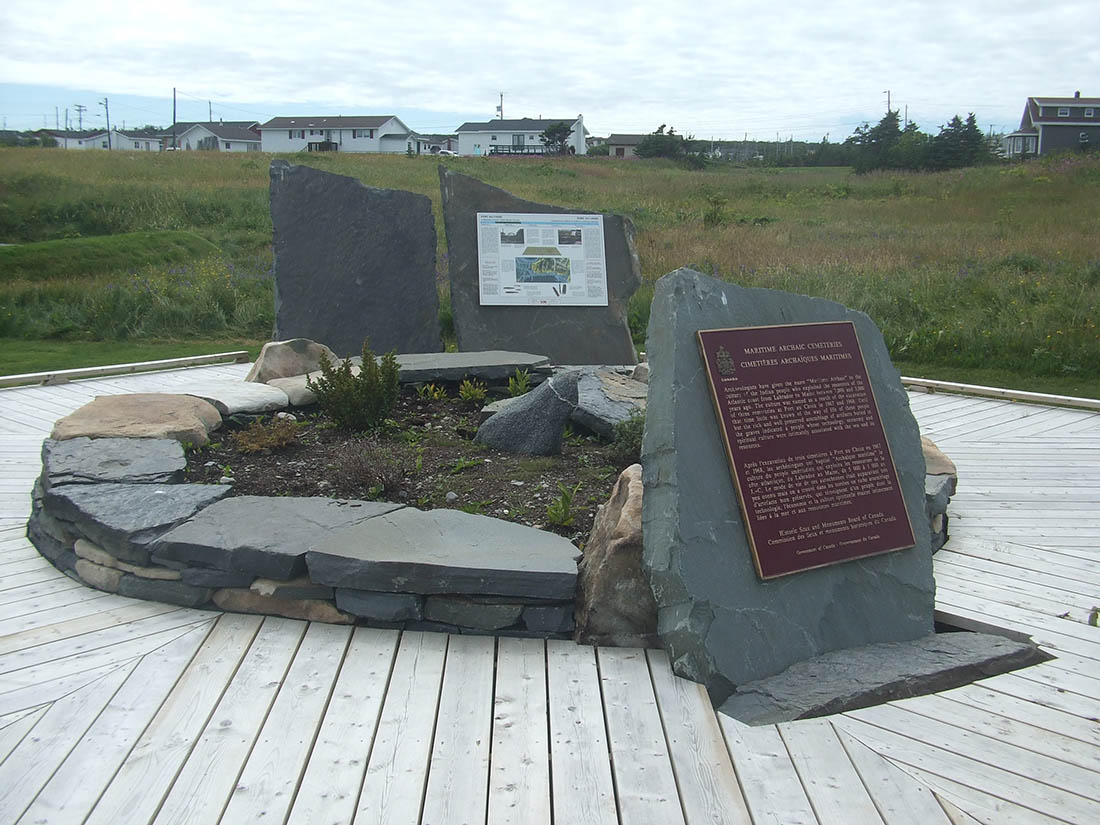
The Archaic First Nations were the first humans to arrive in Newfoundland and Labrador. They lived in the province from around 9,000 to 3,200 years ago. Archaic First Nations are sometimes separated into two related branches, commonly called the Maritime Archaic and Labrador Archaic. The Labrador Archaic lived in northern Labrador and across the Labrador coast, with some even living on the island of Newfoundland. They lived from around 9,000 to 3,000 years ago. The Maritime Archaic lived in southern Labrador, Newfoundland and the Maritimes from around 6,500 to 3,200 years ago. Their toolkit, which reflected their reliance on marine resources for survival, included chipped stone tools, projectile points, watercraft, gouges and toggling harpoons. Archaeologists are not sure what happened to the Archaic First Nations, as evidence of the continuation of their cultures disappeared from the archaeological record. Some believe they experienced competition with the Pre-Dorset, who moved into the area around 4,100 years ago.
Intermediate First Nations
Following the Archaic First Nations were the Intermediate First Nations. They lived in the territory from about 3,600 to 1,100 years ago. There are debates among archaeologists regarding how to divide this cultural group. Many believe there are two subcultures, the Saunders Complex and the North West River Phase. Some archaeologists indicate that the Cow Head Complex people were also Intermediate First Nations, which would mean there are numerous sites of Intermediate Period First Nations on the island of Newfoundland.
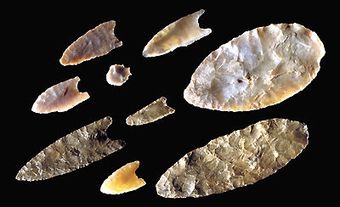
Some archaeologists believe these peoples sustained themselves using seasonal rounds with reliance on land mammals and coastal resources. Their toolkit includes a variety of tools made from Saunders chert and white-brown quartzite. These tools include sharp, one-sided or wide blades, small scrapers shaped like thumbnails, long and narrow stone blades, projectile points, flake tools, stemmed scrapers and scrapers made from stone cores. Red ochre was also a notable part of their toolkit.
Recent First Nations
The Recent First Nations lived in Newfoundland and Labrador from about 2,000 to 400 years ago. Archaeologists put various groups into the Recent First Nations Archaeological Cultures, including the Little Passage, Beaches, Daniel Rattle and Point Revenge. Some archaeologists have placed Cow Head Complex people in this category rather than the Intermediate First Nations category. Their toolkit included spears, bows and arrows, which they used to hunt caribou and small mammals in seasonal rounds.
Contemporary First Nations
Following the Recent Period peoples, the archaeological and anthropological record shows contemporary First Nations, including the Mi’kmaq, Innu and Beothuk. Some argue that the Innu and Beothuk descended from the Recent Period peoples. However, this assertion is debated amongst archaeologists. Work is needed to determine the origin of these sites as archaeological processes advance.
Paleo-Inuit Archaeological Cultures
The Paleo-Inuit Archaeological Cultures are thought to be the first people to live in the Arctic — likely sharing a common ancestor and tool technology. This tool technology is commonly referred to as the Arctic Small Tool Tradition, and it includes the Pre-Dorset, Groswater and Dorset subcultures.
Pre-Dorset
During the end of the Archaic period, the Pre-Dorset lived in northern Labrador. They lived there from around 4,100 to 3,500 years ago. The Pre-Dorset are believed to have descended from the Denbigh Flint Complex in Alaska. Archaeological evidence from Saglek Bay and the Nain region suggests they shared the Labrador coast with the Archaic, though it’s unclear if they interacted. The Pre-Dorset used tools like bows and arrows, end blades and harpoon heads to hunt land and sea mammals as part of their seasonal way of life. They may have moved north, developed into Groswater or disappeared due to climate change.
Groswater
The Groswater lived throughout the territory from around 2,800 to 1,900 years ago. They were once thought to have simply preceded the Dorset culture, rather than changed into it. However, archaeologists have differing views. Some see the Groswater as a distinct group. Others suggest they may have been a transitional population between the Pre-Dorset and Dorset or were a regional variation of the Dorset, called the Groswater Dorset. The Groswater used stone blades, ground tools and harpoon heads. They relied on both land and marine resources. They lived in Labrador, Newfoundland and Quebec’s Lower North Shore, often having overlapping territory with Archaic sites.
Dorset
The Dorset lived in the territory from about 2,500 to 700 years ago. Early, Middle and Late Dorset lived in Labrador, while the island of Newfoundland only included Middle Dorset. Some archaeologists believe these Dorset groups came from what is now Greenland. They typically used blades with fluted tips, tools shaped like chisels, blades with several notches, rectangular bowls made of soapstone, harpoon tips, sleds, and partially excavated houses. They lived in more intensive, larger communities than the Pre-Dorset. Archaeologists think they hunted large marine mammals (including seals), as indicated by remains found at the Port au Choix site in Newfoundland. Also, archaeologists think that the Dorset and the early Inuit could have interacted, with the Dorset referred to as Tuniit in Inuit oral history.
Inuit Archaeological Cultures
Inuit Archaeological Cultures include two related groups, the early Inuit (formerly called “Thule”) and the Inuit. The early Inuit, living in Labrador from approximately 700 years ago to contact with Europeans, are the ancestors of Inuit living in Labrador today. The early Inuit toolkit included items like ulus, soapstone lamps (kulik), sleds (kamituk), sealskin floats, tents (tupiq), kayaks, large boats (umiat), bow drills and wood snow goggles. They also adopted European goods such as iron, brass, ceramics and gunflint. Early on, whaling was common. Later, hunting shifted to smaller animals along with fishing and harvesting other marine resources. Land resources played a smaller role. The early Inuit period ended about 400 years ago, transitioning into the contemporary Inuit of Labrador.