Share on Facebook
 Share on X
 Share by Email
 Share on Google Classroom
Charles Edward Inglangasak Lennie, Inuvialuk Elder, coach, mentor, champion of Indigenous traditions and sports (born 23 June 1934 at Husky Lake, NT; died 6 November 2020 in Inuvik, NT). Forced into a residential school as a child, Elder Edward Lennie returned to his community determined to learn, protect and teach Inuit and Inuvialuit traditions. In 1970, he convinced organizers of the first Arctic Winter Games to include a demonstration of traditional Indigenous sports and coached young athletes to compete, popularizing those sports across Canada’s north and internationally.
Early Days
Elder Edward Lennie was born on 23 June 1934, near Imaryuk, Husky Lake, near the Arctic Ocean, in the Northwest Territories. When he was eight years old, he was forced to attend a residential school, where the goal was to assimilate Indigenous children into European-Canadian culture. As he grew up, Lennie became increasingly determined to learn, then later to teach, traditional Inuit ways of life.
In the early 1960s, Lennie worked at a northern Canadian Armed Services base. At the base gym, he challenged others to try traditional Inuit games that demanded the agility and skills needed to successfully hunt and live on the land. He taught them, for example, the One-Foot Kick, in which a person stands with both feet on the floor then jumps straight up, kicks a target suspended from the ceiling with one foot then lands on that foot. He also taught them the even more difficult Two-Foot Kick, in which a person leaps up with both feet together, kicks the target with both feet then lands balanced on the floor. The soldiers realized the tremendous athleticism and strength needed to successfully complete the kicks.
Northern Games and Arctic Winter Games
In 1967, many northern leaders were disappointed with the performance of northern athletes at the Canada Winter Games in Quebec City, due mostly to a lack of funding and training facilities in the north. They decided to create the first Arctic Winter Games, which took place in Yellowknife in March 1970.
Elder Edward Lennie noted, however, that the Arctic Winter Games planned to include only southern sports such as badminton, basketball and hockey. He helped to organize the Northern Games. Lennie trained athletes to do eight traditional Inuit games including One-Foot and Two-Foot Kicks. Among the other sports was the Knuckle Hop, in which a competitor assumes a push-up position, with their knuckles on the floor, then moves, bloodying their knuckles with each hop, to attain the greatest distance. Another game was the arm pull in which enormous strength and balance is demanded as competitors brace on each other’s ankles then slowly pull at the elbows until one person falls or touches a hand to one’s chest.
The national media and Prime Minister Pierre Trudeau observed the first Northern Games demonstrations. The national exposure to traditional Inuit sports inspired more athletes to learn them. Lennie led training sessions at his home and at the Ingamo Hall Friendship Centre in Inuvik. The Northern Games were about friendly competition as well as enhancing an appreciation of Indigenous cultures while building the skills and resilience needed to live on the land.
Part of that appreciation involved having young athletes spend time with Elders and enjoy traditional Inuit food, often prepared by Lennie’s wife, Jeanie (see also Inuit Country Food in Canada). Beyond helping athletes, he and Jeanie adopted many foster children.
The Northern Games grew and continued to be a part of the Arctic Winter Games that took place every two years. Lennie worked with others to spread the knowledge and popularity of Inuit sports and culture with demonstrations in Japan, Greenland, the United States and at the 2010 Olympic Winter Games in Vancouver.
In July 2023, Lennie was influential in having the Northern Games welcome athletes from across the north to compete at the Inuvialuit Piuyausiat or Youth Northern Games Summit in Tuktoyaktuk.
As the Northern Games and Arctic Winter Games grew, they attracted athletes from across Canada’s north and the world’s circumpolar regions and countries with territory north of the 55th parallel such as Russia, Norway, the United States, Finland, Greenland and Sweden. The games celebrated the diversity and shared cultural traditions of northern peoples in sport, dance, music and ceremony.
Recognition and Death
In 2003, Elder Edward Lennie was honoured with the National Aboriginal Achievement Award (now Indspire Award) for his work as coach, mentor and all he had done to found and grow the Northern Games.
Lennie died on 6 November 2020, at the age of 86.
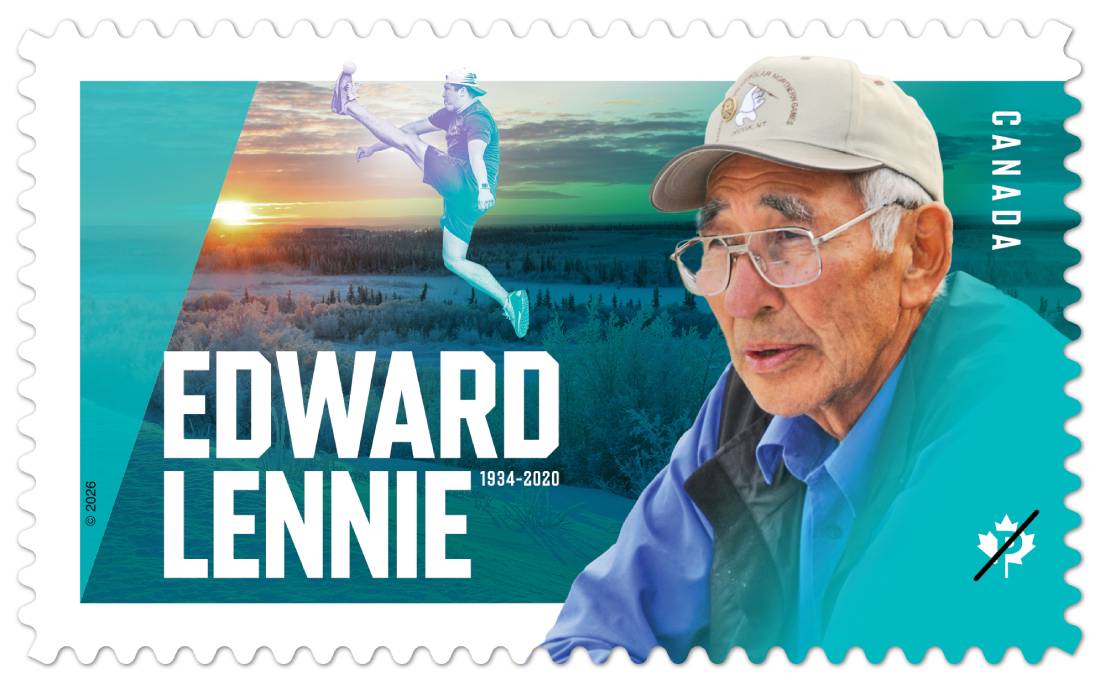
Two years later, Lennie was inducted into Canada's Sports Hall of Fame as a builder. In 2026, he was honoured with his picture on a Canadian postage stamp. Former Northwest Territory Premier Nellie Cournoyea said, “He was … a very true, natural leader and a traditional man... He was very much an inspirational person without really knowing it.”