Share on Facebook
 Share on X
 Share by Email
 Share on Google Classroom
Prior to the emergence of distinctively Canadian modernist painters in the 20th century (e.g., Tom Thomson, the Group of Seven, Emily Carr and David Milne), Canadian painting closely followed conventional, academic European models and tastes. This did not change after the 1840s. Cornelius Krieghoff captured the habitant lifestyle along the St. Lawrence River, while Paul Kane and Frances Anne Hopkins sketched and painted the First Nations people and landscapes of Western Canada. But as the century progressed, artists in Canada increasingly began to address specifically Canadian themes. The influence of photography, especially the work and studios of William Notman, was significant. The Royal Canadian Academy of Arts (RCA) was founded in 1880 and various artists’ groups thrived heading into the 20th century.

Art Prior to Confederation
Prior to Confederation, the documentary tradition dominated Canadian painting. Paintings typically recorded the frontier, high society in the garrison towns, or the scenic wonders of a new land. Romanticism, a major European movement, was a common style in the early and mid-19th century. Romanticism was preoccupied with imagination, emotion and the natural world.
The most popular and prolific of the romantic painters in Canada was Holland-born and Quebec-based Cornelius Krieghoff. After 1841, Krieghoff painted a variety of local scenes along the St. Lawrence River. Some were humorous and some were anecdotal. Krieghoff had seen genre painting at the Düsseldorf Academy in Germany. His naturally upbeat temperament transformed his snapshots of everyday life into subjects of immense popular appeal. He had a lifelong interest in Indigenous peoples. Also, because his wife was of French birth, he knew the habitant lifestyle intimately. It is interesting that Krieghoff's support came from English-speaking patrons in the Canadas. The French bourgeoisie, meanwhile, found in his work a vulgar caricature of habitant life and an insult to their cultured lifestyle.
In addition to Krieghoff's fascination with everyday life in Quebec, there was also a growing preoccupation with the western frontier. Swiss-born Peter Rindisbacher immigrated to the Red River Colony in 1821 at the age of 15. He was so excited by the way of life in Fort Garry that he painted a remarkable series of watercolours of the local scene. He also painted Indigenous peoples in traditional dress and bison on the prairies in winter. Frances Anne Hopkins, a British painter whose husband worked for the Hudson’s Bay Company, was an artist who sketched and painted Canadian landscapes. Her most famous works, including Shooting the Rapids and Canoes in a Fog, Lake Superior, depict long-distance canoe voyages undertaken by the Hudson’s Bay Company in the 1860s.
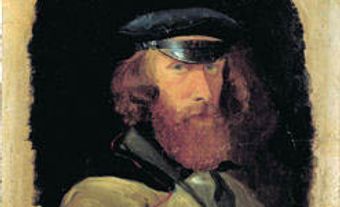
Two decades later, Paul Kane made himself famous by painting this same western scenery and its Indigenous peoples. Kane had been a minor portrait painter in Ontario. But he aspired to artistic greatness and studied in Europe. Kane was inspired by George Catlin's “Indian Gallery” portraits then displayed in London. Kane conceived a similar project of portraying Indigenous peoples in Canada. He went on a celebrated wilderness trip with fur traders from Ontario to Fort Vancouver between 1846 and 1848. He sketched the landscape and First Nation bands he encountered. He then painted 100 canvases based on these sketches and published an account of his travels. (See also The Adventurous Paintings of Paul Kane.)
Kane also inspired other artists. In 1872, Frederick Verner made a similar sketching trip to depict Indigenous peoples and bison. William G.R. Hind spent a season as an expedition artist with his scientist brother Henry, exploring Labrador. Hind then joined the 1862 Overlanders. They travelled by land to the British Columbia goldfields. (See also Fraser River Gold Rush.)

Art and the Birth of Canada
The late 19th century was filled with growth and change in Canada. There was industrialization, Confederation, the Red River Resistance and North-West Resistance, and western expansion. (See also History of Settlement in the Canadian Prairies.) Yet few of these events were recorded by contemporary artists. Photography took over the role of documenting society. As a result, Victorian artists escaped into an ideal world of rural landscapes. They also established professional art societies, where they could exhibit, promote and sell their works. These groups were mostly in Montreal and Toronto.
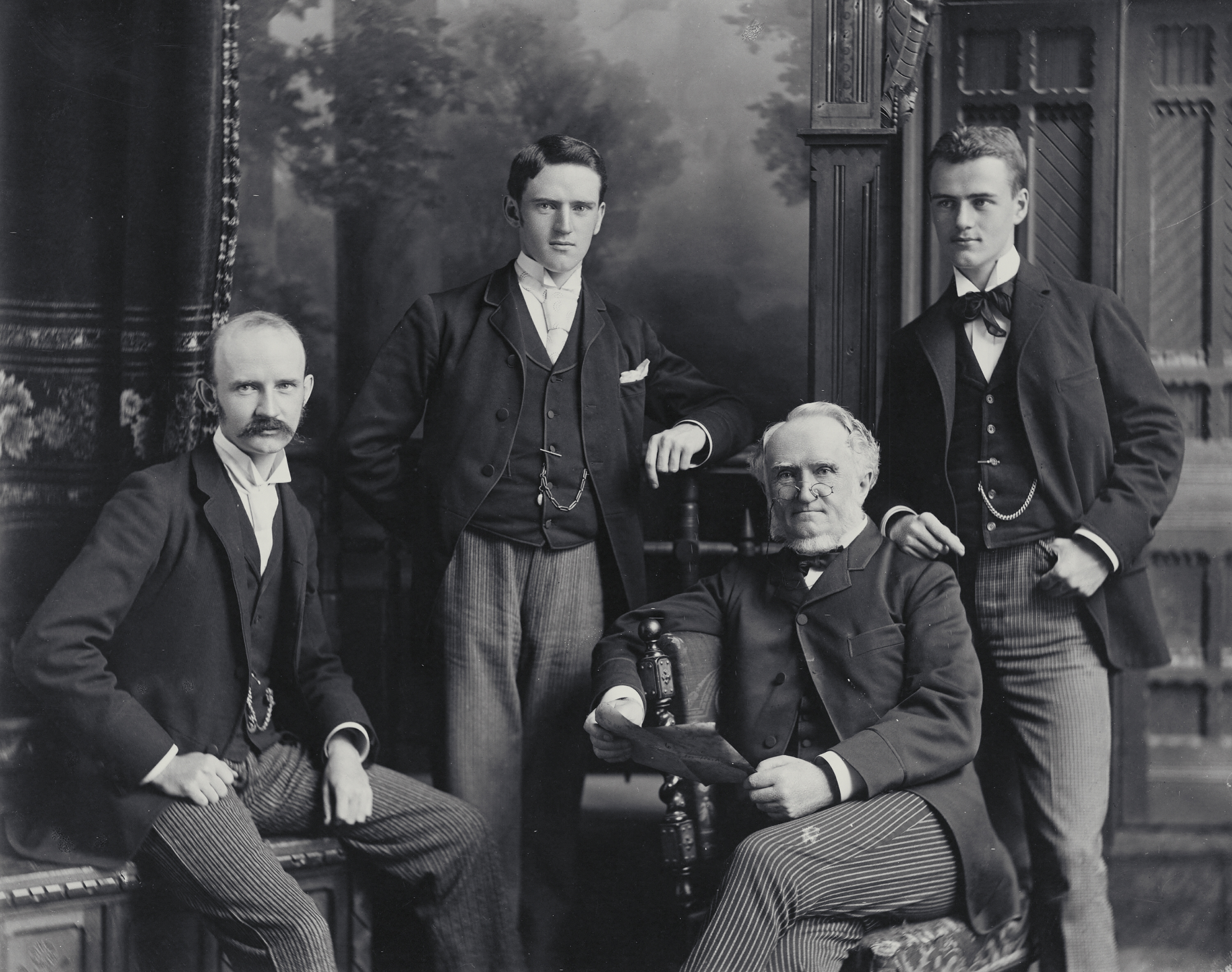
Several talented artists worked in the studios of William Notman. Notman was a Montreal photographer. By the 1860s, he had achieved an international reputation for his portrait photographs. He then went on to greater heights with landscape and genre, or everyday, subjects. The company had its own exhibition space and art collection. It rapidly became the leading, if unofficial, art school in the country. There was a camaraderie among the staff. They painted in their spare time and made sketching trips to the lakes and hills of the Eastern Townships and beyond. John Fraser was an acknowledged leader. He opened a branch in Toronto and was instrumental in organizing the Ontario Society of Artists. This group held its first annual exhibition in the Notman studio in 1873. Faser’s associates included his brother-in-law, Henry Sandham. He later opened a Notman studio in Saint John. There was also Paris-trained Allan Edson and Otto Jacobi, who had enjoyed an earlier career in Germany.
The search for the Canadian landscape by Notman photographers and artists was intimately connected with the railway expansion. Painters had travelled from Montreal by train in the earlier years to sketch in Quebec and the Matapedia Valley. Now they broadened their vision. The transcontinental line of the Canadian Pacific Railway (CPR) edged its way across the Prairies and through the Rockies. Sir William Van Horne, president of the railway and himself an art collector, gave artists free passes to produce promotional pictures for the CPR. Notman sent a camera crew with the work trains to detail progress through the mountains. Fraser and other artists associated with Notman went to the West to make an oil and watercolour record of the magnificent scenery. Their paintings of the West are technically brilliant and marked by photographic realism. These works dominated many art exhibitions until the end of the century.
Creation of the Royal Canadian Academy of Arts
Canadian art achieved new prestige with the founding of the Royal Canadian Academy of Arts (RCA) in 1880. The group came about through the efforts of Governor General John Douglas Sutherland Campbell, Marquess of Lorne, and his wife Princess Louise.
Lucius O'Brien was the first president of the RCA. He was swept up in this new search for the true face of Canada. He visited Nova Scotia and New Brunswick. Then, as the railway reached the Pacific, he travelled west to paint the mountains and the Vancouver area. Some of his finest paintings, such as his majestic views of Quebec or Sunrise on the Saguenay (1880), introduced a glowing quality. This incorporated the diffuse light characteristic of American painting of the Hudson River School of the same period.
The Influence of Europe
During the 1880s and 1890s, Europe once again became the model for artists in Canada. Painters aspired to study in Parisian academies and exhibit at the Salon — the prestigious and traditionally conservative annual exhibition at the Academie des Beaux-Arts in Paris. It was the conservative French and English masters, not the avant-garde, who attracted the young Canadians. They painted heroic images in a highly finished naturalistic style.
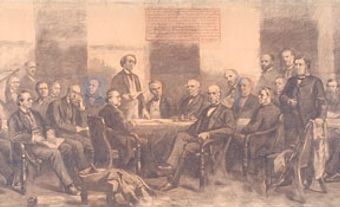
William Brymner and Robert Harris followed this path. On their return to Canada they taught “in the French manner” in Montreal and Toronto. In 1883, Harris was commissioned by the federal government to paint the Fathers of Confederation. Paul Peel was acclaimed in Paris and at home for his studies of bathers and children. But he did little that was specifically Canadian. George Reid, on the other hand, used the same monumental figurative tradition in his scenes of rural Ontario, such as Mortgaging the Homestead (1890).

Homer Watson and Ozias Leduc both derived their inspiration from their rural Canadian surroundings. They visited Europe only after they were established. Watson became a celebrity early on when his etching The Pioneer Mill (1890) was purchased for Queen Victoria's royal collection. Leduc lived in St-Hilaire, Quebec. He supported himself doing church decorations. He painted still lifes and the people and landscape close to him for his own satisfaction.
Meanwhile, in Paris, the polished, narrative style of the Salon was increasingly attacked by innovative painters of the impressionist, Barbizon and Hague schools. Horatio Walker was influenced by this naturalistic depiction of landscape. On his return to Canada, his paintings of rural scenes on Île d’Orléans rapidly brought him acclaim in North America. In 1911, the National Gallery of Canada paid $10,000 for Walker’s Oxen Drinking (1899).
Maurice Cullen and James Wilson Morrice were among the first artists to apply the principles of French impressionism to the Canadian landscape. Cullen attracted attention in Paris before returning to spend his mature years in Quebec. Criticism was harsh and sales were poor. But he exerted a tremendous influence through his teaching at the Art Association of Montreal. Independently wealthy, Morrice lived much of his life in Paris. He travelled widely, befriended Henri Matisse and was influenced by James Whistler. Through annual exhibitions at the Canadian Art Club in Toronto between 1907 and 1915, Cullen, Morrice and Marc-Aurèle de Foy Suzor-Coté served as models for the next generation of Canadian artists.
(See also Painting: Beginnings; Painting: Modern Movements.)