Share on Facebook
 Share on X
 Share by Email
 Share on Google Classroom
The Canadian Jewish Congress (CJC) was a Jewish Canadian non-governmental organization. For more than 90 years, it was the primary representative and advocate for Canada’s Jewish community. The CJC adhered to democratic processes and sought broad representation. Many viewed it as the “Parliament of Canadian Jewry.” Throughout its history, the CJC was front and centre in the struggle for civil and human rights. It notably fought for equality and immigration reform in Canada. (See Immigration Policy in Canada.) In its later decades, the organization was involved in the campaign for Soviet Jewry. It also worked to track down alleged Second World War-era war criminals living in Canada. (See War Crimes.) In 2011, the organization’s disbanding was highly controversial. It marked a shift from Canadian Jewish and civil rights advocacy to a greater emphasis on defending Israeli interests.
Early History of Canadian Jewish Organizations
Jews have lived in Canada since at least the 18th century. The first stable Jewish communities established themselves in the cities of Eastern and Central Canada, especially Montreal and Toronto. These were nonetheless small communities. Local social and political life was often focused on the community’s synagogue.
The first major cohort of Jewish immigration to Canada occurred in the late-19th century. Many Jews were fleeing the pogroms and poverty in Europe. They looked for the chance at a better life in North America. By the time of the First World War, the Jewish community in Canada had grown to 100,000. Many of these immigrants were exceptionally poor. They took up jobs in the industries of Canada’s major cities, such as the needle trade in Montreal.
Some Canadians were xenophobic and did not welcome Jewish immigrants. Others were opposed to Jews because of antisemitism. As a result, many Canadians excluded Jewish people from society. These factors, alongside the exploitation of Jewish workers, led to several important events in the history of Jewish Canadian advocacy. These included the Plamondon Libel Case; the Pinsler Case and the Jewish School Question; the tailor’s strike of 1912; and the Aberdeen School Strike of 1913.
This hostile context encouraged the development of Jewish community advocacy groups with a national scope. The Federation of Canadian Zionists was one such organization, though its leadership was nominated. There were also chapters of Po’alei Zion (Jewish Socialist Labor Party) in Canada, which was a socialist workers’ rights group.
However, the Jewish community in Canada was inherently multicultural and multilingual. (See also Multiculturalism.) It also had different political orientations. These factors created the conditions necessary for a new, national, democratic Jewish organization.
Founding
In March 1919, 200 delegates founded the Canadian Jewish Congress at the Monument-National in Montreal. It became the first democratically elected body to represent Canada’s Jewish community. Almost 25,000 Jews from across Canada voted to choose their delegates.
The event was the first pan-Canadian Jewish assembly in Canadian history. The CJC’s first general secretary was Hananiah Meir Caiserman. Fittingly, he was a tailor and came from Romania. He thus reflected the Eastern European origins of much of Canada’s Jewish community at the time. Moreover, he represented the community’s working-class roots and involvement in the needle trade. Caiserman held the position until his death in 1950.
Did you know?
In 2005, Parks Canada recognized the founding of the Canadian Jewish Congress as a National Historic Event.
Formative Years
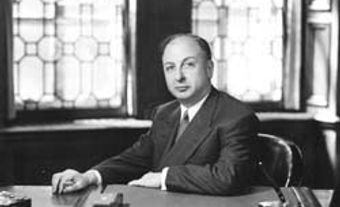
Saul Hayes played an integral role in transforming the Canadian Jewish Congress (CJC) into an effective lobby group. He acted as the organization’s long-time executive director throughout much of the middle of the 20th century.
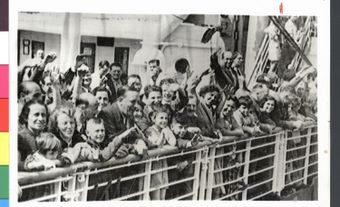
In the 1930s, Hayes distinguished himself during his involvement with the CJC Committee for Refugees. (See also Refugees to Canada.) He pushed the Canadian government to change their policies restricting Jewish immigration. Despite the best efforts of Hayes, the CJC and their allies, Canada accepted fewer than 5,000 Jews between 1933 and 1947. Canada’s acceptance rate was the least of any Western nation. (See Canada and the Holocaust; None is Too Many.)
Despite this, Hayes developed important political connections. Coupled with his oratory prowess, this made him an effective leader. He became the Jewish community’s representative in Ottawa. Notably, Hayes worked closely with Samuel Bronfman, the famed Canadian distiller and business magnate. (See Bronfman Family.)
Bronfman was also the longest-serving president in the CJC’s history; he occupied the position from 1939 to 1962. During this era, Hayes represented Canada’s Jewish community at important international meetings. These included the World Jewish Congress, the San Francisco Conference on International Organization in 1945, the Paris Conference on Peace Treaties in 1946 and the United Nations Relief and Rehabilitation Administration. In this last case, Hayes became the first person to represent almost all Jewish delegates at an international organization since the Versailles Treaty of 1919.
Did you know?
In celebration of the Centennial of Confederation in 1967, the CJC donated a large collection (7,000 volumes) of rare Judaica to Library and Archives Canada.
Advocacy for Soviet Jewry
European Jews had long played an important role in the Soviet Union (USSR). In fact, in the early-20th century, antisemites argued that international communism was a Jewish conspiracy. Despite this, antisemitism and generalized discrimination against Jews were common in the USSR. In addition, there were limitations on emigration from the Soviet Union. Many Jews who wanted to emigrate to Israel were denied permission to do so. They protested, but this led to additional persecution. They could lose their job or position, or even face imprisonment.
Did you know?
Relations between the USSR and Israel were particularly complicated. The USSR supported Israel for a time after its founding. However, the USSR also supported the national liberation movements of colonized people. This included support for the Palestinians ― particularly after the 1967 Arab-Israeli War.
From the 1960s until the end of the 1980s, the cause of Soviet Jewry became an important issue in the Jewish diaspora in Canada and the United States. The Canadian Jewish Congress (CJC) lobbied the Canadian government to support the cause. In 1971, the CJC also created its Action Committee for Soviet Jewry in response to the Leningrad Trials of 31 dissident Soviet Jews. The CJC took a leading role in Canada, raising funds and awareness for the cause.
Nazi War Criminals in Canada
After the end of the Second World War, the Canadian Jewish Congress (CJC) investigated the issue of alleged and suspected war criminals in Canada. Many of whom were Nazi collaborators or fascist sympathizers. The CJC was one of the first organizations to raise the issue with the Canadian government. In the 1980s, when the Canadian government investigated the issue, the CJC contributed to the Deschênes Commission of Inquiry on War Criminals.
In 1997, the American television newsmagazine 60 Minutes investigated the matter. The journalist Mike Wallace notably interviewed CJC national director of community relations, Bernard (Bernie) Farber and previous president Irving Abella.
Farber was credited with working effectively with police and human rights commissions to almost completely eliminate the white supremacist movement in Ontario.
Disbandment
In 2011, the Canadian Jewish Congress (CJC) announced that it was discontinuing its activities. Instead, the Centre for Israel and Jewish Affairs (CIJA) would continue the work of Jewish advocacy in Canada.
At the time, The Forward, the non-profit American Jewish publication, reported that the CJC had financial troubles. Moreover, for nearly a year, several of Canada’s prominent Jewish families had been coordinating a merger of several national Jewish organizations.
CIJA’s founding chief executive officer, Shimon Fogel, argued that the line between antisemitism and “political attacks on Israel” had become blurred. As a result, he argued this merited the consolidation of Canada’s various Jewish community groups.
Fogel’s view contrasted with the opinion of former CJC President Keith Landy. Landy argued that Fogel and the CIJA were destroying a long-standing and revered community organization that had worked for nearly a century. He further pointed out that the CJC model had been adopted by numerous other minority communities in Canada.
Many members of the CJC were unhappy. They argued that the new organization would be less democratic and more beholden to major donors. Moreover, they felt that the CIJA would refocus on pro-Israel advocacy at the expense of the concerns of Canada’s Jewish population. This approach contrasted with the CJC’s greater focus on Canada’s Jewish community and its domestic agenda, including human rights and social justice. Several critical voices at the time of the merger argued that Canada’s Jewish community would be better served by several groups rather than just one. They noted that if the non-Jewish community didn’t speak with one voice, it also made no sense for the Jewish community to speak with only one voice.
The CJC’s archives are maintained by the Alex Dworkin Canadian Jewish Archive in Montreal.