Share on Facebook
 Share on X
 Share by Email
 Share on Google Classroom
The Canadian Space Agency (CSA) has sent several astronauts to the International Space Station (ISS) to participate in short- and long-duration missions. The Canadian government funds these opportunities using robotics, including the Canadarm2 robot servicing arm. A few other Canadians have also flown to the ISS outside of the space agency with different funding. The ISS launched its first module in 1998 and is expected to keep operating until at least 2030. Canadian government-funded experiments on the space station largely focus on astronaut health, with applications for aging populations on Earth.

Development
While Canada has been conducting space activities for decades, the government’s ongoing development of robotics for the United States space program (later known as Canadarm) allowed Canadian astronauts to fly on National Aeronautics and Space Administration (NASA) spacecraft. Canadian astronauts were selected in 1983, and the first astronaut to go to space was Marc Garneau in October 1984. The CSA became the coordinating agency for Canadian astronauts after it was established in 1989.
Canada first agreed to participate in a US-led ISS program in 1986 and signed an initial memorandum of understanding in 1987 before finalizing the intergovernmental agreement the following year. The Canadian government committed robotics — initially, in the form of the Mobile Servicing System (MSS) — to the ISS in 1988 to pay for Canadian astronaut and science opportunities.
The ISS program was changed in 1994 to include Russia as one of the partners. Canada signed a revised intergovernmental agreement for the ISS in January 1998, less than a year before the first module launched and about 16 months before Julie Payette became the first Canadian astronaut to board the ISS. Canada and other participating space agencies have also signed on to memoranda of understanding regarding ISS roles and responsibilities.
Operations of the ISS have been extended several times, most recently in 2023, with the majority of partners — including Canada — committing to the space station through 2030. More recently, Russia has also committed to operations through 2030. US Congress is discussing the possibility of extending NASA’s commitment to 30 September 2032, which may be followed by the other partners if implemented.
Canadian Robotics
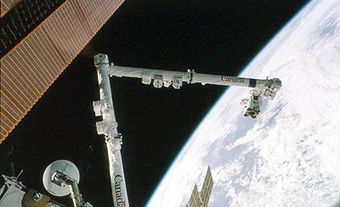
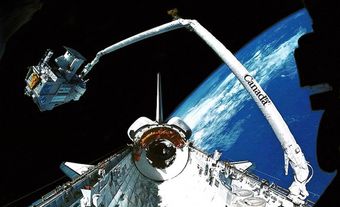
Canada’s contribution to the ISS is three robots that together form the MSS. The system is used for maintenance of the ISS. The CSA funded the system, which is currently managed and maintained by the Canadian company MDA Space. The robots include:
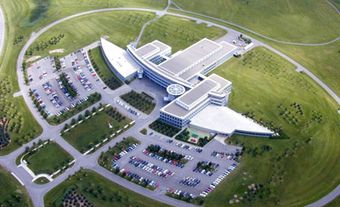
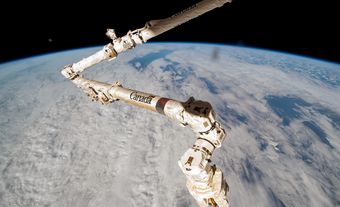
- Canadarm2, a robot arm installed in 2001. It is 17 metres long and used for conducting spacewalks, capturing cargo ships and moving supplies, equipment, robotics and astronauts around on the station. It can be operated by astronauts on board the ISS or at ground-control stations in Houston and Saint-Hubert, Quebec.
- Dextre, a two-armed multi-tool robot installed in 2008. Flight controllers on the ground operate the robot for maintenance tasks such as replacing parts and batteries, setting up experiments and launching micro- and nanosatellites.
- The mobile base, a work platform used to transport Canadarm2, Dextre and other space-station equipment along the backbone (main truss) of the ISS.
Canadian Mission Experience
Canadians have flown to the ISS on behalf of the CSA and on behalf of other organizations.
Three CSA astronauts have flown to the ISS for about half a year each, with a fourth expected to fly soon:
- Robert Thirsk during Expedition 20/21 (2009), which was the first Canadian long-duration mission;
- Chris Hadfield during Expedition 34/35 (2012–13), during which he served as commander of Expedition 35 — a first for Canada;
- David Saint-Jacques during Expedition 58/59 (2018–19), which is the longest Canadian mission to date, at 204 days; and
- Joshua Kutryk, who is expected to fly on another long-duration mission for Expedition 75 (2026–27).
Before 2010, five CSA astronauts flew on six shorter shuttle missions to the ISS:
- Julie Payette, on STS-96 (27 May to 6 June 1999), the first Canadian to board the space station;
- Marc Garneau, on STS-97 (30 November to 11 December 2000), becoming the first Canadian to fly three times in space overall;
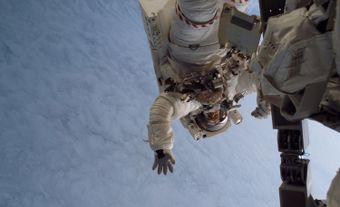
- Chris Hadfield, on STS-100 (19 April to 1 May 2001), who performed two spacewalks and helped install Canadarm2;
- Steve MacLean, on STS-115 (9 to 21 September 2006), who was the first Canadian astronaut to operate Canadarm2 in space and the second Canadian to perform a spacewalk;
- Dave Williams, on STS-118 (8 to 21 August 2007), who did three spacewalks during the mission, setting a Canadian record; and
- Julie Payette, on STS-127 (15 to 31 July 2009), who operated three robotic arms
- Canadarm, Canadarm2 and the Japanese Kibo module arm — during the mission.
Three Canadians have also flown to the ISS for different organizations:
- NASA astronaut Andrew Feustel, a dual Canadian-US citizen, flew to the ISS twice: on shuttle mission STS-134 in 2011 (during which he did three spacewalks) and the long-duration Expedition 55 mission in 2017–18 (during which he served as commander of Expedition 56);
- Guy Laliberté, the co-founder of Cirque du Soleil, paid US$35 million in 2009 for a seat on a Russian Soyuz spacecraft to become the first Canadian space tourist (the 12-day mission was in part to raise awareness for his One Drop Foundation, which addresses water scarcity); and
- Mark Pathy, an entrepreneur who paid $55 million for his space-flight seat on a SpaceX Crew Dragon, flew with Axiom Space’s Ax-1 private astronaut science mission for 17 days in 2022.
Canadian Science Work
Canadian experiments on the ISS largely focus on applications for astronaut health, as well as Earth living. Microgravity on the ISS simulates the effects of aging on astronauts, providing a temporary acceleration of getting older — by as much as 10 to 20 years — in a six-month mission, although the effects are largely reversible when astronauts return.
CSA astronauts participate in both Canadian and international experiments, and the list evolves often. The Canadian science experiments expected to be used during Joshua Kutryk’s 2026-27 mission are:
- ACTIS, which measures a protein called D-dimer to assess the risk of blood clots;
- AstroFit, which aims to change exercise in space to strengthen against the effects of microgravity;
- Bio-Monitor, which has astronauts wear a "smart shirt" to monitor and record vital signs;
- CARDIOBREATH, which examines the cardiovascular and respiratory systems of astronauts;
- C-STARS, a mental health examination of astronauts that also aims to develop strategies for coping;
- HomeBase, which helps astronauts navigate while in microgravity;
- SANSORI-2, which investigates vision changes experienced by some astronauts in space;
- SPARK, which gathers information about anemia; and
- TBone, which studies bone health using 3D imaging technology.