Share on Facebook
 Share on X
 Share by Email
 Share on Google Classroom
Annie Pootoogook, artist (born 11 May 1969 in Cape Dorset, NT [now Kinngait, NU]; died 19 September 2016 in Ottawa, ON). Annie Pootoogook was a renowned Inuit artist who won the Sobey Art Award in 2006. She was included in prestigious international exhibitions such as Documenta in Kassel, Germany, and in collections like that of the National Gallery of Canada. She was born into a family of accomplished Inuit artists. Her mother was graphic artist Napachie Pootoogook and her father was printmaker and carver Eegyvudluk Pootoogook. She was the granddaughter of Pitseolak Ashoona, and her uncle was Kananginak Pootoogook.

Early Life and Career
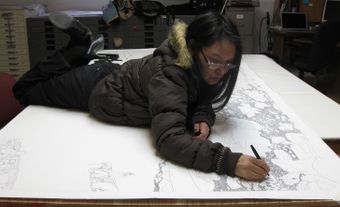
Annie Pootoogook began making art at the age of 28, working within the nurturing environment of the West Baffin Eskimo Co-operative (now known as the Kinngait Studios) in Cape Dorset (now Kinngait) (see also Inuit Co-operatives). Throughout her career, her chosen medium involved drawing with pen and coloured pencils. Along with her cousin Shuvinai Ashoona, Pootoogook is credited with introducing a powerful new strain of expression into the art of the North, an approach that has offered an alternative to traditional treatment of Inuit experiences.
The West Baffin Eskimo Co-op was established in 1959. Its purpose was to introduce the techniques of stone carving and printmaking to the people of the region. The co-op was meant to encourage self-sufficiency through the marketing of Northern artworks to buyers in the South. Although there was no strong tradition of artmaking in these media, the inhabitants of Cape Dorset community quickly took to the new initiative. A vital art scene rapidly developed. Driven in part by southern expectations, the art of the North tended to focus strongly on conventional Northern subjects. These included depictions of seals and owls, for example, narrative portrayals of life on the land and explorations of Inuit traditional stories. What set the art of Pootoogook and Ashoona apart from the rest was their willingness to abandon the tried-and-true themes of Inuit art. They drew on their personal experiences of life in the modern North viewed within a contemporary context. Although still firmly rooted in Northern experiences, their drawings reflect broader — and more personal — concerns. In Ashoona's case, this has involved an exploration of her inner world through surprising, often fantastical imagery. Pootoogook's drawings, on the other hand, are characterized by a more detached quality. In their uniquely deadpan presentation, however, they communicate a similar kind of connection with the artist's inner world. They reveal something of the conflicts that arise from the confrontation of that inner experience with the outer reality of life in the modern North.
A Unique Vision of the North

Annie Pootoogook's art has occasionally been referred to as “narrative realism.” This term expresses the descriptive quality of her drawings, but it ignores their subtle emotional effect, which is created by the unsettling associations her drawings prompt in viewers. Her drawings have a journalistic quality, with people and events presented more or less without censure or editorial commentary. Mundane scenes of domestic life are presented with the same straightforward detachment as depictions of violent physical confrontations.
Pootoogook generally relied on simple line drawing with figures posed full on or in profile. Everything in her compositions tend to occupy a space that is lined up parallel to the picture plane, as if any other orientation would introduce a sense of instability that might subvert the quiet detachment that seems so much a part of the artist's conception. Objects in the scenes are separated by expanses of white space, giving the impression that they are on display, like specimens in a museum, or clues to a crime scene. Clocks, for example, are ubiquitous if unobtrusive, subtly suggesting that these are specific events happening in real time.
Pootoogook was a talented draughtsman with an accurate eye for depiction of physical form — as demonstrated, for example, in the subtly nuanced curves of her drawing of the semi-nude female figure in Woman at Her Mirror (Playboy Pose) (2003). However, she tended to present the characters that people her drawings in simple, child-like fashion, as if to deliberately strip them of personality or any kind of individualism that might draw the viewer into their inner worlds. It's the situation and its implications that are important in her works, not so much the feelings and motivations of the individuals who act out their mini-dramas.
On the surface straightforward and illustrative, Pootoogook's drawings are often wryly humorous, with sly irony expressed in subtle details. In Woman at Her Mirror, for example, the elegantly bow-tied rabbit of the famous Playboy logo has been transformed into a depiction of something much less virile and alert. Even when humour is absent, information is conveyed with simple but telling touches. Her drawing Sobey Awards (2006) shows the subject of the drawing — the award winner — with her back turned to the viewer, as if to suggest that the real focus of the ceremony is not the winning artist, but the officials and art-world dignitaries who populate the event.
International Recognition

The artist with her back turned in Sobey Awards is, of course, Annie Pootoogook herself. In 2006, after several well-received exhibitions at Toronto's Feheley Fine Arts, a commercial gallery in Toronto specializing in Inuit art, Pootoogook was chosen for the prestigious award. This was a remarkable honour for an artist whose career was barely a decade old. The Sobey Art Award, given out annually to encourage young Canadian artists, carries with it a $50,000 prize. It is presented to an artist under 40 who has had a show in a public or commercial art gallery within the previous 18 months. Prior to receiving the award, Pootoogook had a major show at Toronto's Power Plant. In their citation, jury members remarked that Pootoogook's work reflected “both the current moment of a specific tradition and of a contemporary drawing practice. It comes from a point when Modernism is being re-examined and reflects the hybrid nature of contemporary life." Pootoogook was the first Inuit artist to be nominated for or win the Sobey Art Award.
The Sobey win marked a major turn in Pootoogook's career. International attention suddenly focused on the artist and her work. For virtually all of her life, she had not strayed far from her Cape Dorset home. However, now she was presented with exhibition opportunities, and potential lifestyle changes, that would disrupt the lives of artists with substantially more art-world experience. Following her selection for the Sobey Award, the Illingworth Kerr Gallery at the Alberta College of Art + Design organized a solo travelling show of her work. She was invited to show in the 2007 Biennale de Montréal. The same year, she was featured in a documentary by filmmaker Marcia Connolly. Also in 2007, she was selected to participate in the Art Basel art fair and Documenta 12 in Kassel, Germany. Documenta 12 was one of the most prestigious international art exhibitions. In 2009–10, her drawings were presented in a solo exhibition at the National Museum of the American Indian George Gustav Heye Centre in New York. In 2012–13, she participated in the group exhibition Oh, Canada at MASS MoCA (Massachusetts Museum of Contemporary Art).
Final Years and Death
In 2007, shortly after the Sobey win and Documenta 12, Annie Pootoogook left Cape Dorset to live in Ottawa. The intense public attention was not particularly positive for her art, and she produced little new work after the move. It was reported that she was dealing with substance abuse and living in poverty on the streets and in shelters, where she gave birth to a child.
On 19 September 2016, Pootoogook’s body was found in the Rideau River in Ottawa. While her death was not classified as a homicide, the major crime unit of the Ottawa Police Service investigated suspicious elements of the case (see also Missing and Murdered Indigenous Women and Girls in Canada).
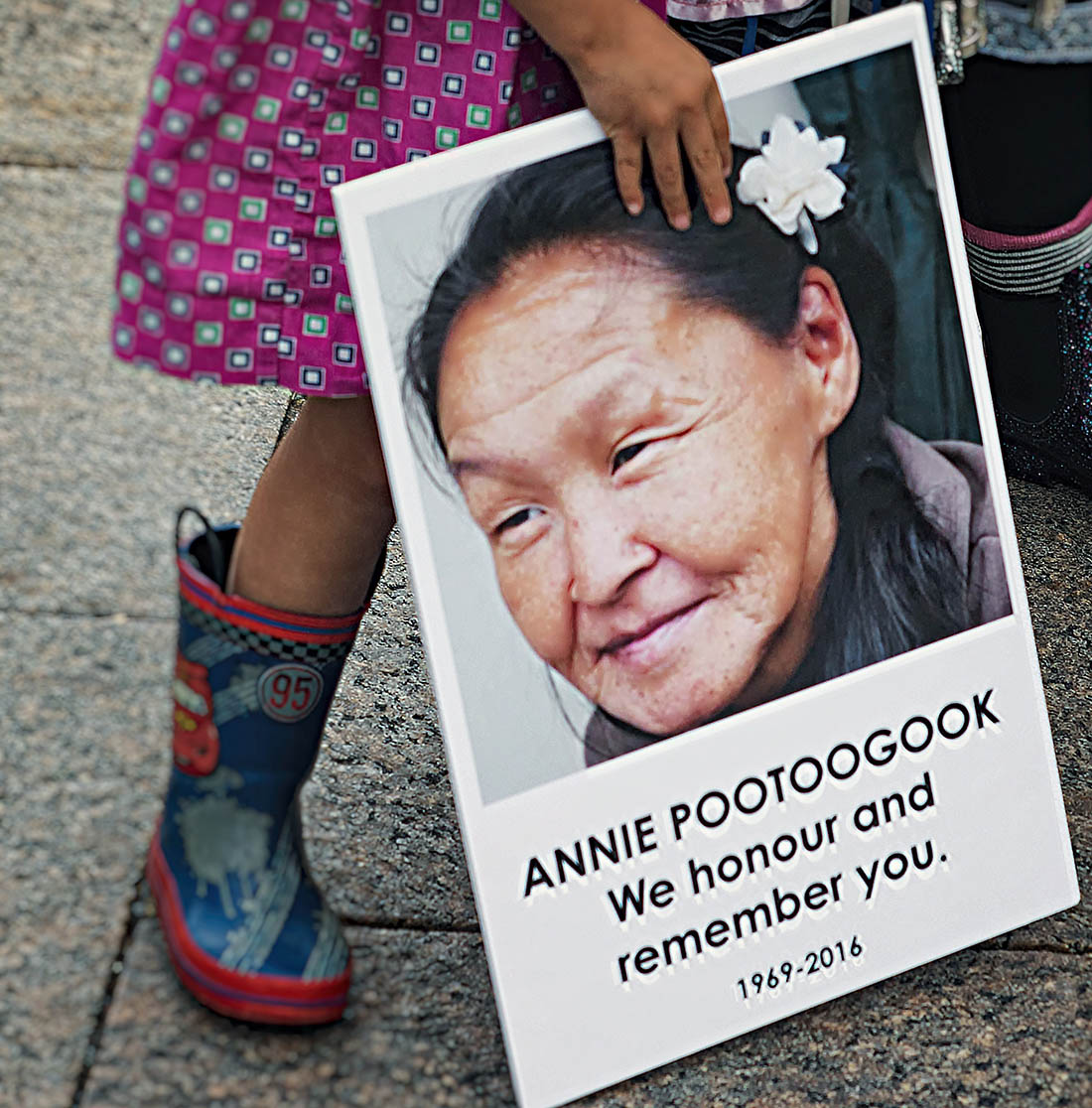
Days after her death, Sergeant Chris Hrnchiar wrote in the comments section of an Ottawa Citizen article about Pootoogook’s death. These comments were widely condemned as racist and gave rise to an internal investigation of his conduct. He pleaded guilty to two counts of discreditable conduct under the Ontario Police Services Act, was demoted and was required to take cultural sensitivity training. Following his guilty plea, Hrnchiar continued efforts to understand Indigenous cultures and histories. He formed relationships with Inuit organizations in Ottawa as well as Pootoogook’s family, including her youngest daughter, Napachie, and her adoptive family.
Pootoogook’s funeral took place in Cape Dorset. The service was entirely in Inuktitut. Napachie Pootoogook, then four years old, and her adoptive family were able to travel to Cape Dorset for the funeral, the first time she would have met her extended Inuit family.
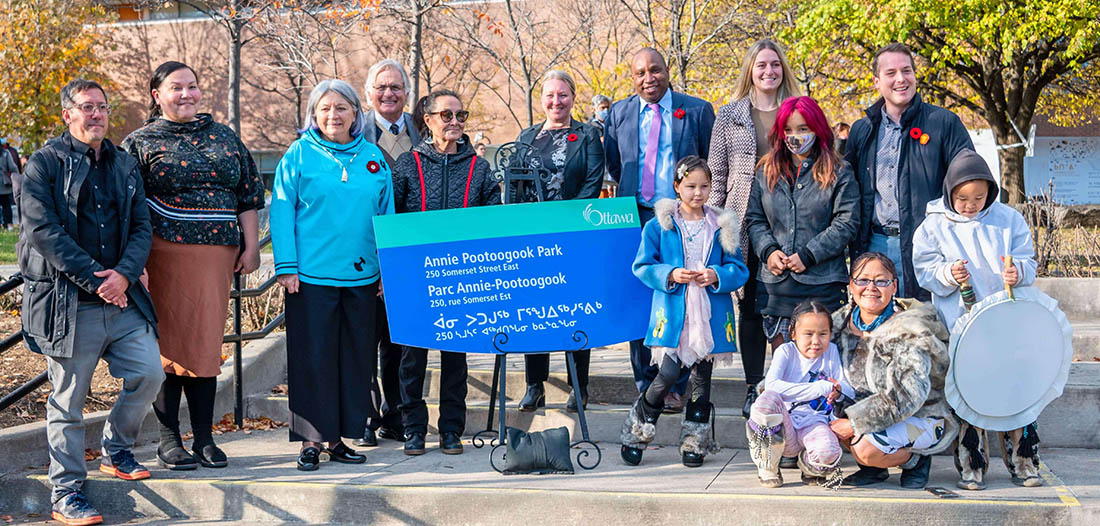
In 2021, a park in the Sandy Hill neighbourhood of Ottawa was renamed the Annie Pootoogook Park in recognition of the artist.