Share on Facebook
 Share on X
 Share by Email
 Share on Google Classroom
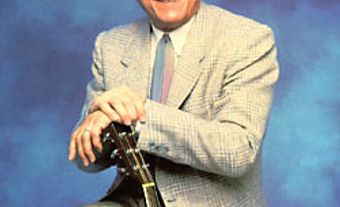
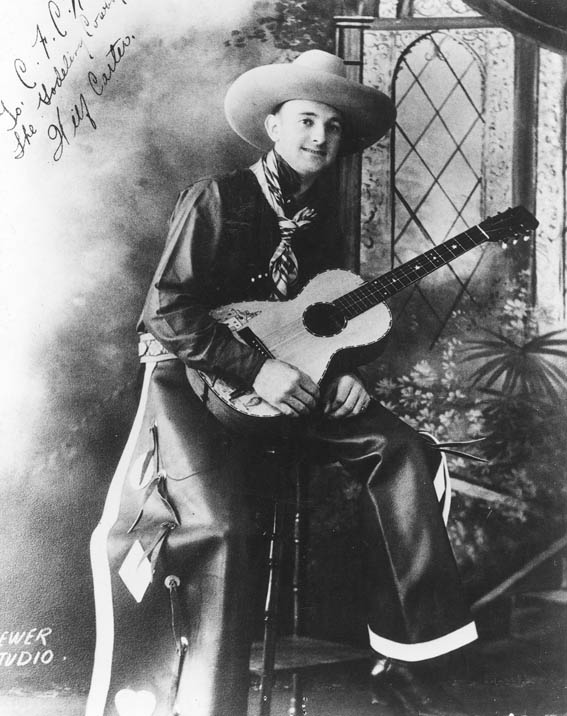
Wilfred “Wilf” Arthur Charles Carter (a.k.a. Montana Slim, the Yodelling Cowboy), singer, songwriter, cowboy (born 18 December 1904 in Port Hilford, NS; died 5 December 1996 in Scottsdale, AZ). The father of Canadian country music, Wilf Carter was Canada’s first country star. He was known for his simple, straightforward singing and guitar style, his skillful yodelling and his prolific songwriting. “The Capture of Albert Johnson” was the first hit record by a Canadian country performer. His versions of “Blue Canadian Rockies” and “You Are My Sunshine” were also popular. Carter was a US radio star in the 1930s and 1940s and enjoyed an international reputation as far afield as Australia. One of the most prominent country stars of his day, Carter was inducted into the Nashville Songwriters Association Hall of Fame in 1971, the Canadian Music Hall of Fame in 1985, the Canadian Country Music Hall of Fame in 1989 and the Canadian Songwriters Hall of Fame in 2007.
Early Life and Career
Inspired by a touring Swiss yodeller, Wilf Carter began to sing as a boy. After working as a lumberjack in his teens and clashing with his Baptist minister father, he left his large family of eight siblings and went to Alberta in the early 1920s and became a cowboy. He joined a rodeo circuit, entertained at dances and performed for tourist parties in the Rocky Mountains. He made his radio debut on Calgary’s CFCN in 1930. He was later heard locally on CFAC, and nationally on the CRBC (the precursor of the CBC).
In Montreal a few years later, he recorded for RCA Victor “My Swiss Moonlight Lullaby” and “The Capture of Albert Johnson,” which were hits; the latter was the first hit record by a Canadian country performer. Carter’s popularity grew with subsequent recordings and radio shows on the CBC and on CBS and NBC in the US, where his stage name was “Montana Slim.”
Career Highlights
In 1935, Wilf Carter went to New York, where, as “Montana Slim,” he was host until 1937 for a CBS radio country music show. He then returned to Canada (purchasing a ranch near Calgary) and was heard on CBC Radio. Before 1940, however, he had two other US radio shows, on the CBS and NBC networks. Many of Carter's early songs were published by Thompson between 1933 and 1949 in several volumes (Cowboy Songs, More Cowboy Songs, New Cowboy Songs, etc.).
Carter was seriously injured in a car crash in 1940. Though he was still able to record, he was unable to perform until 1949. He then resumed live performance with tours in Canada and the US.
Throughout the 1950s, Carter's touring show was one of Canada's most popular attractions. In 1950, he played to 70,000 people in one week at the CNE Bandshell in Toronto. For several years, he performed with his daughters Sheila and Carol. His early tours also introduced such country artists as the Rhythm Pals and Orval Prophet to audiences across Canada.
In 1961 Carter published his autobiography The Yodelling Cowboy: Montana Slim from Nova Scotia by Wilf Carter Himself. Although his popularity began to wane in the 1960s in the face of the changing styles in country music, Carter continued to tour in Canada and performed regularly on CBC TV’s Tommy Hunter Show (see Tommy Hunter), and at the Calgary Stampede, of which he was the Grand Marshall in 1979. As well, his song “Have a Nice Day” was a modest Canadian hit in 1976.
Carter was still performing, writing songs and recording for RCA in the 1980s. Over the course of his career, he wrote more than 500 songs. Carter recordings have also been issued or reissued by Apex, Decca, MCA, Starday (USA), Bear Family (Germany), and other labels. Carter had more than 40 original and compilation LPs released by RCA and its Camden and Pickwick lines, including several theme albums: e.g., Nuggets of the Golden West, Christmas in Canada, Songs of the Rail and Range, Songs of Australia, Wilf Carter sings Jimmie Rogers, and the gospel Let's Go Back to the Bible.
In 1981, Carter toured Western Canada with his contemporary Hank Snow. In 1983, he re-recorded many of his most popular songs for Fifty Gold Years, a two-record 50th-anniversary salute released by RCA. Many of his recordings were subsequently released on CD.
In 1991, at age 86, Carter undertook his farewell tour, aptly titled The Last Round-up Tour, through Nova Scotia, New Brunswick, Ontario and Manitoba.
Death and Tributes
Wilf Carter died of stomach cancer in Scottsdale, Arizona, on 5 December 1996 at the age of 91. Following his death, Hank Snow and Johnny Cash both praised Carter as “a legend in his own time.”
The documentary The Last Round-up: The Wilf Carter Story (2000) explores the country star's career.
Honours
Wilf Carter was made an Honourary Chief of the Stony Indian Tribe and an Honourary Citizen of both Winnipeg and Tennessee. He was inducted into the Nashville Songwriters Association Hall of Fame in 1971, the Canadian Country Music Association Hall of Honour in 1984, the Canadian Music Hall of Fame in 1985, the Canadian Country Music Hall of Fame in 1989 and the Canadian Songwriters Hall of Fame in 2007.
A version of this entry originally appeared in the Encyclopedia of Music in Canada.