Share on Facebook
 Share on X
 Share by Email
 Share on Google Classroom
The spiny softshell (Apalone spinifera) is a large freshwater turtle native to North America. Five subspecies are recognized across its range, but the Northern spiny softshell (Apalone spinifera spinifera) is the only subspecies native to Canada. In Canada, it is found in lakes and river systems in southwestern Ontario and at a single location in southern Quebec. Spiny softshell populations are declining in Canada, and this species is listed as Endangered under Canada’s Species at Risk Act.
Description
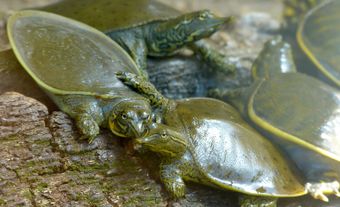
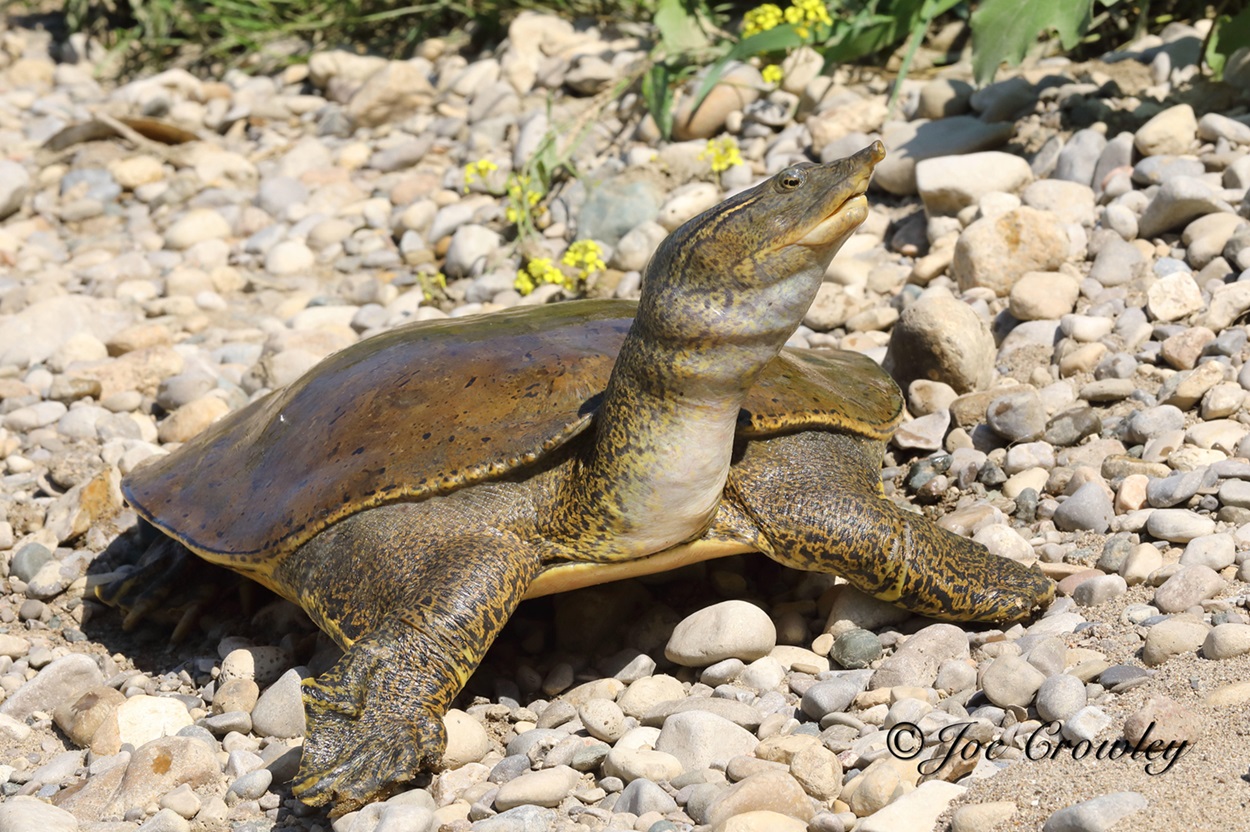
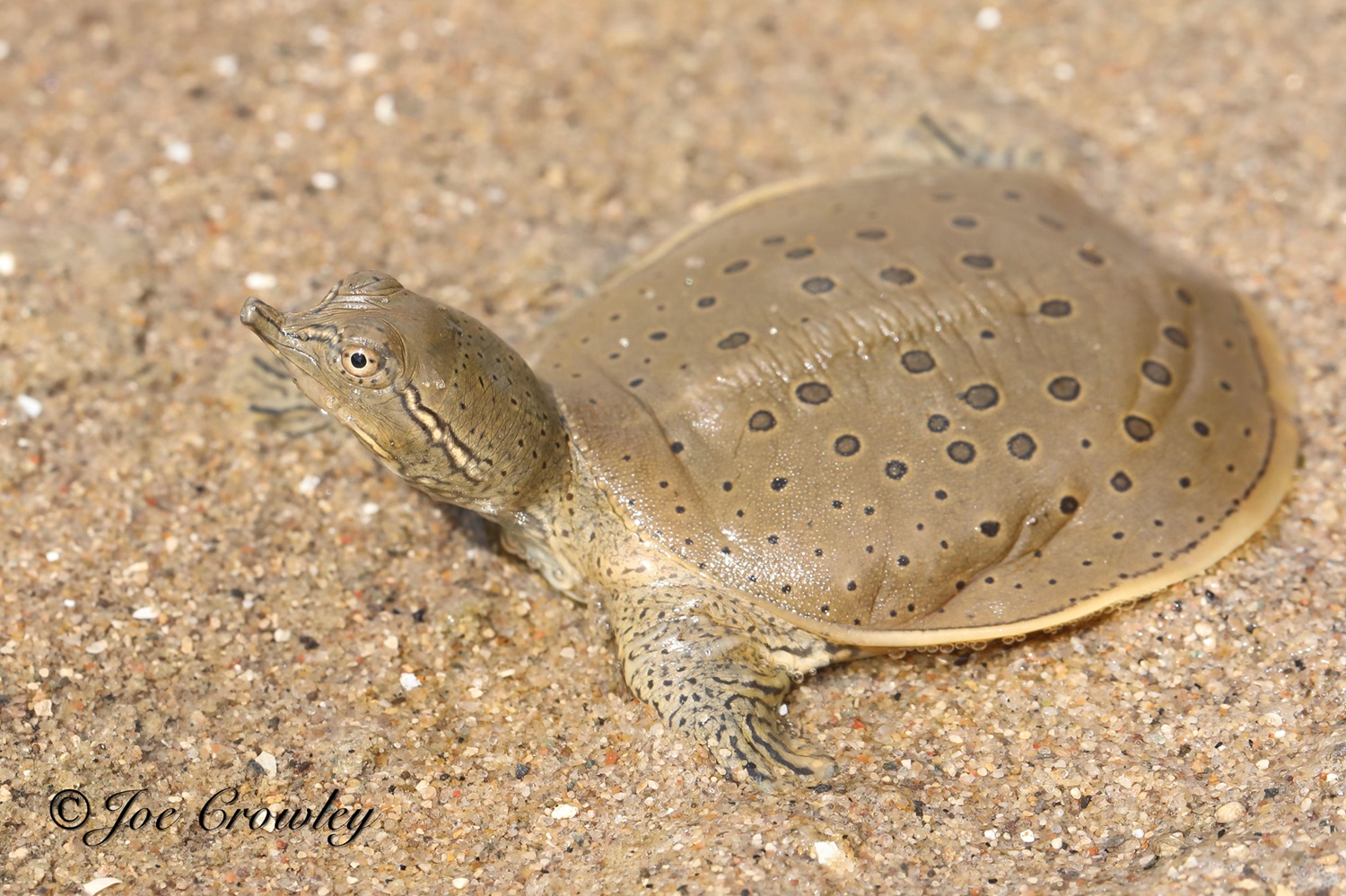
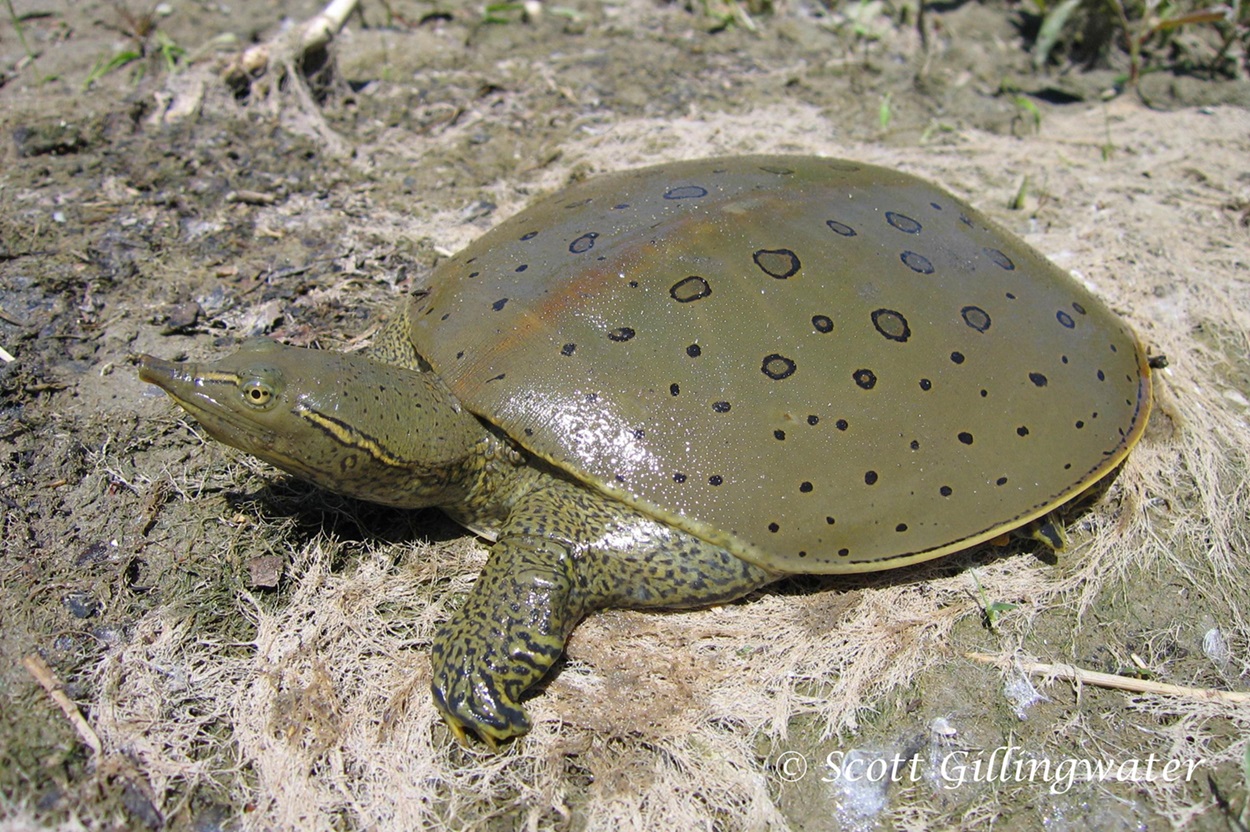
Female spiny softshells can grow to a carapace (upper shell) length of 54 cm. Males are much smaller than females and have a maximum carapace length of around 24 cm. The carapace is relatively flat, round and leathery with a rough, sandpaper-like texture and small spiny projections along the front edge. Spiny softshells have a long neck, a long, snorkel-like snout and webbed feet. The carapace is olive green, tan or brown with a yellow border along the rear edge. Males have a solid-coloured carapace with black-bordered dark spots, while females have a mottled or blotched carapace with black flecks and broken circles. The plastron (bottom shell) is much smaller than the carapace and is white, cream or yellow. The upper surface of the head, limbs and tail are green or olive with black and yellow spots and streaks, while the undersides are white or grey. Hatchlings largely resemble males, but female hatchlings often have incomplete black borders around the spots on their carapace.
Did you know?
Although spiny softshells have lungs, they are also able to exchange gases (e.g., oxygen and carbon dioxide) directly through their permeable skin, even when underwater. Since they can absorb oxygen directly from the water, spiny softshells can remain underwater for a long time. Individuals often stay submerged for 20–50 minutes at a time but can survive underwater for days, if necessary. During hibernation, spiny softshells have low metabolic requirements and can obtain all of the oxygen they require through their skin — remaining underwater (in well-oxygenated water) for over 150 days.
Distribution and Habitat
In Canada, the spiny softshell is found in southwestern Ontario and southern Quebec. Historically, this species had a larger distribution that likely included Lake Ontario and the Ottawa River, as well as other river systems in southern Quebec. The spiny softshell is widespread in the United States, ranging from Vermont south to Florida and west to Montana, Wyoming, Colorado and Arizona.
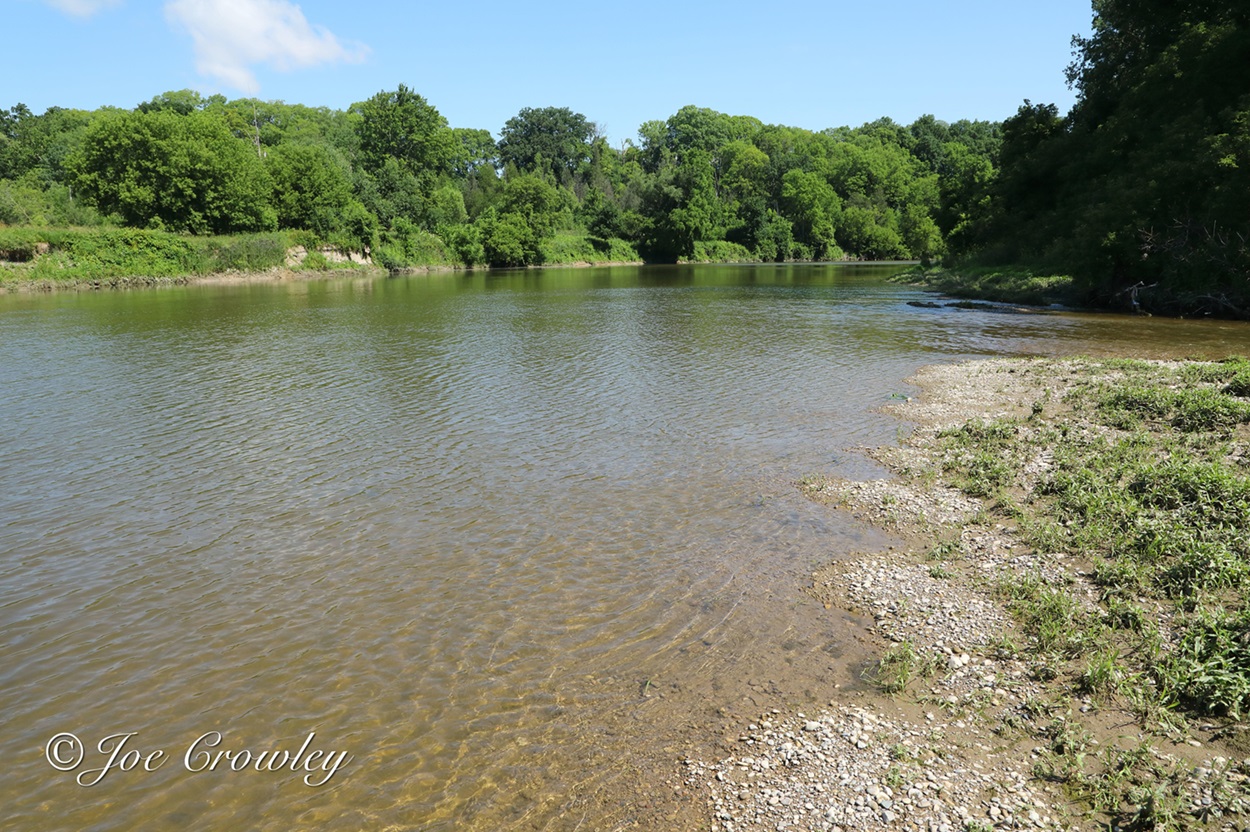
Spiny softshells live in lakes and rivers with soft bottoms, as well as associated streams and wetlands. Shallow areas with a mucky bottom and sparse aquatic vegetation (e.g., calm backwater areas, sheltered bays) provide important habitat for foraging, thermoregulation (body temperature regulation), and as nursery sites for juveniles. Spiny softshells bask (warm up in the sun) on gradually sloping shorelines, rocks, fallen trees and floating vegetation, by floating at the surface of the water or by burying themselves in the mud in warm, shallow areas. Females typically nest on sand or gravel bars and beaches. Spiny softshells hibernate in deep and well-oxygenated areas of rivers and lakes. Spiny softshells can travel considerable distances between their nesting, hibernation and summer habitats and some individuals have home ranges that are over 25 km in length.
Reproduction and Development
Spiny softshells typically mate in the spring. In Canada, females lay one or two clutches of eggs each year from late May to mid-July. Clutch size ranges from 3 to 43 eggs, but most nests contain 15–20 eggs. Eggs are round with a diameter of 24–32 mm. Hatchlings emerge from the eggs in August or September after an incubation period of 55–100 days. Hatchlings have an upper shell length of 30–44 mm. Unlike most other turtle species in Canada, the sex of the hatchlings is determined genetically rather than by the incubation temperature of the eggs. In Canada, female spiny softshells do not reach sexual maturity until they are at least 15 years old. Turtle eggs and hatchlings have low survival, meaning very few survive to adulthood. Once spiny softshells reach adulthood, however, they may live for over 50 years.
Diet and Predation
Spiny softshells eat a variety of small animals, but insects (e.g., beetles, flies, dragonflies), crayfish and fish usually make up most of their diet. Individuals forage for prey by swimming or crawling along the bottom of water bodies. Adult spiny softshells have few predators, and humans are the main cause of adult mortality. Juveniles and hatchlings are eaten by a wide range of predators, including mammals, wading birds, eagles, fish, snakes and other turtles. Mammals, such as raccoons, striped skunks, red foxes and coyotes, are the main predators of spiny softshell nests.
Threats
Habitat destruction is the most significant threat to spiny softshells in Canada. Conversion of natural areas to agricultural and urban uses not only eliminates critical habitat but also introduces a range of additional threats. For example, rainwater from major storms flows rapidly over agricultural and urban surfaces, causing “flash floods” that wash out nesting areas or drown nests. Hydroelectric dams also alter water levels, flooding nests and draining shallow nursery habitats. Invasive species, such as Japanese hops and European common reed, are eliminating spiny softshell nesting habitat by replacing sand and gravel shorelines with dense stands of vegetation. In areas with high recreational fishing pressure, the ingestion of fishing hooks can be a major source of spiny softshell mortality. Some nest predators, such as raccoons, have become over-abundant in many human-settled areas due to increased food sources (e.g., garbage, corn fields). In some areas, these “subsidized predators” can consume virtually all of the spiny softshell eggs that are laid each year. Other threats to spiny softshells in Canada include illegal collection of turtles and eggs for food and traditional medicine, boat strikes, pollution and climate change.
Status and Conservation
Globally, the spiny softshell is listed as of Least Concern by the International Union for Conservation of Nature. However, in Canada, spiny softshells are found in the most heavily impacted regions of the country, where the severity of threats has led to significant and ongoing population declines. For this reason, the spiny softshell has been listed as Endangered under Canada’s Species at Risk Act (SARA). A dedicated conservation program spanning over 30 years has helped recover one of the largest remaining populations in Canada. However, considerable work is still needed to address major ongoing threats and ensure the long-term survival of all of Canada’s spiny softshell populations — many of which are on the brink of disappearing.