Share on Facebook
 Share on X
 Share by Email
 Share on Google Classroom
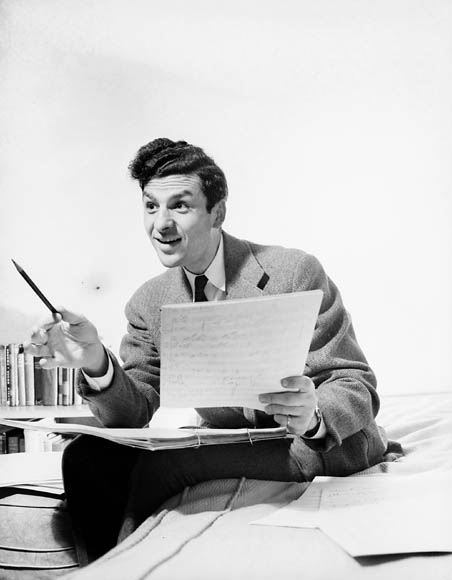
Louis Applebaum, CC, OOnt, composer, conductor, administrator (born 3 April 1918 in Toronto, ON; died 20 April 2000 in Toronto). One of Canada’s most prodigious composers, Louis Applebaum wrote and conducted hundreds of scores for film, theatre, and radio and TV drama. His frequently commissioned concert pieces, ballets and fanfares were widely admired. In addition to his busy career as a composer, Applebaum’s administrative skills made him a consultant and administrator for such organizations as the National Film Board, the Canada Council for the Arts and the CBC. Applebaum established the music wing of the Stratford Festival in 1955. In 1965, he chaired a government-commissioned committee whose report led to the formation of the National Arts Centre Orchestra. He was also the founding president of SOCAN. Applebaum was made an Officer of the Order of Canada in 1976 and was promoted to Companion in 1995.
Early Life and Education
Louis Applebaum studied at the Toronto Conservatory of Music (now Royal Conservatory of Music) and the University of Toronto with Boris Berlin, Healey Willan and Sir Ernest MacMillan. Applebaum then went to New York in 1940–41 on scholarship to study composition with Roy Harris and Bernard Wagenaar. By the mid-1940s, he had moved to Hollywood, where his film scores were in great demand. But he soon returned to Canada.
Career as Composer
As a film composer, Louis Applebaum produced some 250 scores for the National Film Board (NFB) between 1942 and 1960. His career as a composer proceeded steadily despite the heavy demands of his other activities.
By 1953, most of Applebaum’s several hundred film scores were behind him (including The Story of G. I. Joe, which was nominated for an Academy Award in 1946). He had also written a great deal of incidental music for CBC radio productions of Hamlet, Le Médecin malgré lui, Peer Gynt, Antigone, Oedipus, and The Madwoman of Chaillot. In 1953, Applebaum was hired by Tyrone Guthrie to be a kind of staff composer for the first Stratford Festival. He wrote the “foyer fanfares,” which became a tradition there. He also composed incidental music for the inaugural productions of Richard III and All's Well that Ends Well. In total, he turned out incidental music for more than 75 Stratford plays, the last being The School for Scandal in 1999.
Applebaum composed many scores for plays, for example those produced by Esse Ljungh on CBC radio, by Tyrone Guthrie (Tamburlaine the Great, 1956) and Michael Langham (Max Frisch's Andorra, 1963) on Broadway; by the Royal Shakespeare Company (Much Ado About Nothing, 1961); by the Manitoba Theatre Centre (Mother Courage and Nicholas Romanov, the latter revised for Stratford, 1966, as The Last of the Tsars); and by Theatre London (Timon of Athens, 1983).
Applebaum's three ballets were commissioned: Dark of the Moon (revised as Barbara Allen) by the National Ballet of Canada; Legend of the North by the Janet Baldwin Ballet of Toronto; and Homage for performance by the National Ballet at the opening ceremonies of the National Arts Centre. He also composed the electronic curtain-music used on that occasion.
For CBC TV, Applebaum composed scores for eight episodes of The National Dream (1973), 14 of the Purple Playhouse (1973), and five of the Images of Canada. He also produced scores for many other series, as well as for the specials Mother Courage (1964), Next Year in Jerusalem (1974), Journey Without Arrival (1975), Homage to Chagall (1976), Sarah (1976), The Masseys (1978), Raymond Massey (1984), and Karsh: The Searching Eye (1985). His score for the mini-series Glory Enough for All (Gemstone Productions) received a 1990 Gemini Award.
Like his theatre music, Applebaum's concert pieces were usually written to order, the assignments as various as the commissioners (e.g., “Cry of the Prophet” for the Canadian Jewish Congress; Concertante for Small Orchestra for the Edmonton Symphony Orchestra; Place Setting for the opening of Hamilton Place; and Play On! for the Royal Conservatory of Music’s centennial concert).
In this field, also, the size of Applebaum's output is remarkable when taken in relation to the complexity of his administrative life, particularly considering he conducted many of the Stratford and CBC performances of his own music, Stratford opera productions (including Guthrie's stagings of H.M.S. Pinafore and The Pirates of Penzance on tour in England and the USA, 1962-3), and Eldon Rathburn’s soundtrack (later issued as a recording, Dominion LAB-650S, conducted and produced by Applebaum) for Expo 67's Labyrinth.
Later major works by Applebaum include: The Holly Wreath, a suite of carols composed in 1995 in collaboration with Robertson Davies; Five Snapshots for English horn and strings; and the opera Erewhon with librettist Mavor Moore, for performance by Pacific Opera Victoria in February 2000.
Career as Administrator
Louis Applebaum established himself early as a conceptual thinker, practical planner and resourceful negotiator. Appointments with the NFB (music director 1942-8, consultant 1949-53) and in New York with World Today films (music director 1946-9) and the National Film Council (member, advisory committee) were the first assignments that put Applebaum at the forefront of the evolution of performing rights and arts policies.
In 1955, Applebaum established the Stratford Music Festival as a separate aspect of the two-year-old Stratford Festival. In 1960, Applebaum resigned from administrative duties at Stratford in 1960 (though he continued until 1999 to provide incidental music for festival productions). He embarked on his first private enterprise, serving as president of Group Four productions, makers of documentaries and TV shows for market, until 1966.
During the same period, Applebaum was music consultant for CBC TV (1960–63); chairman of the music, opera and ballet advisory committee for the NAC (1963–66); and the author in 1965 of A Proposal for the Musical Development of the Capital Region, the government-commissioned report that led to the formation of the NACO and of a plan for the establishment of a music department at the University of Ottawa.
Louis Applebaum
Louis Applebaum gives a speech in July 1963.
(courtesy Getty Images)
Applebaum then served as chairman of the CAPAC-Canadian Association of Broadcasters committee (1965–70) for the promotion of Canadian music. He also sat on the advisory arts panel (1966–69) and was an arts award jury member for the Canada Council (1970–71). He served on the planning committee for Co-ordinated Arts Services (1967–68) and was consultant for the St Lawrence Centre (1968–70). He was on the staff of the Composers, Authors and Publishers Association of Canada (CAPAC, 1968–71) in charge of member relations. He subsequently served on its board, a function he had filled almost without a break since its inception. He became the trustee of the John Adaskin Memorial Fund and was a regular consultant for the POCA (see Ontario Arts Council).
In 1971, the OAC appointed Applebaum its executive director. The position brought into play all facets of his experience in the administration and politics of the arts, and in the arts themselves. It also gave him a major role in the phenomenal acceleration of cultural development in Ontario in the 1970s. He retained the position until 1980, when he took up new duties as chairman of the Federal Cultural Policy Review Committee. (See Applebaum-Hébert Report.) Originally set up in 1979 as an “advisory committee on cultural policy,” this body was enlarged in 1980 and charged with consulting country-wide on matters of cultural concern. The committee's report strongly reiterated the “arms’ length” principle of government involvement in culture and the arts. It also made persuasive cases for policy renewal, especially in areas such as heritage, film development, and international cultural relations.
Other Activities
Louis Applebaum taught courses on music for film, theatre, and TV at York University (1974–76, and jointly with Paul Hoffert, 1982–89). Applebaum was interim artistic director of the Guelph Spring Festival for the 1988–89 season. He was president of CAPAC from 1988 to 1990 and co-chair of the committee to negotiate a merger with PRO Canada.
He was executive director of the Ontario Arts Council from 1970 to 1979, when he became co-chairman, with Jacques Hébert, of the Federal Cultural Policy Review Committee, which reported in 1982. Applebaum became vice-president of the CAPAC in 1985, and president from 1988 to 90. When the new performing-rights body, SOCAN, came into existence, Applebaum was elected its first president, 1990–92.
In 1998, Applebaum established the Louis Applebaum Composers Award with contributions from the Laidlaw Foundation and others. This lifetime achievement award recognizes both excellence in composition and the impact of a composer's work on society. In November 1999, R. Murray Schaffer became the first recipient of the award and said: “I am particularly touched by this award that recognizes the importance of the arts in a broader societal context.” The Louis Applebaum Composers Fund is administered by the Ontario Arts Council Foundation.
Applebaum was also a founding member of the Canadian League of Composers and an associate of the Canadian Music Centre. At the time of his death, he was chairman of the SOCAN Foundation.
Louis Applebaum and Robertson Davies in 1987
(courtesy Getty Images)
Characteristic Traits
Louis Applebaum’s creative trademarks were energy and optimism. His flexibility and assured craft, evident in his many occasional and functional scores, were complemented by a command of discursive lengths. This was illustrated in more autonomous projects, from the early Barbara Allen through to the musical ghost story The Harper of the Stones (librettist and first narrator, Robertson Davies), with its spectral dance episode accompanied on spoons and its striking passacaglia-finale.
Applebaum’s extensive film experience gave him an aptitude for technological devices. From King Lear in the mid-1960s to Hamlet in 1991, his Stratford scores often employed electroacoustic means. At the same time, his repertoire of song settings for Stratford productions, whether for vocal-instrumental ensemble or small choir, covered a wide gamut of styles and conventions. In 1987, he gathered some of these in a Folio adapted for voice-and-piano concert performance. Applebaum's last major work was the opera Erewhon (libretto by Mavor Moore), commissioned by the Pacific Opera Victoria, which debuted February 2000.
Though the administrative and compositional aspects of Applebaum's career may seem divergent, to him they were confluent. He explained his perspective in an interview with Canadian Composer in January 1974.
“Essentially I’m working to improve the lot of my colleagues and I have been doing that for many years — at the same time staying on ... as a functioning artist ... Though I was a composer there, the Film Board was the kind of operation that made one part of a great social force.... And when I got into other kinds of musical activities, like the theatre at Stratford, it was a Stratford that was changing the theatrical life of our country. When the Canada Council was formed, I was there, helping in whatever way I could, and also with the League of Composers and the Canadian Music Centre, the Music Council and the National Arts Centre.... No matter where I am or in what medium I am working, my life always seems to be pointing in the same direction.”
Death and Tributes
In 1998, impresario Lawrence Cherney organized an evening of multimedia entertainment at Toronto's St. Lawrence Centre to honour Louis Applebaum on his 80th birthday. The celebration featured Applebaum's compositions performed by longtime friends and colleagues, including some of Canada’s finest entertainers. Applebaum died of lung cancer on 20 April 2000 at the age of 82.
Stratford's Richard Monette said that Applebaum “was kind, magnetic and hugely generous, particularly in the support he gave to young Canadian composers.” Monette also called Applebaum “the dean of Canadian theatre composers.” In the SOCAN News, Rick MacMillan said, “Louis Applebaum ... will be remembered for his astoundingly broad and comprehensive contributions to Canadian music. But those close to him will always recall his open-mindedness, his modesty, his patience and his unselfish passion for improving the working environment for composers.” Applebaum's papers are held at York University.
Louis Applebaum in 1987
(photo by Jeff Goode, courtesy Toronto Star via Getty Images)
Honours and Awards
In addition to the aforementioned Academy Award nomination, Louis Applebaum won a special Hollywood Writers’ Mobilization award (1945) for his score for Tomorrow the World; a citation (1950) from the New York National Board of Review for Lost Boundaries; the Flaherty Award (1952) for And Now Miguel; Canadian Film Awards for Paddle to the Sea (1958), Wheat Country (1959) and Athabasca (1968); and a Wilderness Award (1973) for Folly on the Hill.
Applebaum was the first recipient of an honorary ARCT from the RCMT. He became an honorary fellow of the Ontario College of Art in 1980 and of OISE in 1988. In 1991, the Jewish Community Centre in Toronto named him Arts Person of the Year, and he and was Artist in Residence at the University of Windsor. He was made an Officer of the Order of Canada in 1976 and was promoted to Companion in 1995. He was appointed to the Order of Ontario in 1989.
He received an Honorary Doctor of Humanities from the University of Windsor in 1994 and the Walt Grealis Special Achievement Juno Award in 1995 for contributing to the growth of the Canadian music industry. He also received various SOCAN awards, including the first SOCAN Special Achievement Award in 1997. In 1998, he was granted both the Arts Toronto Lifetime Achievement Award and the Diplôme d'honneur of the Canadian Conference of the Arts. In 1999, he received the Roy Thomson Hall Award and the SOCAN Serious Music Award.
A version of this article originally appeared in the Encyclopedia of Music in Canada.