Share on Facebook
 Share on X
 Share by Email
 Share on Google Classroom
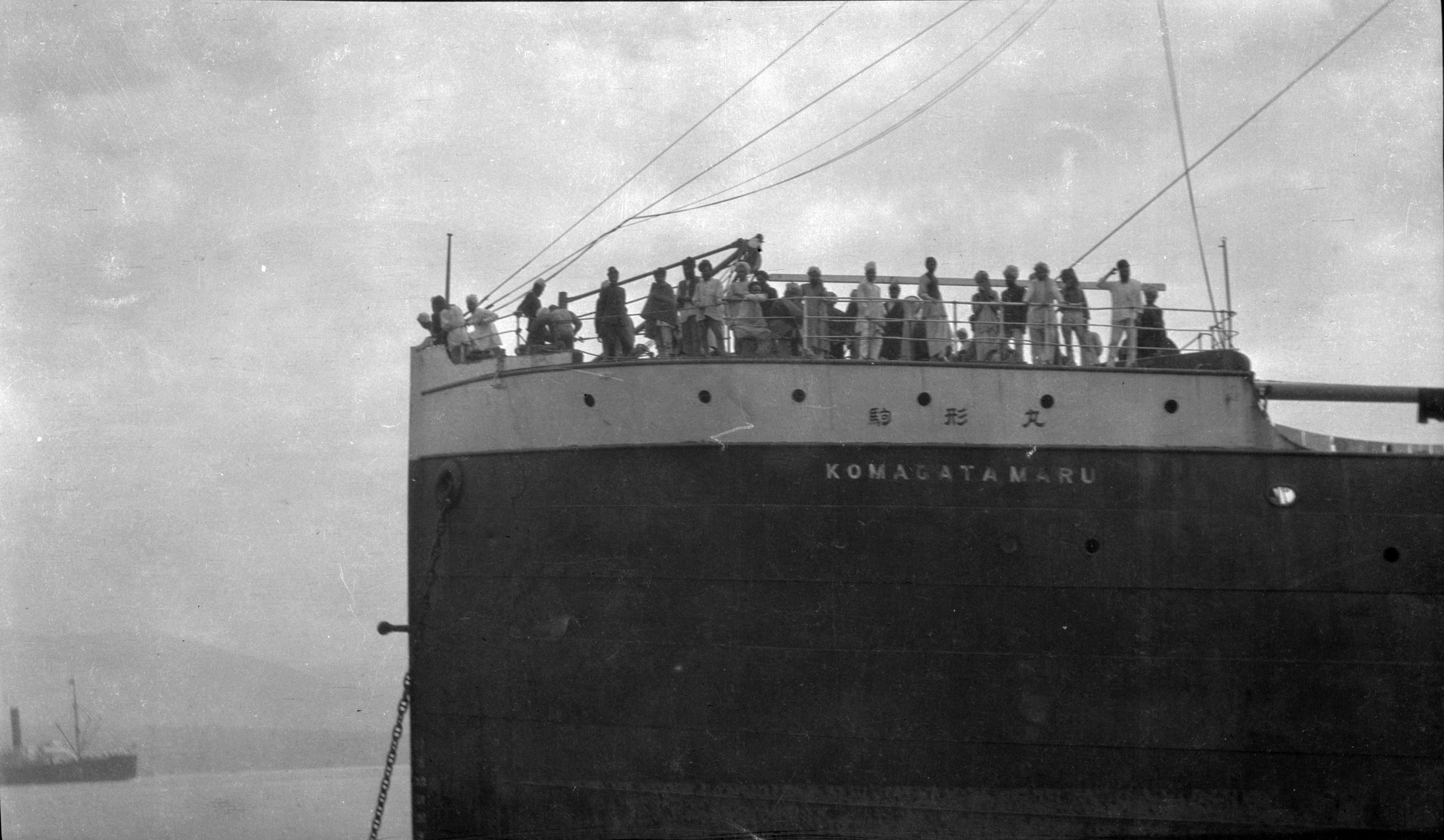
The Komagata Maru was a ship. It was also called Guru Nanak Jahaz. The ship became famous in Canada in 1914. The passengers on the ship were from India. They wanted to come to Canada. The ship arrived in Vancouver. But most of them were not allowed to leave the ship. Back then, many Canadians did not want Indians to come to Canada. They believed that Canada should be a “white man’s country.” The passengers on the ship protested. This even caused violence. Passengers and the police fought each other. Soon after, the Komagata Maru went back to India. There, authorities killed 20 of the passengers.
The story made many Indians angry. Indians were members of the British Empire. So, they believed they should be able to immigrate to Canada.
This article is a plain-language summary of Komagata Maru. If you are interested in reading about this topic more in depth, please see our full-length entry, Komagata Maru.
Early South Asians in Canada
In 1914, a few thousand South Asian people lived in Canada. Most came from Punjab, in northern India. (See Punjabi Canadians.) Most lived in British Columbia. They faced much discrimination. Anti-Asian groups had much power. They always tried to get governments to change immigration laws. (See Anti-Asian Racism.)
In 1908, Canada listened to them. It created two rules. These made it very hard for Indians to come to Canada.
One rule stated that Indians could only come to Canada if they came straight from India. But Canada’s government made that very hard. They did not let Indians buy tickets for such a trip.
The other rule stated that Asian immigrants entering Canada needed to have $200. If not, Canada could stop them from entering. This was a lot of money.
Planning
The immigration rules upset many Indians. They really upset a man named Gurdit Singh Sirhali. He decided to try to change the laws. He thought he could change the laws by sending passengers from India to Canada on a ship. He believed that this would get much publicity. As a consequence, he hoped that the courts in Canada would be forced to reverse the immigration rules.
Gurdit Singh Sirhali found many Punjabi men who wanted to go to Canada. Most of the passengers who went to Canada were Punjabi men. (See Punjabi Canadians.) Of these men, at least 337 were Sikhs. There were also about 27 Muslims and 12 Hindus. There were two wives and four children.
Gurdit Singh Sirhali found a ship named the Komagata Maru in Hong Kong. The group renamed it Guru Nanak Jahaz.
The ship left Hong Kong in early April 1914. There were 150 passengers. The other passengers boarded when the ship stopped in Shanghai and Japan.
Arrival in Canada
The Guru Nanak Jahaz arrived in Vancouver on 23 May 1914. Canadian authorities allowed almost none of the passengers to leave the ship. Later on, authorities did not allow the passengers to have food, water or other supplies. They wanted the ship to leave Canada. Soon after, violence erupted between the police and the passengers.


Friends of the passengers hired lawyers. They wanted to get the authorities to change their mind. But they lost the case in court. Gurdit Singh, the passengers and their friends understood that they could never win. So, the Guru Nanak Jahaz sailed back to India.
Back in India and Legacy
The Guru Nanak Jahaz eventually arrived at the port of Budge Budge in India. A tragedy soon resulted. British officials did not trust the passengers. They did not trust Indians who opposed British authorities. Consequently, the officials did not allow the passengers to travel freely. A fight then ensued. Authorities killed around 20 passengers. Other passengers escaped.
For a long time, Canadians did not discuss the story of the Guru Nanak Jahaz. This has changed recently. Sikh Canadians started to call on Canada to apologize. In 2008, Canada did. The Government of British Columbia apologized, and so did Prime Minister Stephen Harper. In 2016, Prime Minister Justin Trudeau also apologized. In 2012, a memorial to commemorate the passengers of the Komagata Maru was built. Thanks to this, the events of 1914 will not be easily forgotten.