Share on Facebook
 Share on X
 Share by Email
 Share on Google Classroom
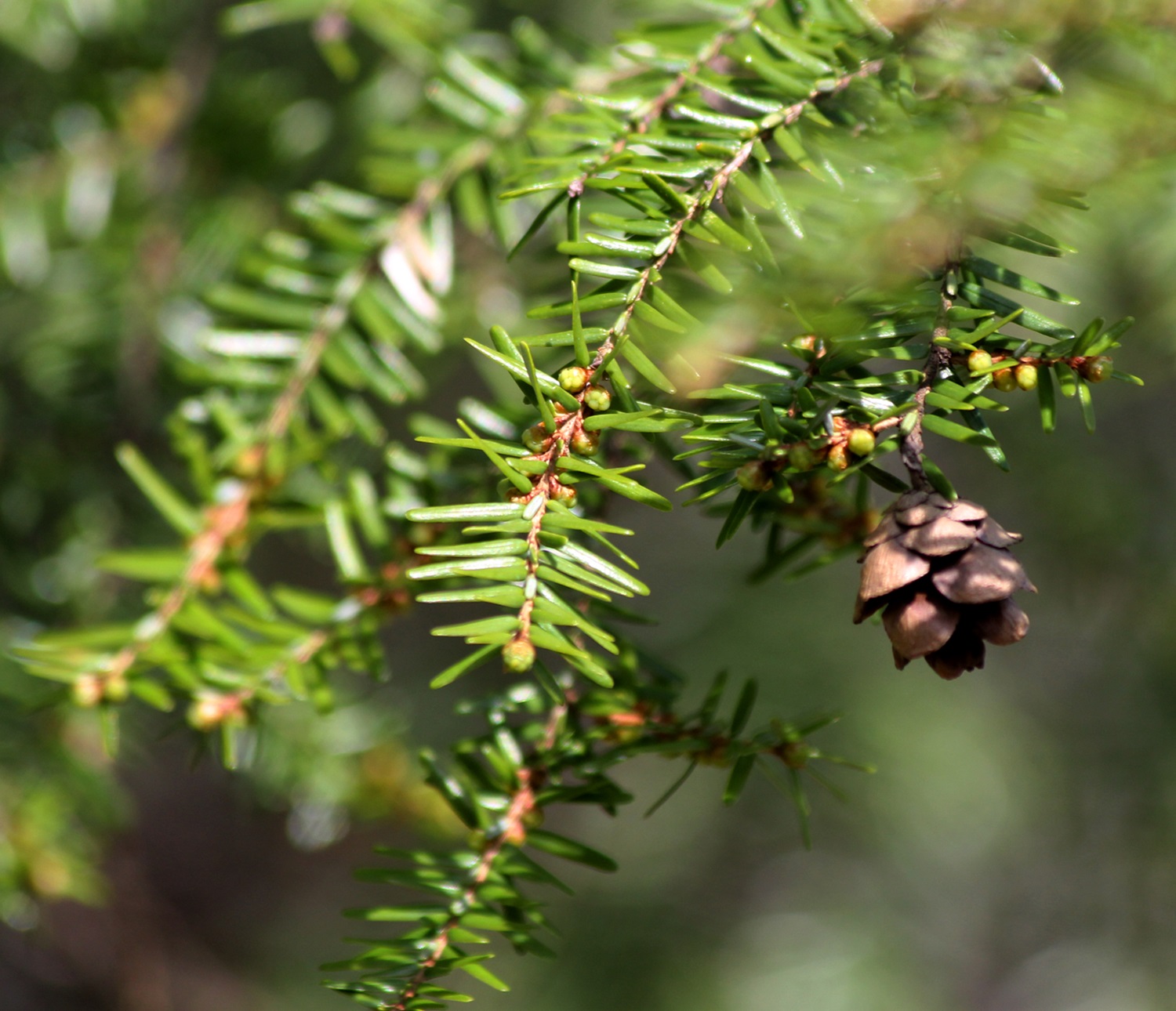
Hemlock (Tsuga) is a genus of evergreen trees in the Pinaceae family native to North America and central and eastern Asia. At least 10 species of hemlock exist in the world, with only three growing in Canada: the eastern hemlock, western hemlock and mountain hemlock. These trees are often referred to as foundation species, meaning they play a vital role in creating and maintaining the ecosystem in which they reside. For hemlocks, their roles as a food source and habitat for wildlife, as well as their temperature-regulating qualities, make them incredibly valuable.
Hemlock Tree vs. Poison Hemlock
Hemlock trees are not related to the hemlock plant, or poison hemlock (Conium maculatum), which is a highly poisonous flowering plant; however, when the tree’s foliage is crushed, it gives off a similar smell to that of the poison hemlock, which is how the tree got its name.
Canada’s Hemlock Trees
|
Species |
Description |
Habitat and Range |
|
Tsuga canadensis Eastern hemlock |
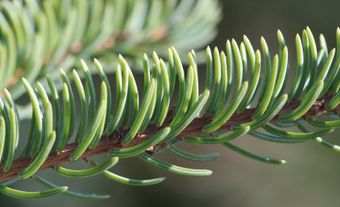
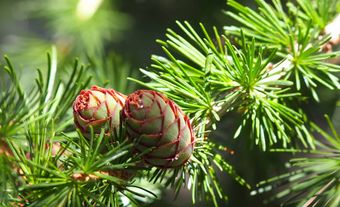
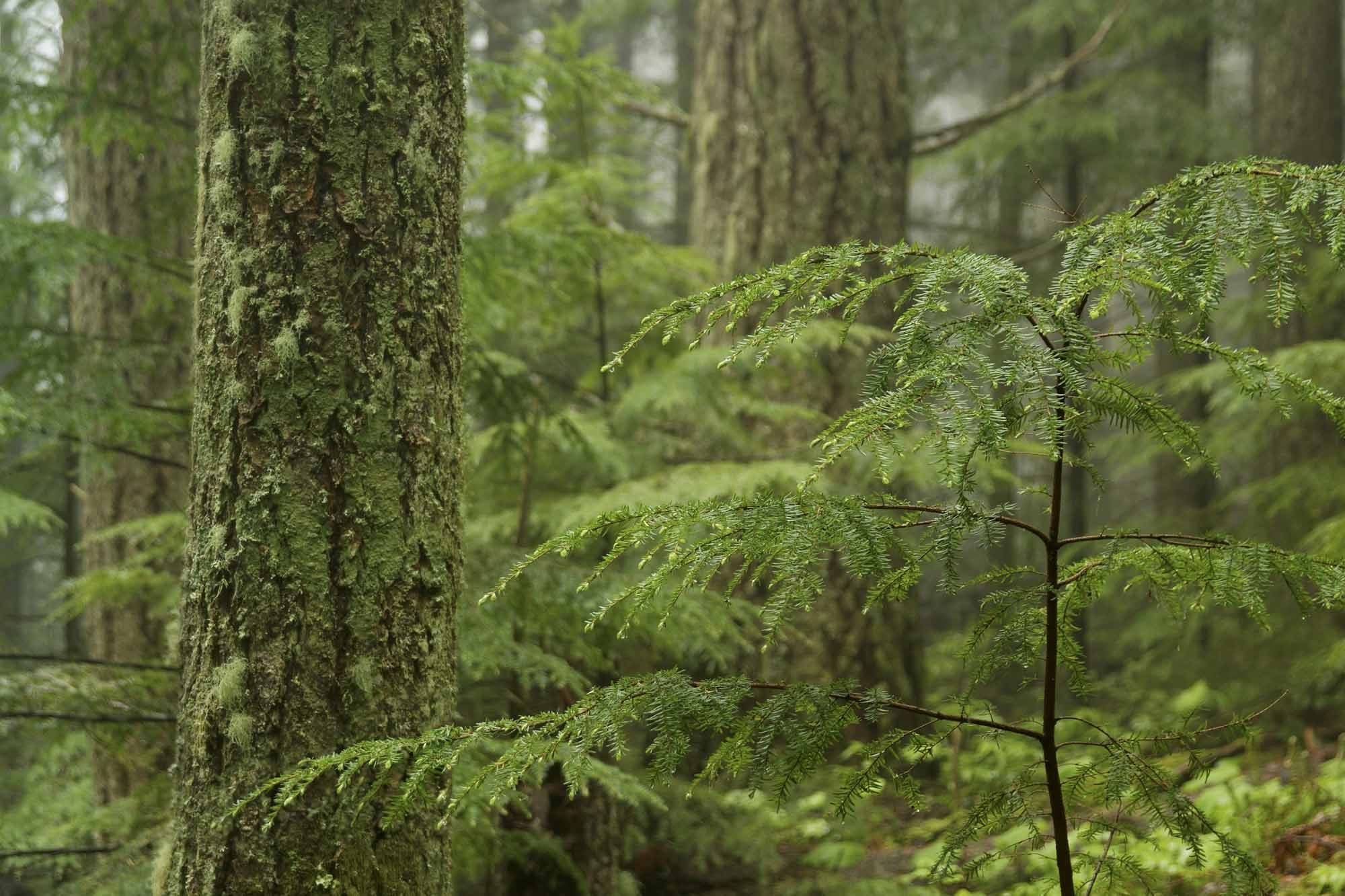
The eastern hemlock stands up to 30 m tall and can live up to 600 years old. It has flat needles, which are shiny green on top and whitened on the bottom. The cones open in autumn, release seeds during the fall and winter, and stay on the tree until the following season. The bark of eastern hemlocks changes as the tree ages. In a young tree, the outer bark is grey-brown and relatively smooth and scaly, while the inner bark is bright reddish-purple. In a mature tree, the bark becomes cinnamon or dark brown and is deeply furrowed with broad, flat-topped ridges. With the trunk growing to a strong taper, the crown of the tree is dense and conical with branches spreading away from the trunk. |
This tree is found in the eastern part of Canada, largely in the Maritime provinces and along southern Ontario and Quebec. It can grow in multiple soil types, but thrives in cool and shady locations. |
|
Tsuga heterophylla Western hemlock |
The western hemlock can grow up to 50 m tall and can live for 500 years. Its needles are flat and blunt-tipped. The upper surface of the leaves is dark green, while the lower surface is lighter with white dots lining the midvein. Its cones are ovoid and short-stalked, opening up in autumn so the seeds fall gradually throughout the winter. Unlike the mountain hemlock, whose cones fall off in the spring, western hemlock’s cones can stay on for one or two years after they open. The bark is smooth and reddish-brown when young, but grows scaly, ridged, and darker with age. The crown is open and conical, growing crooked with age. |
The western hemlock is found in Western Canada, in both coastal and inland British Columbia. It is very tolerant of shade and sun and can grow in variable soils up to 1,500 m in elevation. |
|
Tsuga mertensiana Mountain hemlock |
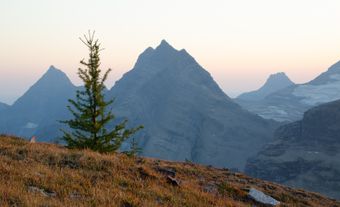
The mountain hemlock usually grows to about 15 m, but can reach up to 45 m, and can live for hundreds of years. The blueish-green needles are blunt-tipped and crowded along the twig, with faint lines of white dots on both sides. The cones are oblong, open in autumn for the seeds to fall throughout the winter, then falling off in the spring. The bark is dark reddish-brown with scaly, flat-topped ridges. The crown of the mountain hemlock is thinner than that of the eastern hemlock and can become twisted with age. |
This tree is found along the entire coast of British Columbia, reaching down into California and up into Alaska. It grows best in deep, moist soils on north slopes in subalpine climates. In higher elevations, it takes on a more shrub-like appearance. |
Wildlife
Many animals use hemlock trees as a food source. Larger animals like moose and deer will forage for needles from the ground, while smaller rodents like squirrels and voles eat the seeds. Birds also use the trees as both a food source and a nesting place.
In the winter, the hemlock’s long and broad branches that grow parallel to the ground are good for catching snow before it hits the forest floor, offering valuable shelter for deer. This also allows the deer to forage for food on the exposed ground in the winter when food sources are scarce.
The branches are also useful in the summer, as they keep the forest floor cooler. As hemlocks often grow near water, the overhanging branches provide shade that keeps water temperatures cool.
Indigenous Peoples
In many Indigenous communities, hemlocks were largely used for tanning hides and dyeing fabric, due to the bark’s high tannin content. After an animal hide was dyed, it would take on a reddish-brown or dark colour.
The inner bark of the western hemlock, called the cambium, was harvested in the spring and eaten in a variety of ways. Coastal Indigenous groups would strip it from the tree to eat dried or cooked, or they would press it into bread and cakes.
Medicinally, hemlock bark was boiled down to a paste and applied to wounds to help them heal faster. Teas made from hemlock have a high concentration of vitamin C, which is used to help with conditions like scurvy, rheumatism, arthritis, colds, coughs and others.
Uses
The hemlock is largely used commercially for pulp, paper, lumber and mulch, though it is not as lucrative as other tree species. The wood is not as strong, and the pulp is often a darker colour, which is more difficult to bleach.
The hemlock is also used as an ornamental tree for lawns and gardens. Since they are shade-tolerant and have shallow root systems, they are very resilient as hedges or ornamental trees.
Threats
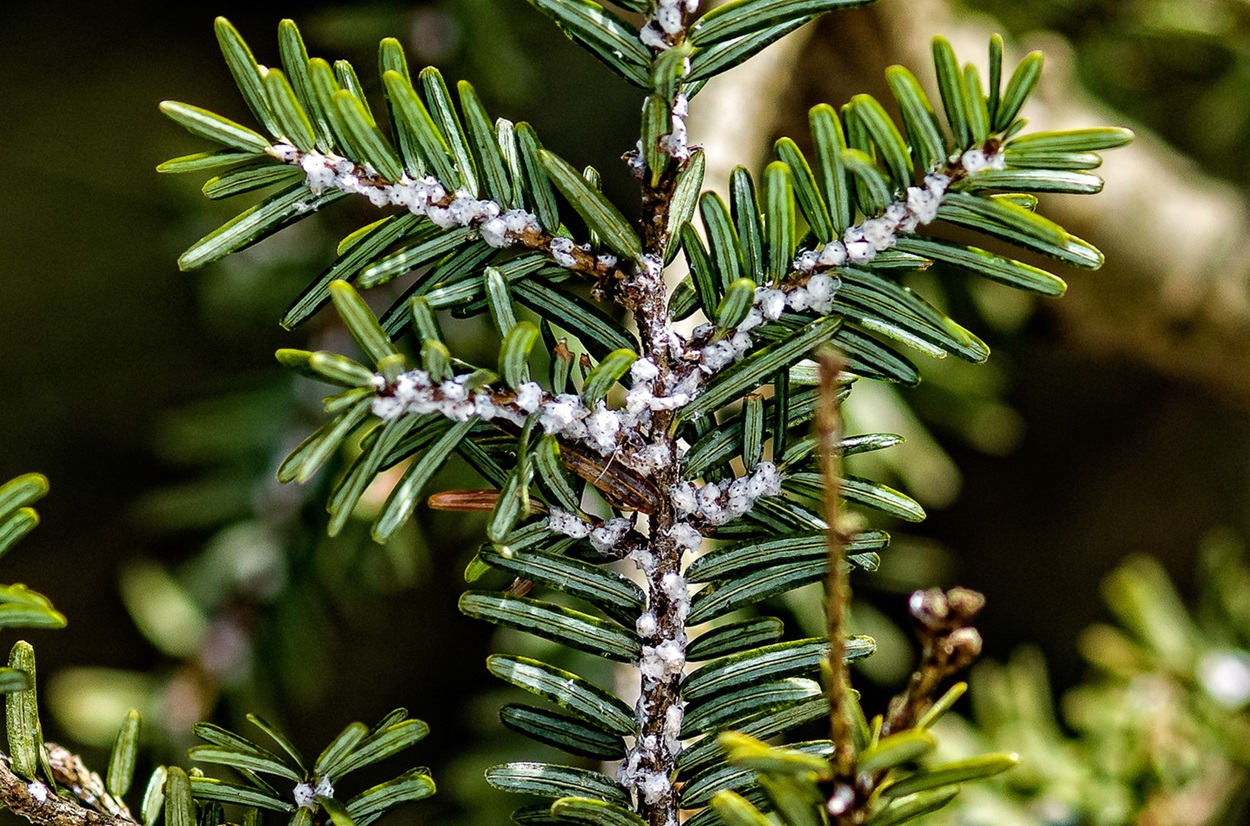
One of the greatest threats to hemlock trees is the invasive hemlock woolly adelgid (Adelges tsugae), a small, pear-shaped insect related to aphids. They feed exclusively on conifers in the Pinaceae family, including pine, spruce, fir, Douglas fir, hemlock and larch, and live in boreal and temperate forests across North America and Eurasia (see Forest Regions). By latching onto the bark, injecting saliva into the tree, and sucking out its nutrients, the insects damage the tree extensively (see Four Major Insect Pests of Forests in Canada). Depending on the stage of the insect when it feeds on the tree, the host can develop abnormal growths, lose needles, twigs or stems near the feeding site, and develop canopy discolouration. The eastern hemlock is especially susceptible to the adelgid, dying within a decade, but adelgid also feeds on the western hemlock with minor resulting damage. The IUCN Red List of Threatened Species lists the eastern hemlock as “near threatened” (see Species at Risk Legislation in Canada).