Share on Facebook
 Share on X
 Share by Email
 Share on Google Classroom
The Great Lakes Storm of 1913, also referred to as the “White Hurricane,” the “Big Blow” and the “Freshwater Fury,” was a devastating and deadly storm that occurred over several days in November 1913. It is generally believed to be the worst storm to have ever occurred in the Great Lakes region, and was responsible for the deaths of up to 300 people, the sinking of 12 ships, and the wrecking of at least 19 more. The storm was an example of the “November gale,” also referred to as the “Witch of November,” a unique and intense weather phenomenon that produces hurricane-force winds. In terms of total ships lost and total number of deaths, it is considered one of the worst inland maritime disasters in both Canadian and American history. The storm killed the entire crews of eight ships that were lost on a single day on Lake Huron. Ships sank on every lake in the Great Lakes, except Lake Ontario. American sources have estimated damage caused by the storm exceeded $200 million, adjusted for inflation.
Historical Context
The possibility of exceptionally strong late-fall or early-winter storms over the Great Lakes was well-known to the Indigenous peoples who lived in the region prior to European colonization. It was understood that anyone caught out on the lakes during such a storm would likely not return. Le Griffon, believed to be the first sailing ship with a European crew to sail the Upper Great Lakes, foundered in September 1679 after being caught in a storm. Another storm, on 10 and 11 November 1835, sank, beached, or capsized 19 ships. And again, on 27 and 28 November 1905, the “Witch of November” sank nearly 30 ships and claimed 35 lives.
The Witch of November
Because the Great Lakes are so large, they can create a large, low-pressure system that sucks in air from other areas. Typically, this means pulling in cold Arctic air from across the Prairies. However, sometimes low pressure over the Great Lakes can also pull in warm air from the Gulf of Mexico. When these two systems meet over the Great Lakes, they can produce hurricane-force winds. The confluence of these atmospheric factors typically occurs in November, earning it the nickname “The Witch of November” or “The November gale.” Both the terms “Witch of November” and “Gales of November” are used in the Gordon Lightfoot song “The Wreck of the Edmund Fitzgerald.” The Edmund Fitzgerald sank in 1975 on Lake Superior due to this unique and extreme weather phenomenon.
Characteristics of the 1913 Storm
The first week of November 1913 was unseasonably warm, an indication that warm air from the Gulf of Mexico was being pulled north. Because of this warm weather, shipping companies capitalized on the good sailing conditions to get in a few more runs before winter set in and made navigating the Great Lakes far more difficult. The air coming down from the Arctic was particularly cold, which caused whiteout blizzard conditions. Though the first indications that a storm was coming appeared on the morning of 6 November 1913, conditions were worse only on the western edges of Lake Superior, and forecasts elsewhere called only for rain and brisk wind.
In the era before long-range weather forecasts, weather radar, Earth-observation satellites and predictive computer modelling, getting accurate weather information was particularly challenging. In addition, as there was no Internet, mobile phones, or satellite communications in 1913, getting this important information out to ships was an additional challenge.
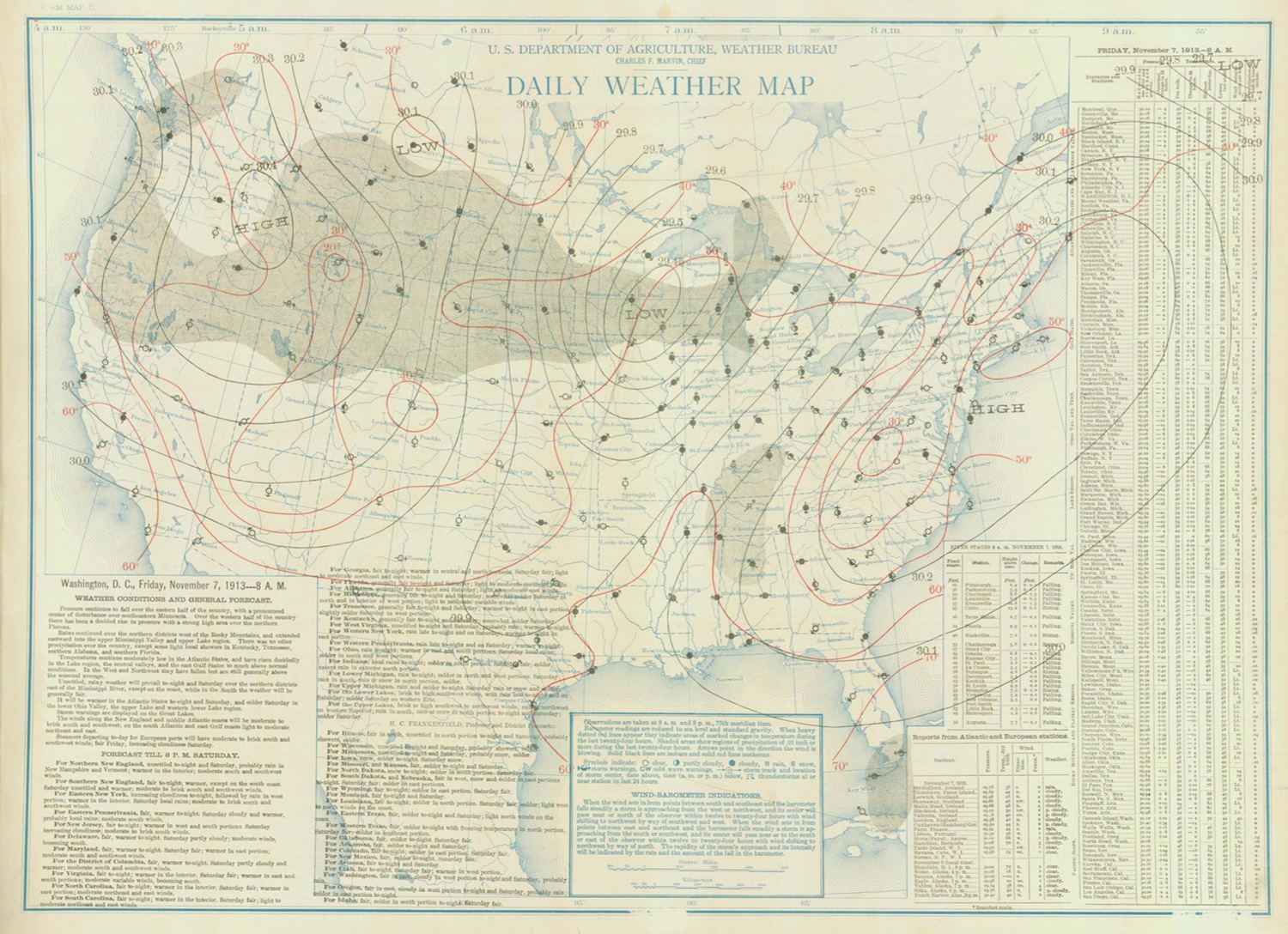
Information about the storm and weather conditions on the Great Lakes was transmitted by telegraph to coastal telegraph stations, which in turn could use the comparatively new invention of wireless telegraphy to contact ships. However, because this technology was so new, not all vessels had radios; most messages were relayed by flags and lanterns from shore. Ships that were too far from shore, therefore, couldn’t see the messages, and deteriorating conditions reduced visibility and transmission reception even further. The US Weather Bureau began issuing warnings about gale-force winds on 7 November 1913, but it too was caught off guard by their intensity. The winter storm reached its apex between 7 and 10 November 1913. The two low-pressure systems converged on Lake Huron, which is where the majority of ships were sunk. Wind speeds during the Great Lakes Storm of 1913 reportedly exceeded 140 km/h and generated waves 12 m high. The whiteout conditions significantly reduced visibility on the lakes as much as on land. Ice accumulated on ships out on the lakes and collapsed telephone lines ashore. Snowfall was significant, with half a meter recorded in cities and towns on either side of the Canada-US border. The intense winds of the storm also wrought havoc on the land, flattening roughly 75 per cent of the forests ranging from north of Lake Superior to the southeast end of Georgian Bay.
SS James Carruthers
The SS James Carruthers was a Great Lakes freighter that sank during the storm with a loss of all hands. It was among the largest ships to sink during the storm, and the largest Canadian ship on the Great Lakes at the time. It was also one of the newest, having launched less than six months earlier from Collingwood, Ontario. The ship had set out from Fort William, Ontario (today, Thunder Bay), loaded with 375,000 bushels of wheat, destined for Ogilvie Milling of Midland, Ontario, when it sank on Lake Huron with 22 lives lost. Shipwreck hunters found the wreck of the James Carruthers lying belly up on the bottom of Lake Huron in September 2025.
Aftermath
Many of the ships lost in the Great Lakes Storm of 1913 remain preserved at the bottom of the lakes, and several have been discovered recently. An area near Thunder Bay is estimated to have roughly 50 shipwrecks, several of which are believed to have sunk as a consequence of the “Witch of November.” Of the 12 vessels that sank during the storm of 1913, only one — the SS Leafield — has yet to be found. The storm left a grisly trail in its wake, as the corpses and other remains of dead sailors washed up on the shores of the Great Lakes for months and even years afterwards. Debris from destroyed ships similarly washed ashore in the months that followed, particularly on the shores of Lake Huron.
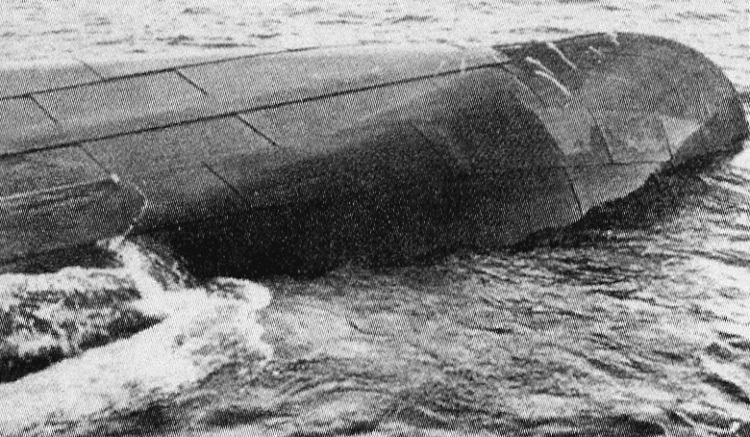
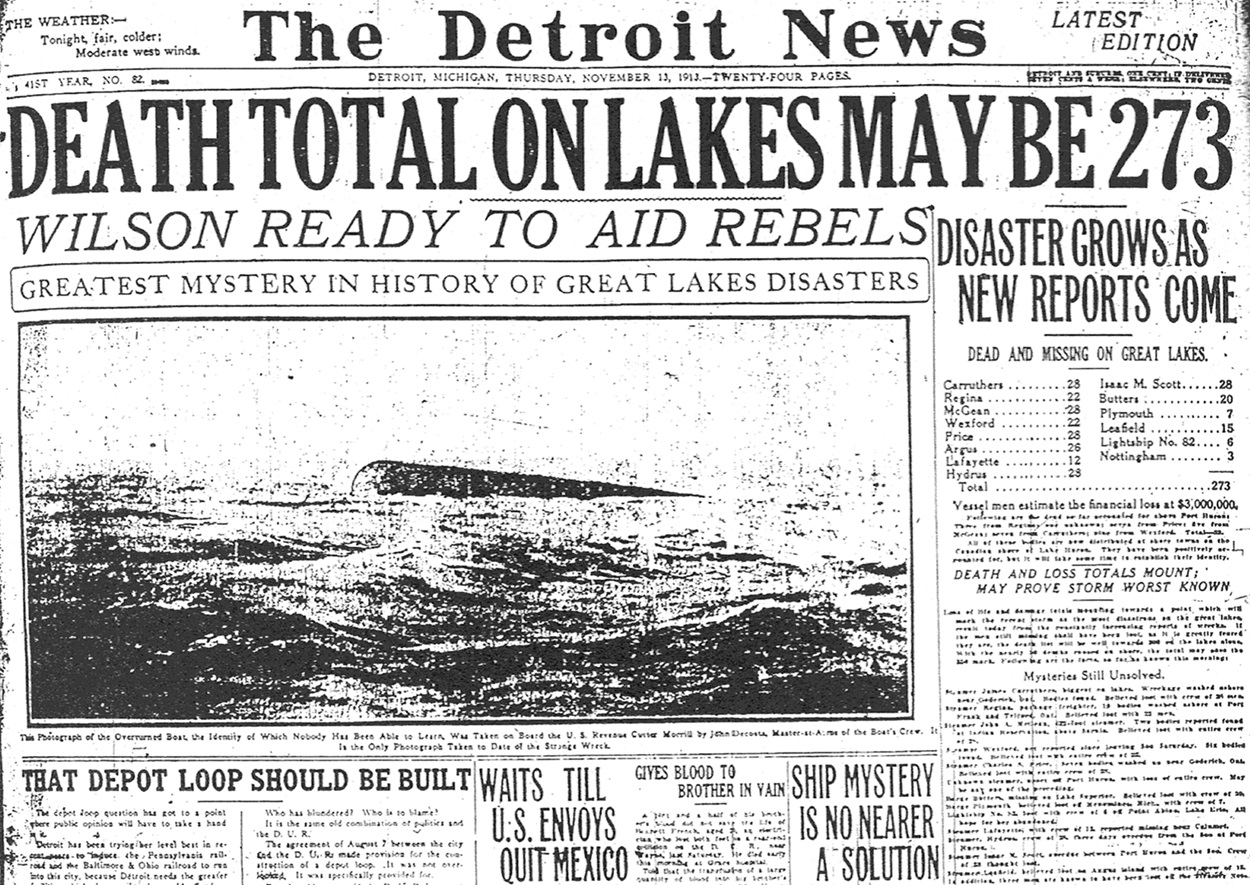
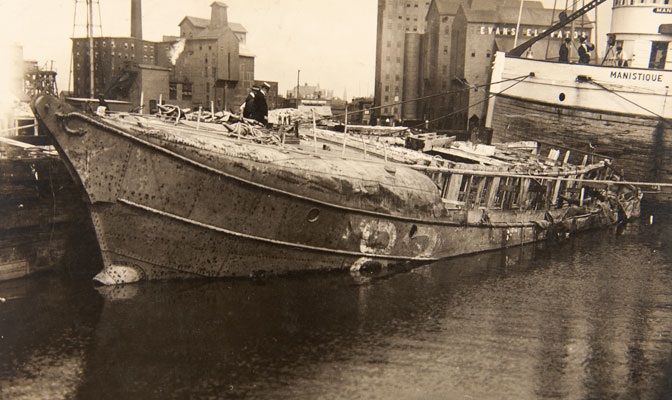
Among the more unusual events related to the storm was the sinking of the freighter Charles S. Price, which had initially capsized and floated upside down for several days, becoming a “mystery ship” whose name and crew were unknown. Eventually, a diver was able to get close enough to read the ship’s name. It would sink shortly thereafter with none of its crew recovered.