Share on Facebook
 Share on X
 Share by Email
 Share on Google Classroom
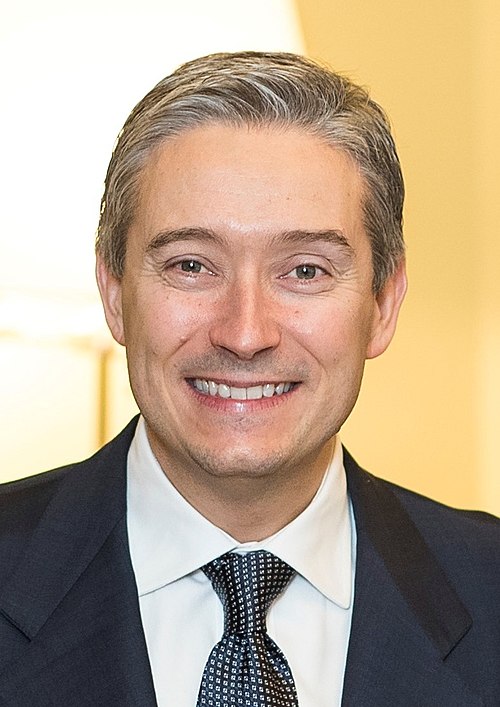
François-Philippe Champagne, Member of Parliament 2015–present, Cabinet minister, politician, businessman, lawyer (born 25 June 1970 in Greenfield Park, QC). François-Philippe Champagne worked as a prominent international corporate lawyer before entering politics in his hometown of Shawinigan, Quebec. Mentored by former prime minister Jean Chrétien, the erudite and articulate Champagne was elected to Parliament in 2015. He became the minister of both International Trade and Infrastructure and Communities in 2018, Canada’s foreign minister in 2021, and minister of Innovation, Science and Industry in 2021. Prime Minister Mark Carney appointed him finance minister in early 2025.
Early Life and Education
François-Philippe Champagne was born in Greenfield Park, just east of Montreal. When Champagne’s parents divorced, he lived with his mother in Quebec City and visited his father, a successful businessman, each weekend in Shawinigan. When he was 15, Champagne moved to his father’s home. He later said of Shawinigan, “I always felt a real privilege to come from a small place.”
While at high school, Champagne met Anne-Marie, whom he later married. They have two daughters together.
Champagne earned a law degree at the Université de Montréal, where he was passionately involved in student politics. He earned a Master of Laws (LL.M) at Ohio’s Case Western Reserve University. He continued his education abroad, studying public and private international law at The Hague Academy of International Law.
Legal and Business Career
In 1999, François-Philippe Champagne moved to Switzerland to join the legal department of Elsag Bailey Process Automation. A corporate merger created ABB, a multinational corporation specializing in electrification and automation. Champagne became its senior counsel and a group vice-president.
In 2008, he joined Amec Foster Wheeler, a London-based multinational consulting and engineering corporation specializing in large-scale energy projects. Champagne was the company’s strategic development director, acting general counsel and chief ethics officer. He was also on its Group Management Committee.
Champagne served as president of the Canadian-Swiss Chamber of Commerce. In 2009, the World Economic Forum recognized Champagne as a Young Global Leader.
Entry into Politics
Yearning to return home and enter politics, François-Philippe Champagne attended the Banff Forum in Banff, Alberta. The annual event gathers young Canadians to discuss issues and leadership. He was elected the forum’s president.
In 2013, Champagne left his job and returned to Shawinigan to become better known in the Saint-Maurice—Champlain riding that he hoped to contest in the next election. It was during this time that he met a famous Liberal politician from Shawinigan, former prime minister Jean Chrétien. Chrétien endorsed Champagne in the 2015 election and even campaigned with him. Champagne has since called Chrétien his “model, mentor and friend.”
When the October 2015 election was called, Champagne had earned the Liberal nomination in Saint-Maurice—Champlain. The Liberal Party was third in the polls behind the Conservatives and New Democrats. Led by Justin Trudeau, however, the party won a majority government. Champagne was elected in his riding with 41 per cent of the vote, nearly double that of the second-place finisher.
MP and Cabinet Minister (2015–21)
After the election, Prime Minister Trudeau appointed François-Philippe Champagne parliamentary secretary to the finance minister. A parliamentary secretary helps a Cabinet minister with House of Commons duties, committee work and non-parliamentary responsibilities. The role is seen as a Cabinet minister in training.
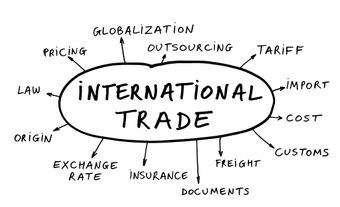
In 2017, François-Philippe Champagne was appointed minister of International Trade. Among the priorities he pursued was increasing Canadian economic ties around the world. He headed the negotiations that led to the signing of the Canada-European Union Comprehensive Economic and Trade Agreement and then the Comprehensive and Progressive Agreement for Trans-Pacific Partnership.
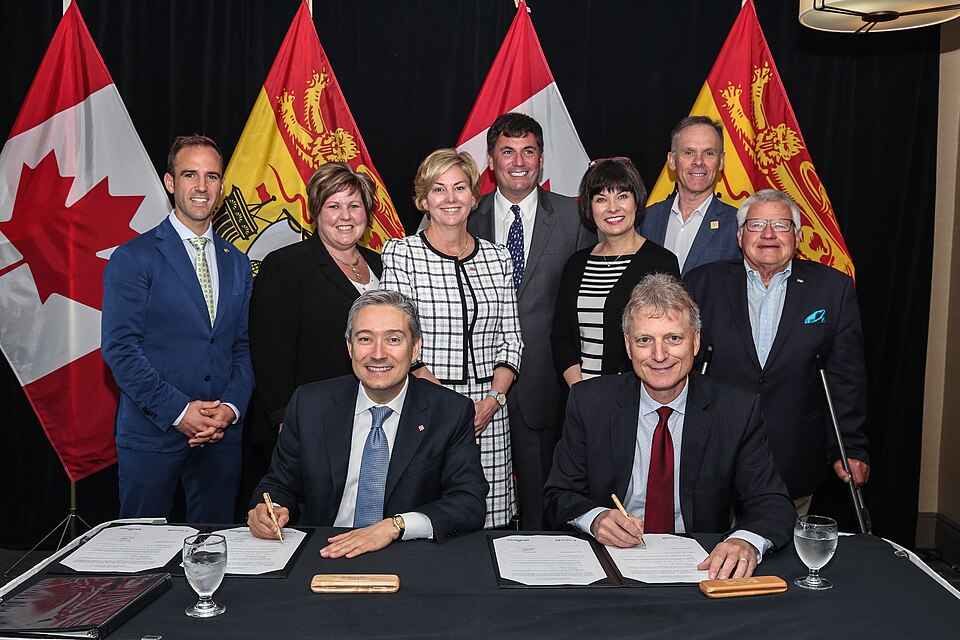
In a 2018 Cabinet shuffle, Champagne was appointed minister of Infrastructure and Communities. His primary responsibility was handling the government’s 12-year, $187-billion infrastructure investment plan, meant to increase Canada’s economic capacity while creating jobs.
MP and Cabinet Minister (2021–24)
In the September 2021 federal election, the Liberals were reduced to a minority government. François-Philippe Champagne was re-elected in Saint-Maurice—Champlain with 42 per cent of the vote.
Prime Minister Trudeau appointed Champagne Canada’s foreign affairs minister. He was responsible for the country’s foreign policy, diplomatic relations and consular services. Among his challenges was handling the crisis of a Ukrainian airliner crash in Iran that killed 55 Canadians and 30 permanent residents. He led the drive to transparently investigate the disaster while re-establishing the always difficult relations with Iran. He was blunt in stating, “I can really assure you that the lens I’m looking at is to seek justice and reparations. It’s really step by step, and so far they have not honoured the commitments they’ve made.”
When the COVID-19 pandemic began in the spring of 2020, Champagne created an informal group of foreign ministers from several countries that led to shared efforts to bring people home despite travel restrictions. Over 40,000 Canadians were able to return.
In a January 2021 Cabinet shuffle, Champagne became the minister of Innovation, Science and Industry. His primary responsibility was to monitor and attract foreign investment in Canada that would benefit the country. For example, in March 2023, Champagne led the negotiations that attracted Volkswagen to build an electric vehicle battery factory in St. Thomas, Ontario. Linking the decision to the government’s commitment to meeting climate change goals, Champagne said, “This investment is another significant step forward as we build a clean transportation sector to meet global and North American demand for zero-emission vehicles.”
By late 2024, the beleaguered Trudeau government trailed Pierre Poilievre and the Conservatives by more than 20 points in the polls. On 6 January 2025, Trudeau announced that he would be resigning as Liberal leader and prime minister. Many observers speculated that Champagne — an erudite and articulate francophone from Quebec who had experience handling the country’s top files and was described by Maclean’s in 2020 as “smiley, friendly, cunning” — might have designs on the Liberal leadership. Champagne appeared to seriously mull the prospect until announcing on 14 January that he would not run to be leader. He called the decision “one of the most difficult” of his life but noted that it was the “right one at the right time.”
MP and Finance Minister (2025–Present)
In March 2025, former Bank of Canada governor Mark Carney replaced Justin Trudeau as Liberal leader and prime minister. Carney appointed François-Philippe Champagne the minister of Finance and then called an election for 28 April. The Liberals won a minority government. Champagne was re-elected in his riding with 50 per cent of the vote, more than twice that of the second-place finisher.
Prime Minister Carney appointed Champagne Minister of Finance and National Revenue. His responsibilities included overseeing the Canada Revenue Agency (CRA) and the creation and overseeing of the federal budget.
With the challenges created by a housing crisis, the rising cost of living, and American president Donald Trump’s trade war against Canada, Champagne set out to create his first budget. It needed to balance many priorities. He said the budget would be about tough choices, spending cuts, and generational investments because Canada needed to reinvent its economy as it did after the Second World War. “There’s some headwinds on the horizon,” he told reporters in the House of Commons. “That’s why we need a strong response.”
The budget — which the Liberal minority government passed by a vote of 170–168 — includes several key priorities:
- Running a projected $78-billion deficit, with increased spending on defence, infrastructure, housing and productivity-boosting initiatives, all with the goal of attracting $1 trillion in new investment into Canada in the next five years.
- Cutting the public service by 40,000 positions — about 10 per cent of the federal workforce.
- Introducing a Climate Competitiveness Strategy the government says is “a central pillar of the plan for Canada to become the strongest economy in the G7” and a “clean energy superpower.”
- Boosting defence spending to meet a NATO target of 2 per cent of GDP in 2026 and 5 per cent by 2035.
- Investing $5 billion in the steel, aluminium, lumber and automobile sectors, establishing a $10-billion loan fund to help Canadian business weather Donald Trump’s trade war, and introducing a Buy Canadian Policy to prioritize the procurement of Canadian goods and services.
To underscore the importance of the government’s Buy Canadian Policy, Champagne added a new twist to the tradition whereby a finance minister buys new shoes to wear when presenting the budget. Not only did he buy shoes that were made in Canada, but he also helped make them himself.
(See also Department of Finance.)