Share on Facebook
 Share on X
 Share by Email
 Share on Google Classroom
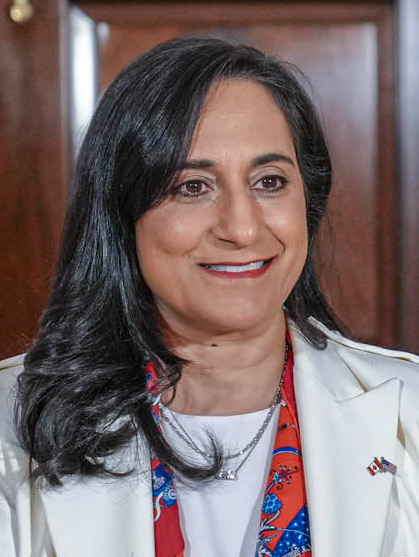
Anita Indira Anand, Member of Parliament 2019–present, Cabinet minister, politician, lawyer, professor (born 20 May 1967 in Kentville, NS). Anita Anand enjoyed a long career as a Fulbright Award-winning law professor before serving on a federal task force and various committees. In the 2019 federal election, she became the first Hindu woman elected to Parliament when she won as the Liberal Party candidate in Oakville. She was also the first Hindu person to serve as a federal Cabinet minister. Anand headed four ministries in the Justin Trudeau government, including Public Services and Procurement during the COVID-19 pandemic and National Defence (she was only the second woman to head that department, after Kim Campbell). Anand was also president of the Treasury Board. Under Prime Minister Mark Carney, she served as minister of Innovation, Science and Industry before being named minister of Foreign Affairs in May 2025.
Early Life and Education
Anita Anand was born and raised in Kentville, Nova Scotia. Her mother, Saroj D. Ram, was an anesthesiologist, and her father, Sundaram Anand, was a surgeon. She has both a younger and an older sister.
In 1989, Anand earned a Bachelor of Arts (Honours) in Political S at Queen’s University in Kingston, Ontario. She then earned a Bachelor of Arts (Honours) degree in Jurisprudence from Wadham College at Oxford University in England. She returned home to earn a Bachelor of Laws at Dalhousie University in Halifax. She articled at Torys, a Toronto law firm, and was called to the bar in 1994. While practising law, Anand completed her Master of Laws at the University of Toronto in 1996.
Personal Life
Anita Anand married John Knowlton in 1995. Two years later they moved to Oakville, west of Toronto, where Anand became involved in the community. She served on several boards, including those of Oakville Hydro Electricity Distribution Inc., the Lighthouse Program for Grieving Children and the Oakville Hospital Foundation. Anand and her husband have four children together.
Academic Career
Anita Anand began her academic career in 1997. She served for two years as an adjunct assistant professor at the Faculty of Law at the University of Western Ontario. She then moved to the Faculty of Law at Queen's University as an assistant professor. Anand earned international recognition in 2005–06, when she was a Canada-U.S. Fulbright Scholar and Visiting Olin Scholar in Law and Economics at Yale Law School. She was also a visiting scholar at the Bank of Canada and the University of Cambridge.
In 2006, Anand became a full professor at the University of Toronto’s Faculty of Law. She was the faculty’s associate dean from 2007 to 2009. She was also the university’s academic director of the Centre for the Legal Profession; the J.R. Kimber Chair in Investor Protection and Corporate Governance; a senior fellow and member of the governing board at Massey College; and the director of policy and research at the Capital Markets Institute at the Rotman School of Management.
In 2015, the Ontario government appointed Anand to its Expert Committee to Consider Financial Advisory and Financial Planning Policy Alternatives. She led research projects for Ontario's Five Year Review Committee. She also served on the federal government’s Task Force to Modernize Securities Legislation in Canada and its Wise Person's Committee.
Cabinet Minister in Trudeau Governments (2019–25)
Anita Anand was the Liberal Party’s candidate for the riding of Oakville in the federal election on 21 October 2019. She said her main goal was to “ensure we have a strong community where people feel a sense of belonging and connection and vibrancy.” She defeated five opponents and won the seat with 46.3 per cent of the vote.
Prime Minister Justin Trudeau appointed Anand the minister of Public Services and Procurement. Months later, the COVID-19 pandemic swept the world. Anand oversaw the purchase and production of much of what was needed to combat the deadly virus. This included medical supplies such as personal protective equipment and essential vaccines.
In the federal election on 20 September 2021, the Trudeau Liberals formed a minority government. Anand was re-elected in Oakville with 46.1 per cent of the vote. Trudeau then appointed Anand Canada’s minister of National Defence. She was the second woman and the first racialized woman to hold the position. She oversaw Canada’s contributions to Ukraine after Russia’s 2022 invasion. The Canadian military establishment had suffered a series of sexual abuse scandals. Anand announced that a priority of her ministry was to initiate changes in the culture of the Canadian Armed Forces.
While serving as the defence minister, Anand received the Global Citizen Award from the United Nations Association (UNA) in Canada.
In July 2023, a Cabinet shuffle saw Anand appointed president of the Treasury Board. In this role, she was responsible for managing all federal government operations. She oversaw federal regulations, 300,000 employees and $450 billion in annual expenditures. She initiated a streamlining of regulations regarding Canadian-American trade and efforts to make the government more environmentally responsible.
In September 2024, Anand was reassigned as Canada’s minister of Transport. She became responsible for Canada’s federal highways and its rail and air transportation systems. She initiated actions to make the systems safer and more efficient while reducing negative environmental impacts.
In November 2024, Donald Trump was elected president of the United States. He promised that when inaugurated in January 2025 he would introduce tariffs on all trading partners. The tariffs could devastate Canada’s economy. In December, Prime Minister Trudeau added to Anand’s Cabinet responsibilities the role of minister of Transport and Internal Trade. With the threat of reduced trade with the United States looming, Anand worked to eliminate regulatory barriers that restricted trade between provinces. She sought to have provinces collaborate to make the Canadian economy more unified and efficient.
Resignation and Reversal
By late 2024, the beleaguered Trudeau government trailed Pierre Poilievre and the Conservatives by more than 20 points in the polls. There was a wave of resignations from both the Liberal caucus and Cabinet as many anticipated a bloodbath in the next election.
When Trudeau announced on 6 January 2025 that he would be resigning as Liberal leader and prime minister, many observers saw Anand as a potential successor. However, Anand announced on 11 January that she would not seek the leadership and would in fact not run for re-election. Instead, she said she planned to return to teaching, research and policy analysis. She said in a statement that she has been “deeply honoured and humbled to serve as Oakville's Member of Parliament and as member of Cabinet.”
However, by late February, Liberal fortunes had improved dramatically. With former Bank of Canada governor Mark Carney widely seen as the frontrunner for the Liberal leadership, the Liberals pulled into a dead heat with the Conservatives in the polls. On 28 February, Anand announced that she was reversing her decision to retire and would instead run for re-election.
After Carney was elected leader of the Liberal Party on 9 March, a Cabinet shuffle saw Anand appointed the minister of Innovation, Science and Industry.
Cabinet Minister in Carney Government (2025–Present)
In the election on 28 April 2025, Canadians elected a Liberal minority government. Anand won her seat — now Oakville East — with 51.1 per cent of the vote.
Prime Minister Carney appointed Anand Canada’s minister of Foreign Affairs. While the foreign affairs portfolio has always been challenging, it was especially so due to many of President Trump’s actions, which disrupted the global rules-based order. In a press conference before the June 2025 NATO meeting in The Hague, Anand said that Canada would advocate for a new world order based on Canadian values, including world peace, the protection of civilians and the development of the domestic economy. At the United Nations in September she reiterated Canada’s position, stating, “When multilateral institutions are under threat, Canada will not turn inward. We will work toward a world where prosperity is shared, security is collective, and peace is lasting.”